

Why ownership coins demand a new standard of transparency and why the infrastructure to support it doesn't exist yet.
“Building in public” usually means sharing the journey of creating a product. This includes the good, the bad, and the ugly. Founders have been doing this on social media for years. When it works, it becomes a growth strategy. It builds trust, creates feedback loops, turns early users into evangelists, and narrows the distance between builders and the market.
With an ownership coin building in public is primarily owner management. Founders are operating in front of people who hold the asset and price what they see in real time.
Background
As an example, when a founder launches an ownership coin through MetaDAO's framework, they are onboarding owners, which changes everything.
Under this model, “building in public” takes on a far more demanding meaning. Treasury inflows and outflows, token mints and burns, decision markets, and more, are all visible onchain and subject to scrutiny from people who hold the asset.
This is a new level of accountability. In some ways, it borrows from traditional capital markets. In others, it goes beyond them.
When it comes to ethics, standards, and duty to holders, ownership coins should aspire to the best of what public companies owe their shareholders. But in transparency and reporting, the public company model should not be the ceiling. Ownership coins can go further.
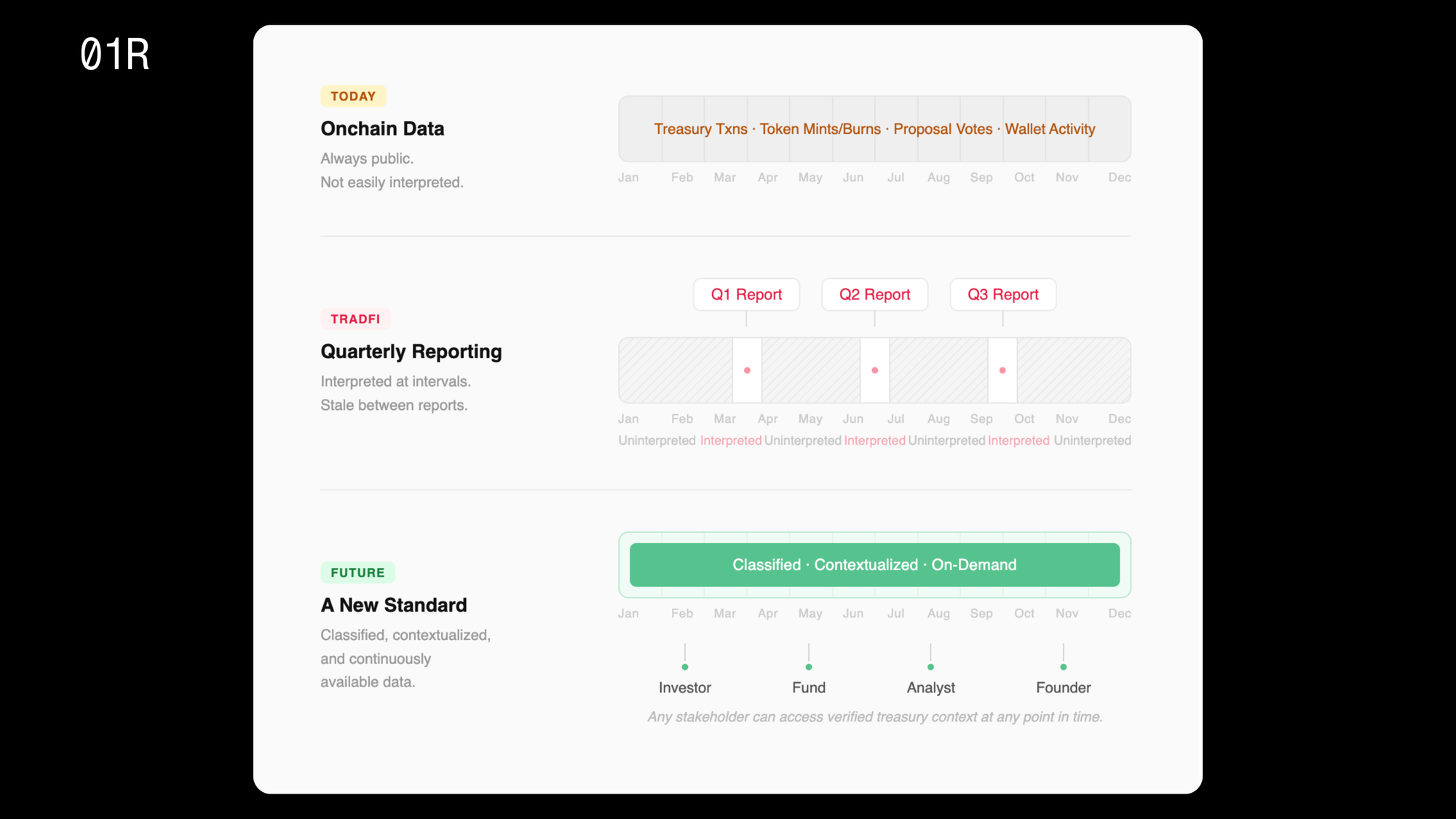
Because the data is already onchain, reporting can theoretically be on demand. Existing and prospective token holders should not have to wait for quarterly disclosures when the underlying information is already public and continuously updating. The shift from periodic disclosure to persistent visibility changes what it means to be a founder, an analyst, and an investor, and it raises the bar for everyone involved.
The Weight of Ownership
For the founding teams that have chosen the ownership coin path, the pressure is real.
In a futarchy-enabled DAO, token holders can create proposals and trade on them with real economic consequences. Proposals for treasury spending, token issuance, team performance packages, and for the better or worse, treasury liquidation can become decision markets. With ownership coins, founders are operating under continuous market evaluation.
When things are going well, this can become a powerful flywheel. Strong execution improves market confidence, which gives founders more room to operate. But when things are not going well, the dynamic changes. Founders must not only ship a core product, but also manage community sentiment, respond to FUD, and continually justify their role in the DAO.
This is not an easy model to operate within. It requires founders willing to build under a level of transparency and accountability that most teams would avoid. The ones doing it today deserve real credit for taking on that challenge.
Transparency as Competitive Advantage
One of the most underappreciated features of the ownership coin model is that transparency can be a product.
Token holders may be able to see the treasury value on a block explorer, but this just shows a balance, not a business. Without structure and context, meaningful analysis is far harder than it should be for retail participants and liquid funds alike.
Ownership coin projects that fully embrace transparency can gain something others cannot easily replicate - investor confidence grounded in verifiable data rather than assurances. The industry has not fully appreciated this advantage. Ownership coins can create a level of transparency that goes well beyond token models of the past.
And the demand for that difference is coming. Years of rugs, misaligned incentives, and governance promises have created the conditions for a better model to emerge. It is a question of when, not if.
But transparency is not a substitute for execution. Founding teams still need to build viable, scalable, profitable businesses. No amount of openness can compensate for weak traction or performance.
In fact, transparency can be unforgiving for struggling projects. When everything is visible decisions are judged in real time and there is nowhere to hide. The same mechanism that rewards strong execution also exposes stagnation. That is the trade-off of building in the open.
What transparency does provide and what the industry has undervalued is credibility. As adoption grows, the differentiator will not be tokenomics or yield design. It will be which teams can make their transparency legible and then deliver something worth understanding.
Making Transparency Legible
The data is already onchain, but raw onchain data is difficult to interpret and contextualize.
A transaction does not tell you whether a payment was an expense, a buyback, an internal transfer, or revenue. A wallet address does not tell you whether it belongs to the DAO, a DAO contributing entity, or a counterparty.
A Dune dashboard might reveal some interesting data about a project, but it can be out of date, inaccurate or unverified and lacking important business (and decision market) context. Data from individual project dashboards also isn't easily comparable against other projects for analytical purposes.
When DAO information is missing or inaccessible, investors and community members cannot see the full picture. In the absence of context, they default to speculation.
Closing this gap is what we are focused on at 01Resolved. More on that soon.
The First Movers Deserve Support
The founding teams that have launched ownership coins are attempting something entirely new. They are running transparent, market-governed businesses onchain, often without the purpose built infrastructure needed to make that sustainable.
Ownership coins, pioneered by MetaDAO, are one of the best attempts yet to align builders and token holders more honestly.
If ownership coins prove viable, they could reset expectations around how token projects and their owners engage with one another. But if the model struggles because the supporting infrastructure is missing, the industry risks losing one of its most promising experiments.
01Resolved exists to help prevent that outcome. We are building the infrastructure that makes building in the open sustainable because the teams that chose transparency first should not have to do it alone.