

For years, crypto tokens promised ownership but were never structurally designed to deliver it. This article traces three eras of crypto "ownership," from faux ownership through financial extraction to the emerging ownership coin model, and explains what real, enforceable ownership actually requires. If you hold tokens, or are evaluating projects, this breakdown will help you understand what you are and are not entitled to.
The Ownership Crisis No One Named
Crypto succeeded in building global, permissionless markets. But it never clearly defined what those markets entitle you to own. Up until recently, most tokens did not provide enforceable claims on cash flows, governance outcomes, or treasury value. In practice, they represented participation without real ownership.
For years this was treated as an acceptable compromise driven by founder risk appetite, investor preferences, and regulatory uncertainty. The result is a pattern many token holders recognize:
- Token buyers bootstrap liquidity and network effects in public markets
- Founders and equity holders capture value in the operating business
- Token holders get sidelined economically when it matters most: acquisitions, front-end monetization, IP and brand, major strategic pivots, and even treasury control
This is not a token design problem. It is an ownership crisis. The next era of crypto will not be defined by "better tokens," but by better ownership structures.
The Three Eras of Crypto "Ownership"
Era 1: The Token-Equity Split (2017-2021)
After the ICO boom, projects converged on a structure that looks something like this:
- An offshore foundation holds treasury assets. The foundation may represent the "DAO" or grant a DAO a subset of total treasury assets
- An operating company that develops the product, holds IP, and contracts or employs staff
- Sometimes a separate token issuing entity layered in for risk mitigation and distributing tokens
This wasn't random. Foundations (like Cayman foundation companies) became a common wrapper for DAOs because they can hold assets, open accounts, contract with third parties, and even be "ownerless," which fits the decentralized narrative.
The token-equity split had a cost: it fractured value flow. Capital was contributed and risk was taken on the expectation of a future value transfer, yet no coherent mechanism existed to deliver it. Tokens were perceived (or marketed) to offer "ownership," while the underlying entity structure quietly ensured they weren't. The result is persistent ambiguity around value capture.
These issues are now openly being talked about on CT and the following questions are coming up:
- Who has the right to monetize the product?
- Who owns the brand and IP?
- Does project revenue belong to token holders, the company building the project, or both?
- Are there legal documents outlining the organization structure?
- If a team's offchain entity is acquired, do token holders get anything?
You can see this tension clearly in the recent Aave DAO governance debate. It is alleged that Aave Labs redirected ~$10M in annual CoW Swap revenue from the DAO treasury to the Labs entity without governance approval. Community members, including delegates like Marc Zeller, have called this a "stealth privatization" that erodes trust and highlights the shortfalls in the DAO and operating entity model.
Aave isn't alone. Holders of $UNI advocated for years to have some level of ownership over Uniswap front-end fees. 100% of all front-end fees were directed to Uniswap Labs, while $UNI holders didn't directly benefit (note that a recent UNIfication proposal is an attempt to change this).
Furthermore, CT was lit up by the lack of economic involvement in recent acquisitions of projects with existing tokens. Circle recently acquired Axelar, Coinbase acquired Vector.Fun (by Tensor Labs) and Pump.Fun acquired Padre. In each case, the $AXL, $TNSR, and $PADRE holders were left out. While they aren't legally entitled to proceeds from an acquisition (as far as we know), token holders who support with capital, time, and energy were left feeling jaded about crypto ownership structure.
Era 1's core failure: tokens looked like ownership, but weren't structurally treated as ownership.
Era 2: The Extraction Era (2021-2025)
Once teams internalized that token holders often had limited enforceable rights, crypto drifted into two extraction tracks:
- Over-structured launches (low float, high FDV): "professional" packaging, but incentives still skewed toward insiders and early exits
- No-structure launches (often anonymous): "fair launches," minimal accountability, rug-pull risk (aka meme coins)
Over-structured launches typically continued with the same token-equity split structure as Era 1 but often had large venture funding and insider participation. Venture funds would get ownership in the project via SAFE + Token Warrants. The equity component acted as a fail-safe in case the token eventually lost value and the team pivoted to growing the equity value of a company, or the equity was acquired.
Upon public release of an over-structured launch, the low initial float and marketing tactics drove retail investors to secondary markets causing price pumps. These price pumps would give early insiders enough liquidity to start exiting at huge multiples. The outcome over time was a downward spiral in price.
This paved the way for no-structure launches. A typical claim was that 100% of tokens would circulate from day 1, without insider or venture fund involvement. This was hardly true in most cases, as insiders sniped significant supply within the same "add liquidity" block. Or even worse, because of the lack of accountability, founders either slow-rugged or fast-rugged the project.
Even though no and over-structured launches are on opposite ends of the spectrum, they had the same outcome: retail was the exit liquidity, and long-term alignment was optional.
Era 2 was the logical outcome of an ecosystem that never standardized real ownership.
Era 3: The Ownership Coin Era (Now)
The next era isn't "better tokens." It's ownership that's explicit, enforceable, and auditable. The defining shift is that the token captures the economics of an onchain organization.
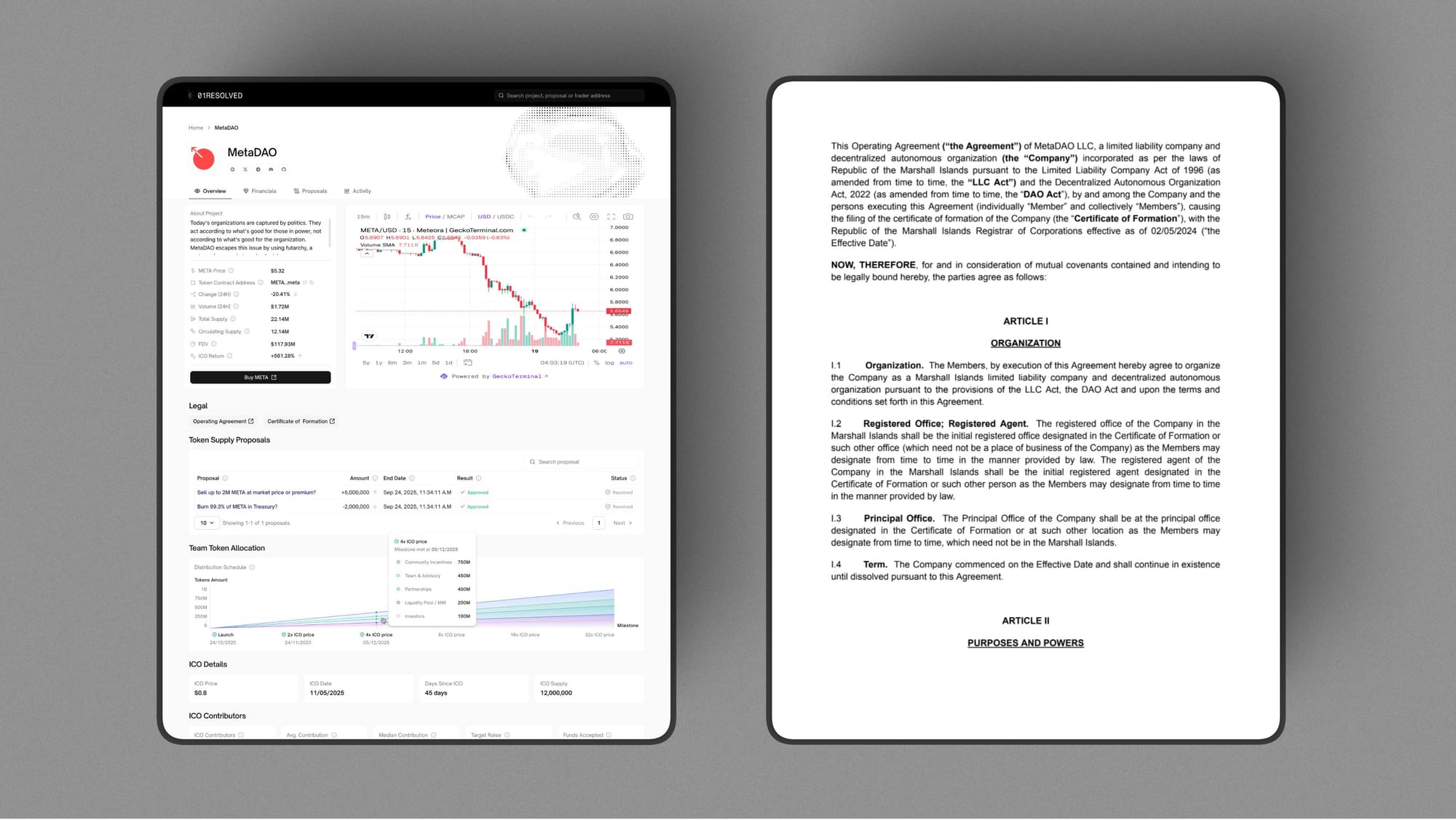
MetaDAO is one of the clearest examples of ownership structure. In a nutshell, their framework offers:
- High-float, fair issuance tokens
- Proceeds locked into an onchain treasury governed by decision markets
- IP and legal ownership assigned to a DAO-linked entity
- Founder incentives locked behind performance conditions
Whether it's MetaDAO specifically or future iterations across chains, the design principles are what matter.
What an Ownership Overhaul Actually Means
If you want to evaluate whether a project has solved ownership, ask the following:
Is there a single balance sheet under enforceable control? If treasury, revenue, and real assets are controlled by different entities or signers, token holders do not have full ownership.
Is IP and brand owned by the DAO? If the operating company owns the domain, front-end, trademarks, repos, and distribution, ownership is incomplete.
Are value flows default, not discretionary? If token holders only benefit when a team chooses to share, rather than through programmatic or contractual means, ownership does not exist.
Can token holders participate economically in structural events? Acquisitions, licensing, revenue deals, asset sales, etc. If token holders don't have a claim, they are not owners.
Is there market oversight? Decision markets introduce economic accountability by making misuse of resources costly. If governance relies on token-weighted voting over a subset of the total treasury secured by a 2 of 3 or 3 of 5 multi-sig, ownership remains unenforced.
Conclusion
The token-equity split structure wasn't irrational: it was a product of its time. But legacy projects are now living with its consequences, with founders and token holders misaligned by default, value capture drifting to whichever entity controls the interface and IP, and token holders economically excluded from the moments that matter most. Most token holders only learn this the hard way, when they get dumped on, rugged, or excluded from value capture in an acquisition. That experience makes one thing clear: ownership cannot be implied, promised, or socially enforced. It must be engineered into the system.