

Decision markets give token holders real market oversight over treasury and supply decisions, but ensuring that market signal reflects sustained conviction rather than momentary manipulation requires a careful mechanism. That mechanism is the Time Weighted Average Price, or TWAP. This article breaks down how TWAP works, how to analyze the two phases of a decision market, and what two real proposals from MetaDAO reveal about market conviction in practice.
What Decision Markets Are and Why TWAP Matters
MetaDAO offers token investors market oversight privileges by way of decision markets (aka Futarchy). When an organization wants to alter token supply or spend from the DAO treasury, a proposal is created, and token holders are able to express support for the proposal through pass or fail decision markets. They do this by choosing to actually buy or sell the pass or fail options which have market determined prices.
The challenge with this model is ensuring this signal reflects sustained conviction, not momentary manipulation. The solution is the Time Weighted Average Price, or TWAP.
While TWAP serves an important mechanical purpose, its integration into decision markets creates an interesting set of analytical opportunities.
TWAP is a Mechanism of Commitment
As it relates to MetaDAO decision markets, the TWAP is calculated as the average price over a fixed time window preceding the decision market resolution. This is a deliberate design choice to enforce integrity. By averaging the price over a duration, the TWAP mechanism:
- Reduces late manipulation: A single, large, last-minute trade has a diluted effect, making it expensive to "snipe" a decision.
- Rewards sustained conviction: Traders must maintain their influence throughout the window, demonstrating a commitment beyond a speculative bet.
A decision market timeline involves a trading period (i.e. 72 hours), which contains the Pre-TWAP window (i.e. 24 hours) and TWAP window (i.e. 48 hours), culminating in the resolution. The proposal passes only if the Pass TWAP exceeds the Fail TWAP by a threshold. In the case of MetaDAO this TWAP threshold is configurable, but looking at past proposals it ranged between 1.5% and 3.0%.
The Two Phases of Market Conviction
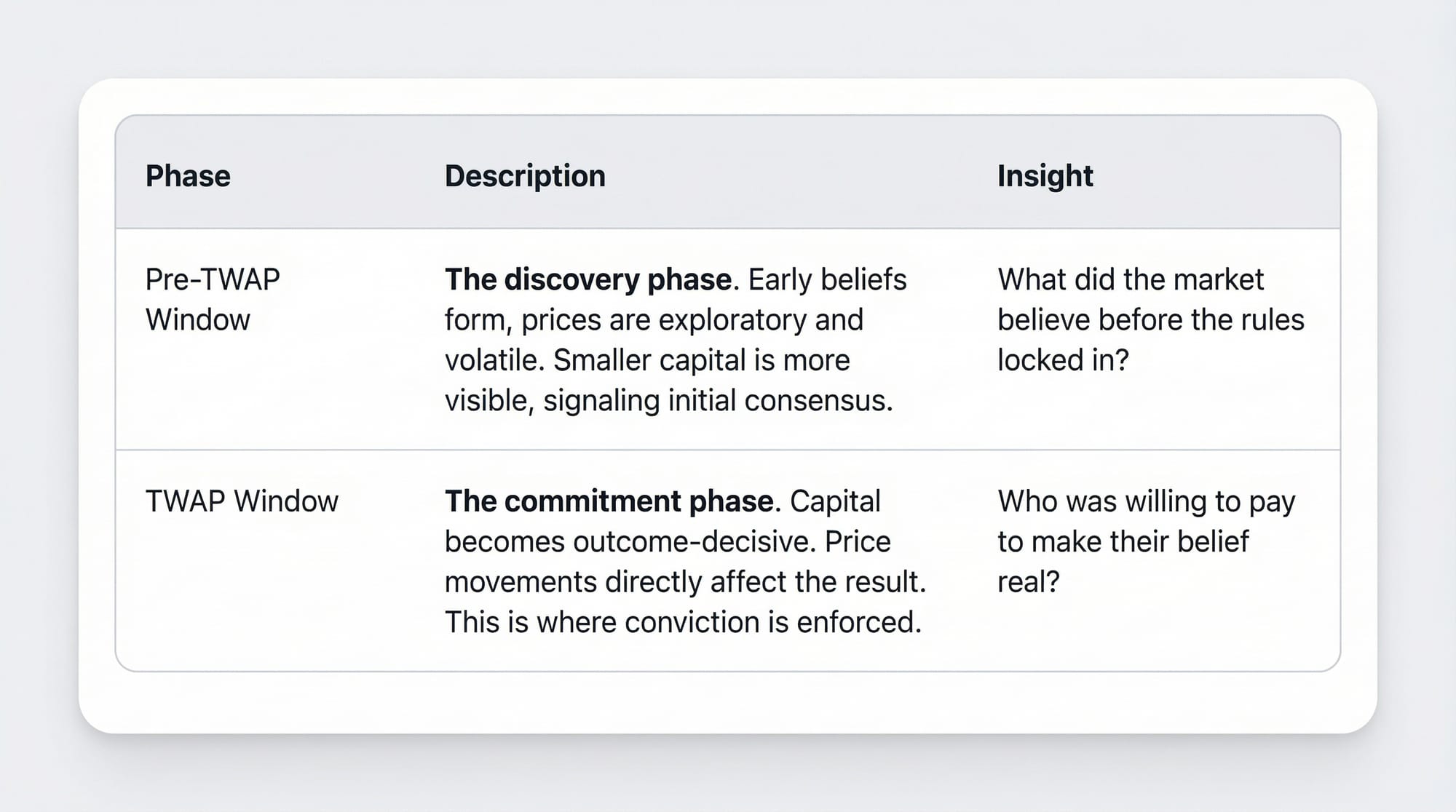
To audit a decision, we must analyze the market's behavior across two distinct phases, separating belief formation from belief enforcement.
Analyzing Late Activity
The concentration of trading activity near the end of the TWAP window signals the nature of the market's final push and is categorized into three types:
- Organic close-out: Position management and arb activity with no directional skew
- Activist pressure: Directional skew in late trades suggesting belief flipping or outcome steering
- Outcome steering: Requires indecisive markets and a non-trivial amount of capital (as illustrated in the case study below)
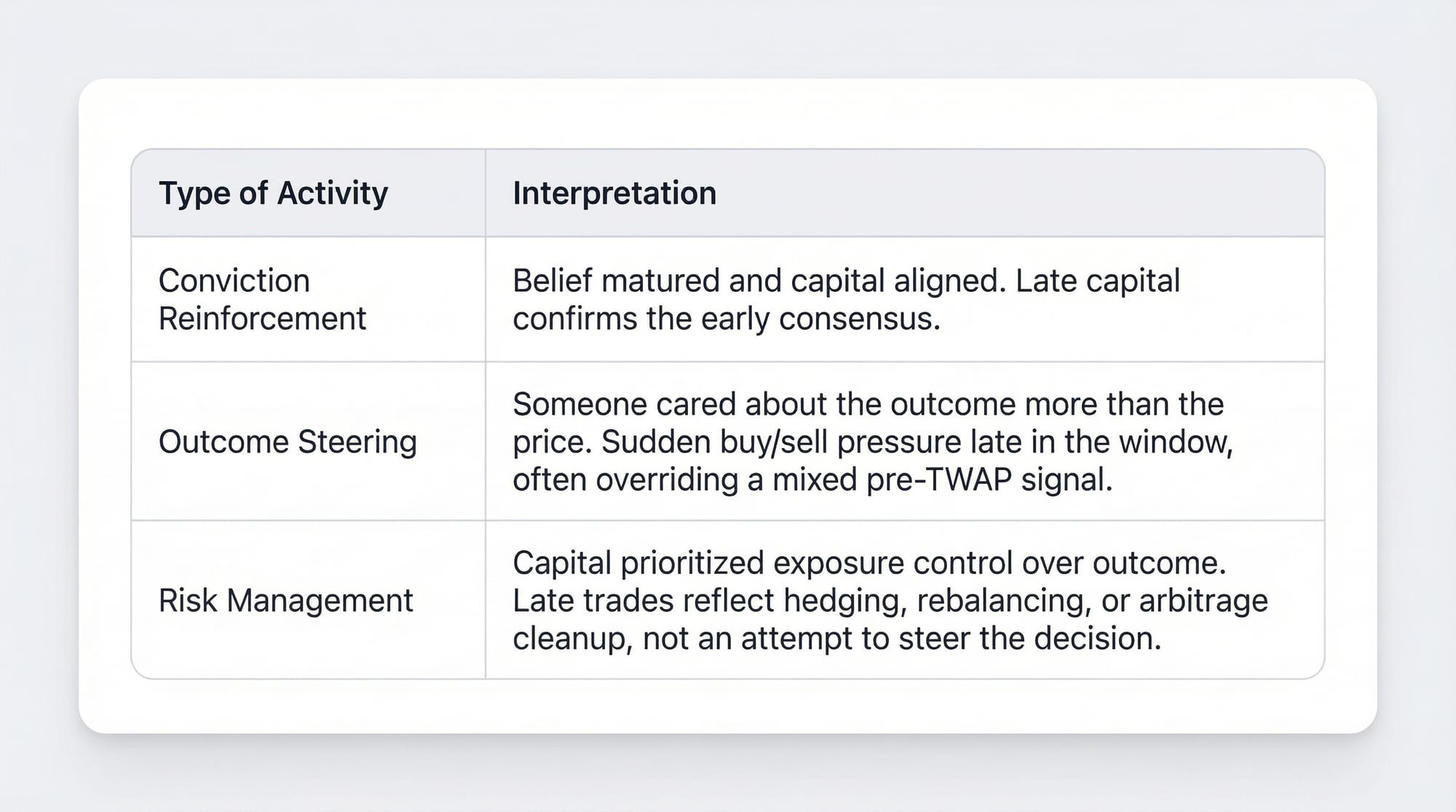
A good analysis of decision market activity shows the timing and concentration of capital, allowing analysts to draw conclusions about the market's intent.
Auditing the Decision
The true analytical power lies in comparing the Pre-TWAP and TWAP phases. Pre-TWAP activity shows belief formation: traders who move early are expressing conviction without waiting for others. TWAP window activity shows belief enforcement: how traders maintained or shifted positions as resolution approached.
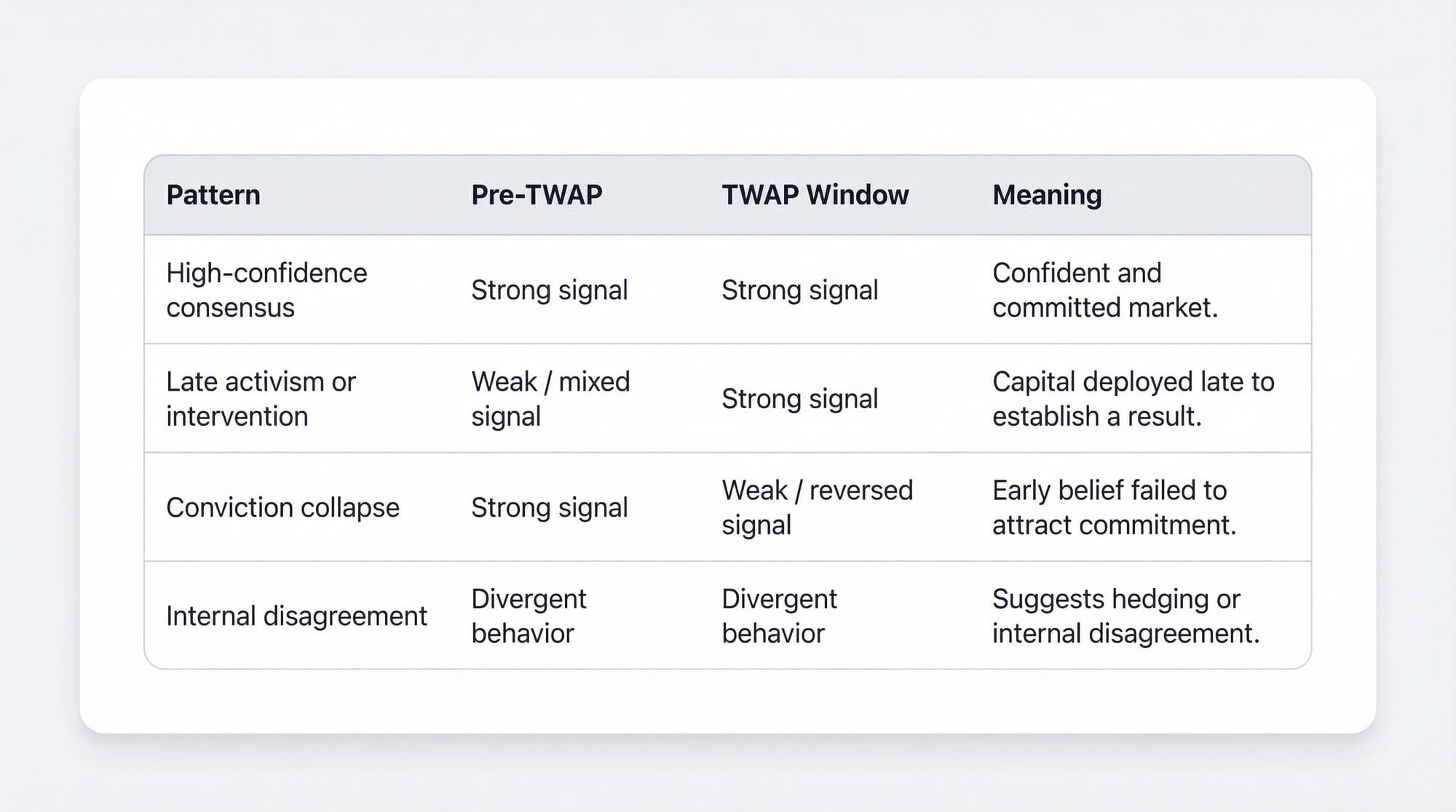
Lastly, the resolution replay is a good analytical exercise. By reviewing the decision activity and looking at volume and trader shifts, analysts and organizations can gain organizational memory. Going forward the community and project team are able to better understand when and what the market "knew," to refine future proposals.
A Case Study: A Tale of 2 TWAPs
Proposal 1: Omnibus Proposal: Migrate and Update (PASSED)
This proposal shows a highly TWAP-centric market with early convergence and limited late urgency. Nearly 90% of trades and volume occurred during the TWAP window.
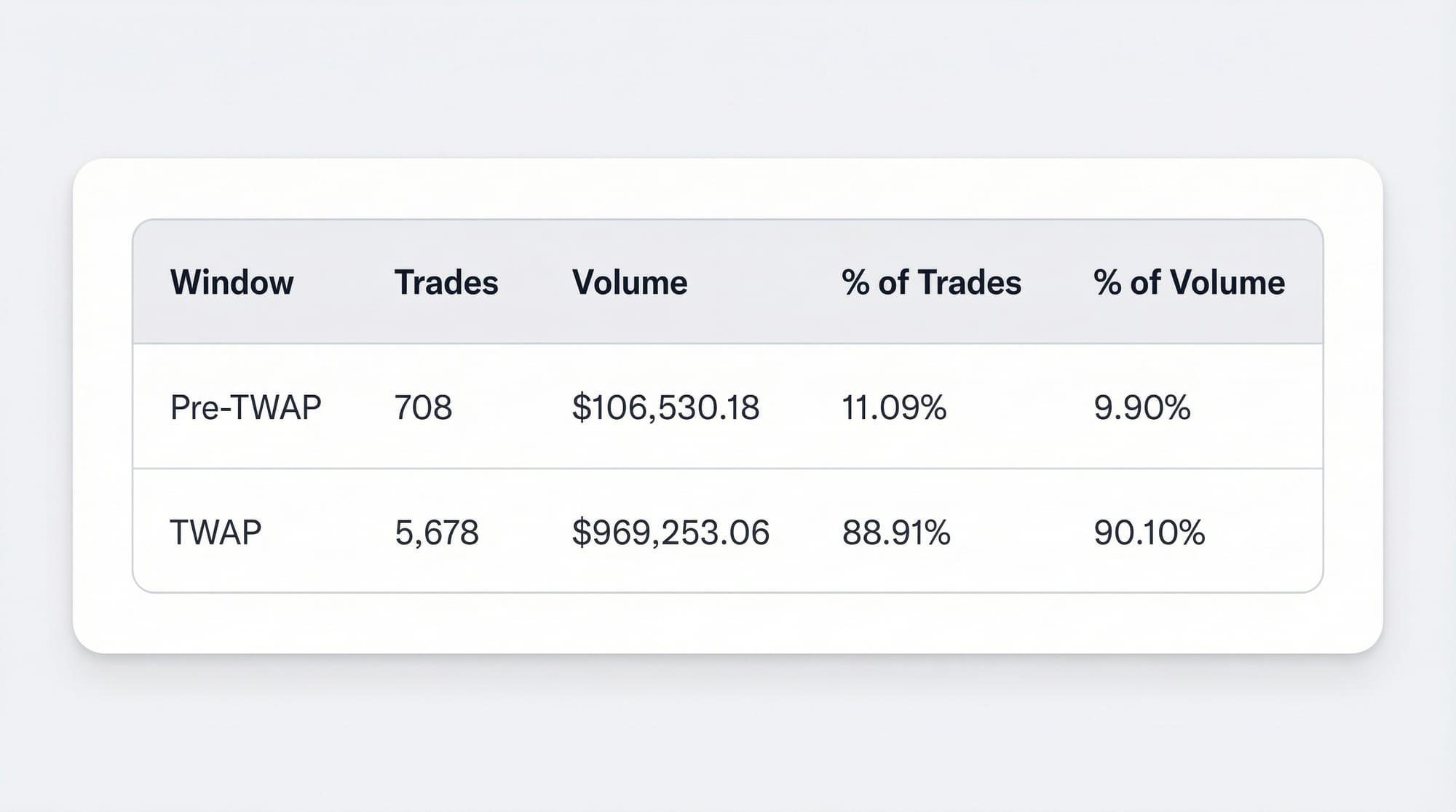
Late activity was modest: only ~4% of trades and ~2.5% of volume in the final 2 hours, and even the final 24 hours captured just ~17% of volume.
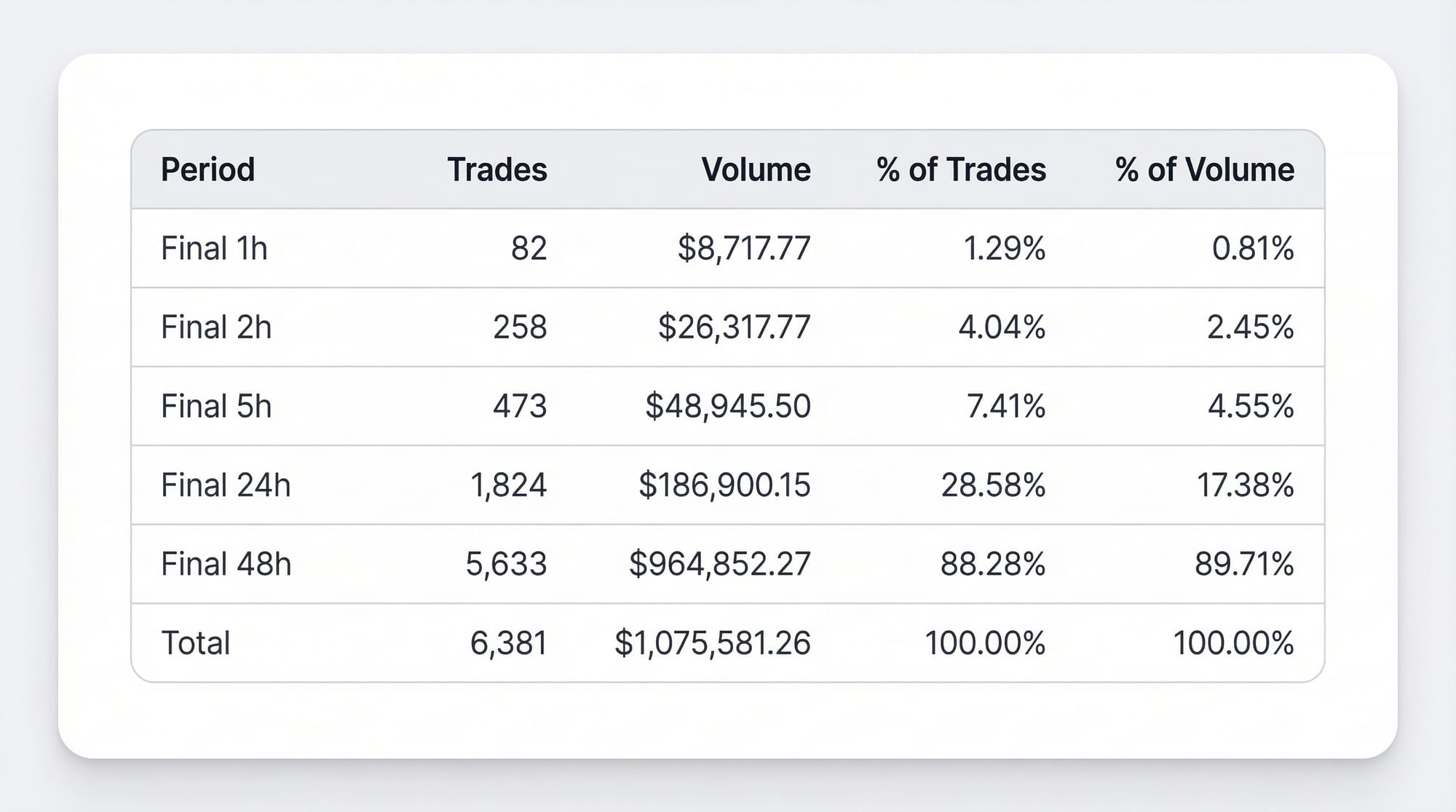
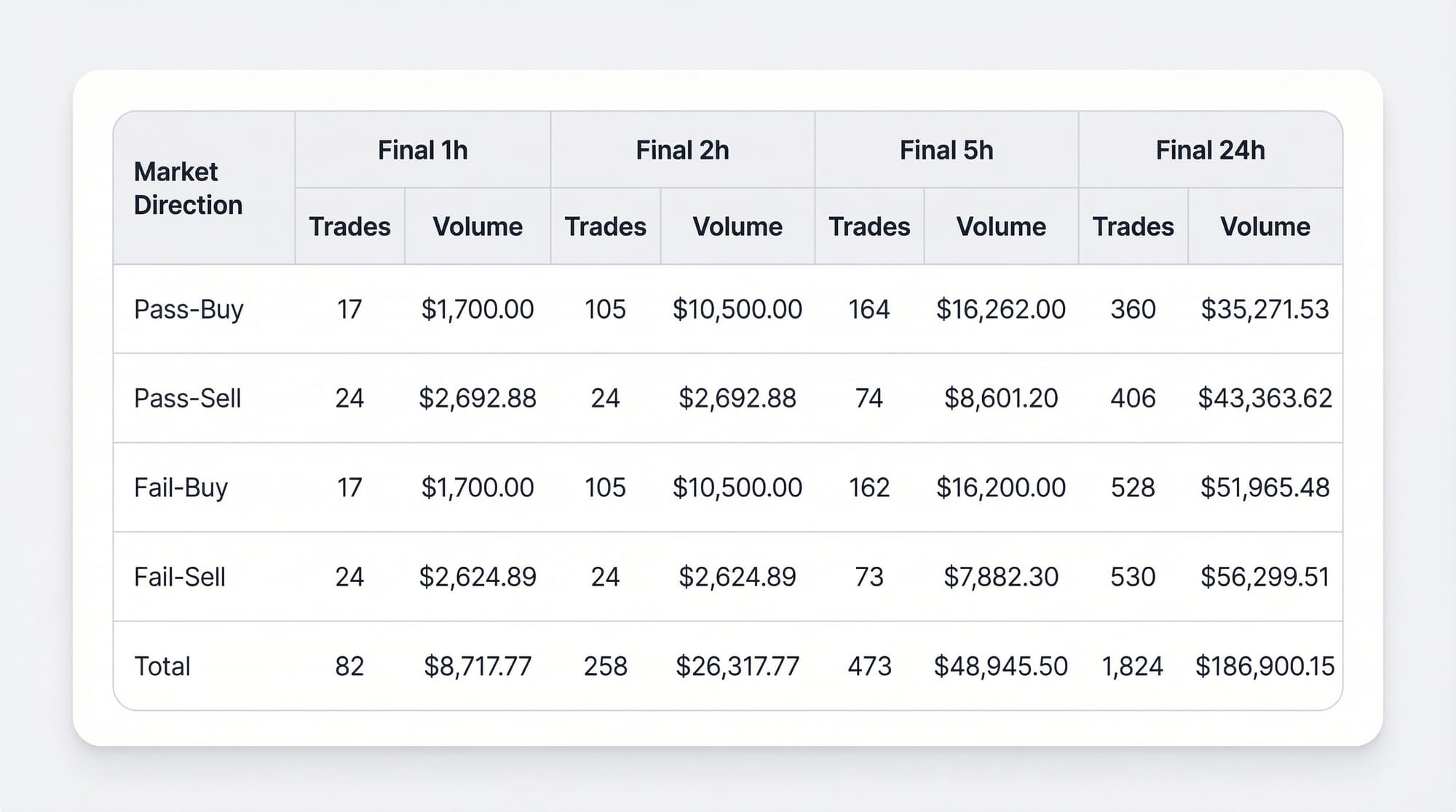
Directionally, late trading was nearly perfectly symmetric across Pass/Fail and Buy/Sell, especially in the final hours, which is a strong signal that late trades were dominated by position management, risk cleanup, or arb bots, not belief flipping or activist pressure.
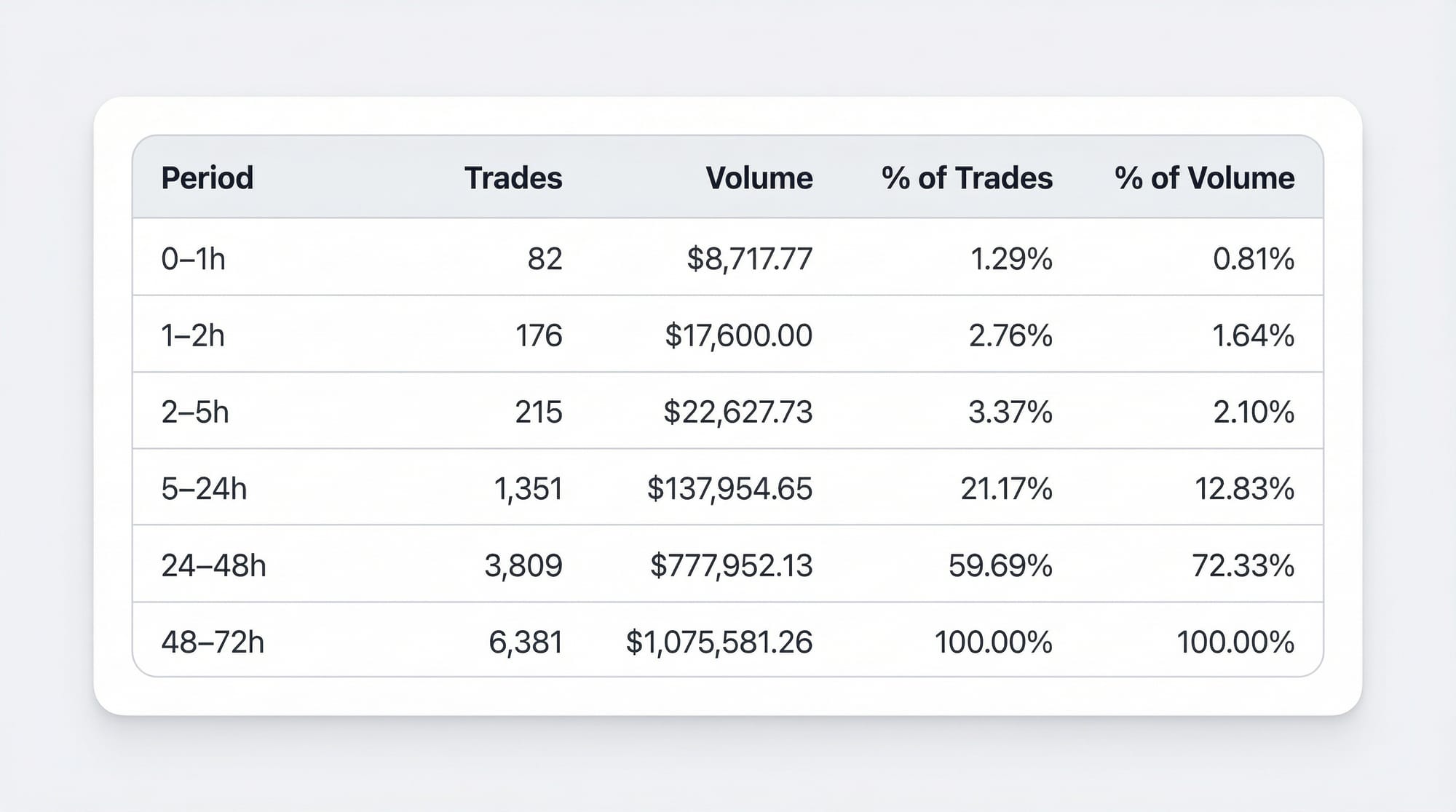
The heavy concentration in the 24-48 hour window (over 70% of volume) suggests that consensus formed before the very end, with traders sizing conviction earlier in TWAP and then stabilizing into trading close consistent with a proposal that the market broadly agreed should pass.
Proposal 2: Engage in $6M OTC with DBA and Variant? (FAILED)
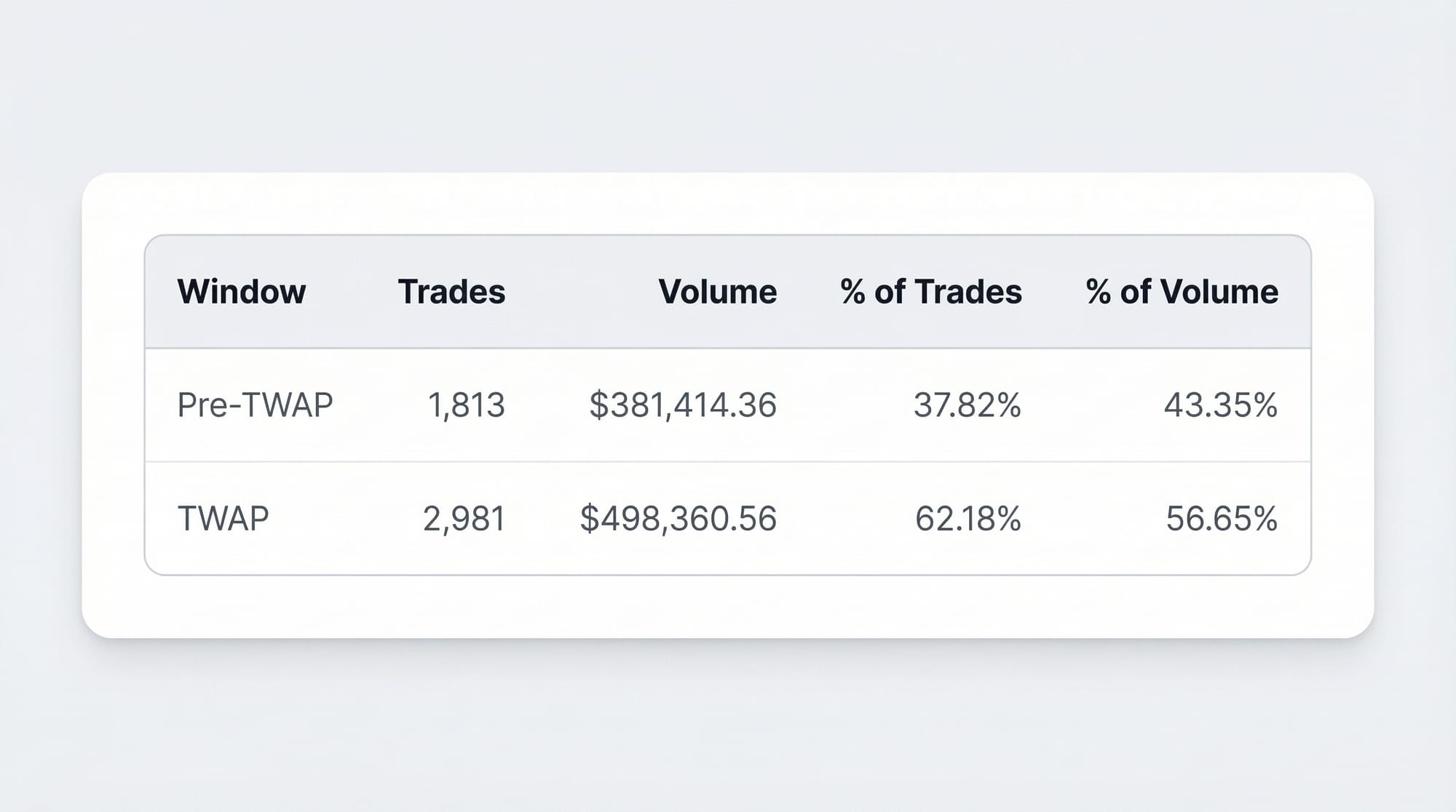
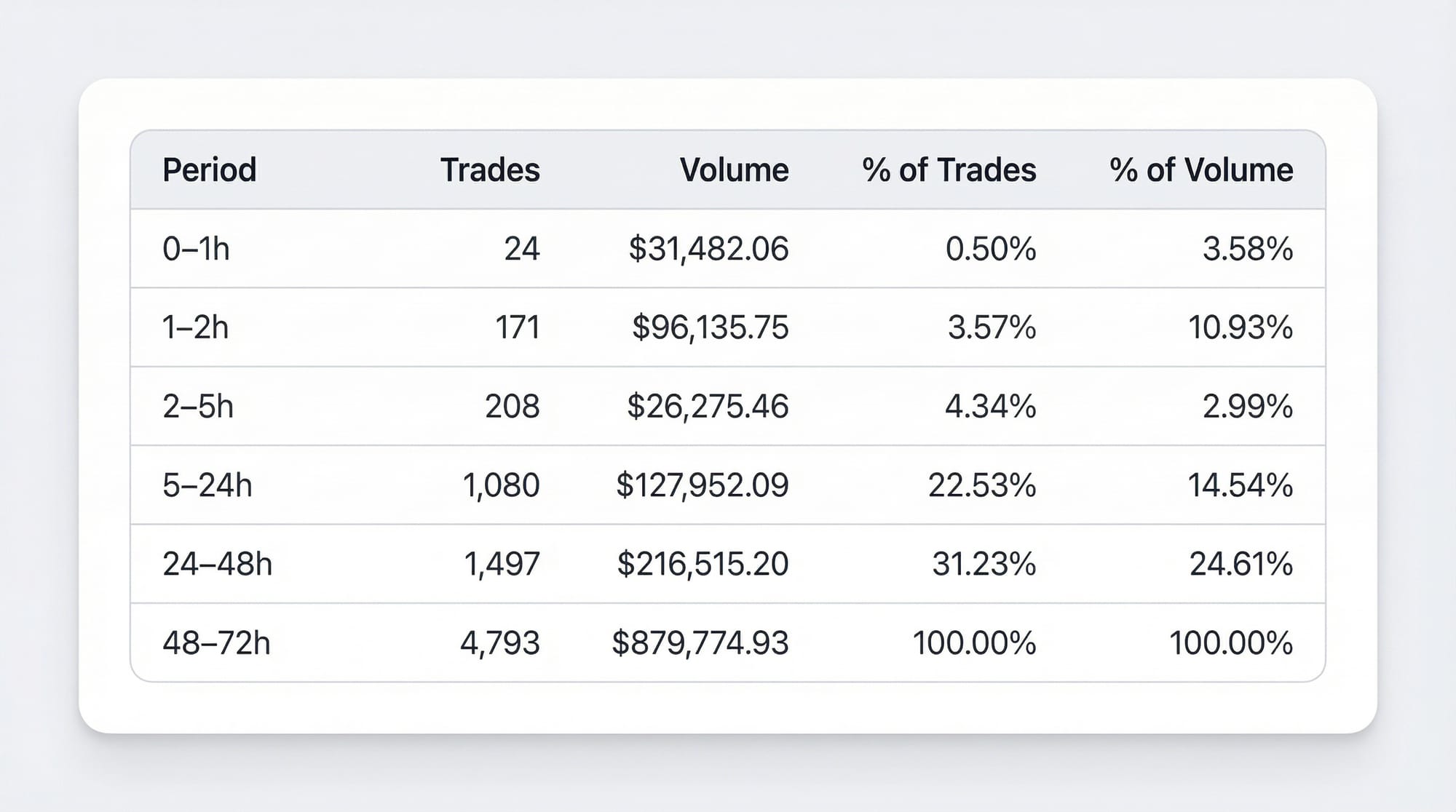
This proposal attracted substantial early capital commitment prior to the TWAP, with roughly 38% of trades and 43% of total volume occurring pre-TWAP, indicating that traders did not want to wait to express their position.
TWAP activity reinforced existing positions, as evidenced by not much change in directional activity.
While the final 1 hour was thin, the final 2-5 hour window saw a large volume share relative to trades, and the final 24 hours alone accounted for ~32% of volume.
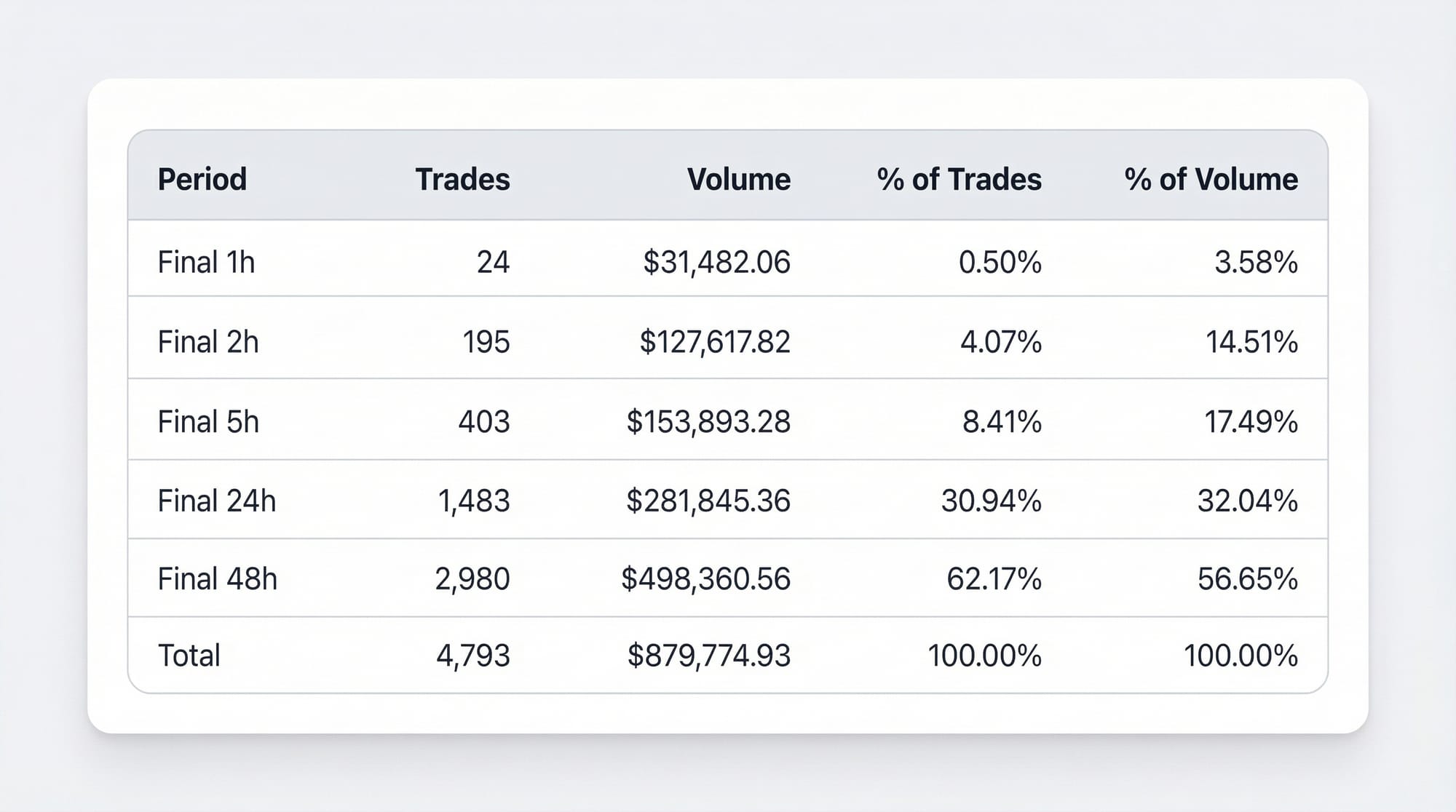
Late activity showed a persistent and meaningful directional skew toward Sell and Fail positions, expressing negative conviction rather than neutral risk unwinding (like the Omnibus proposal).
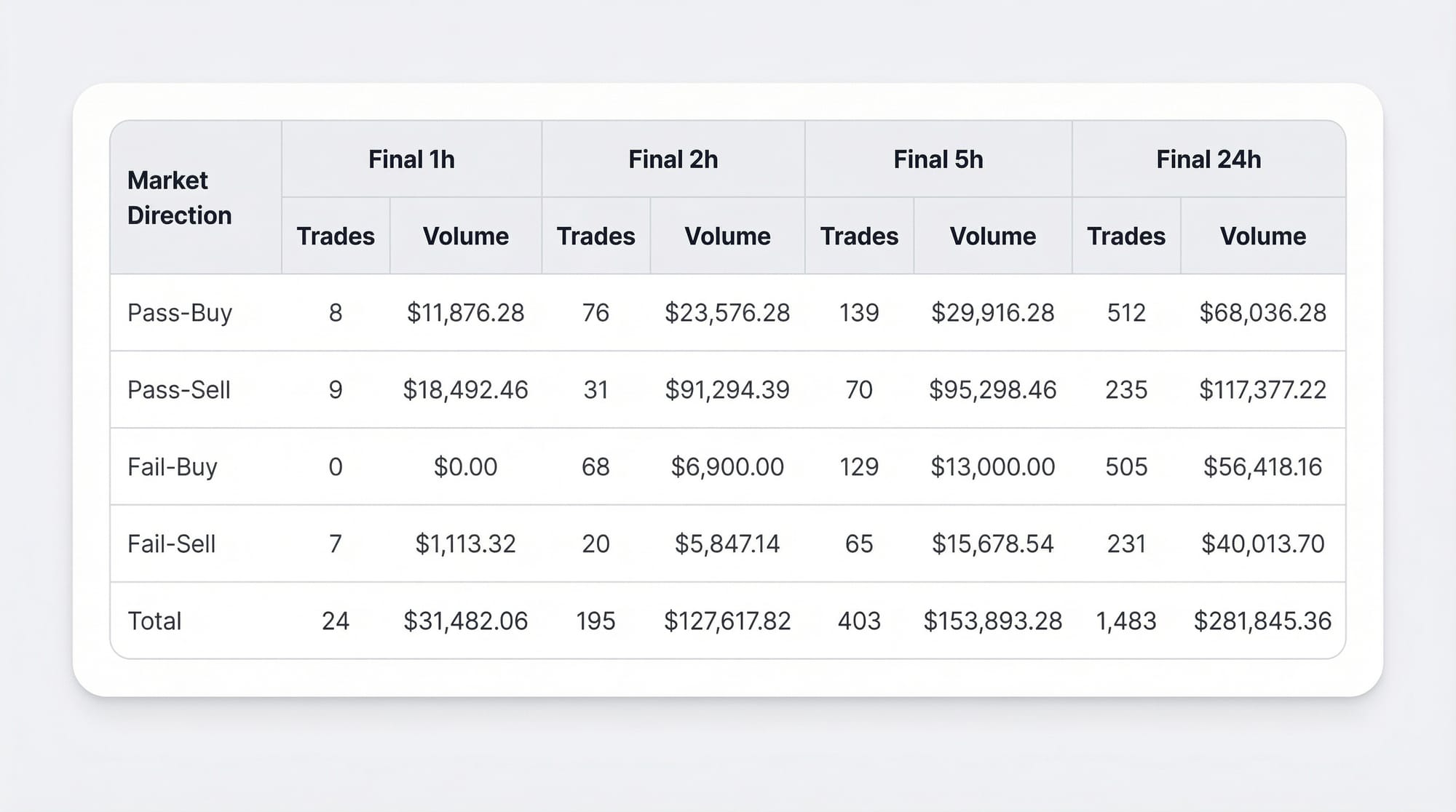
Proposal 2 failed not because of inactivity, but because late TWAP activity actively consolidated a Fail consensus, whereas Proposal 1's late activity reflected stability around an already-agreed outcome.
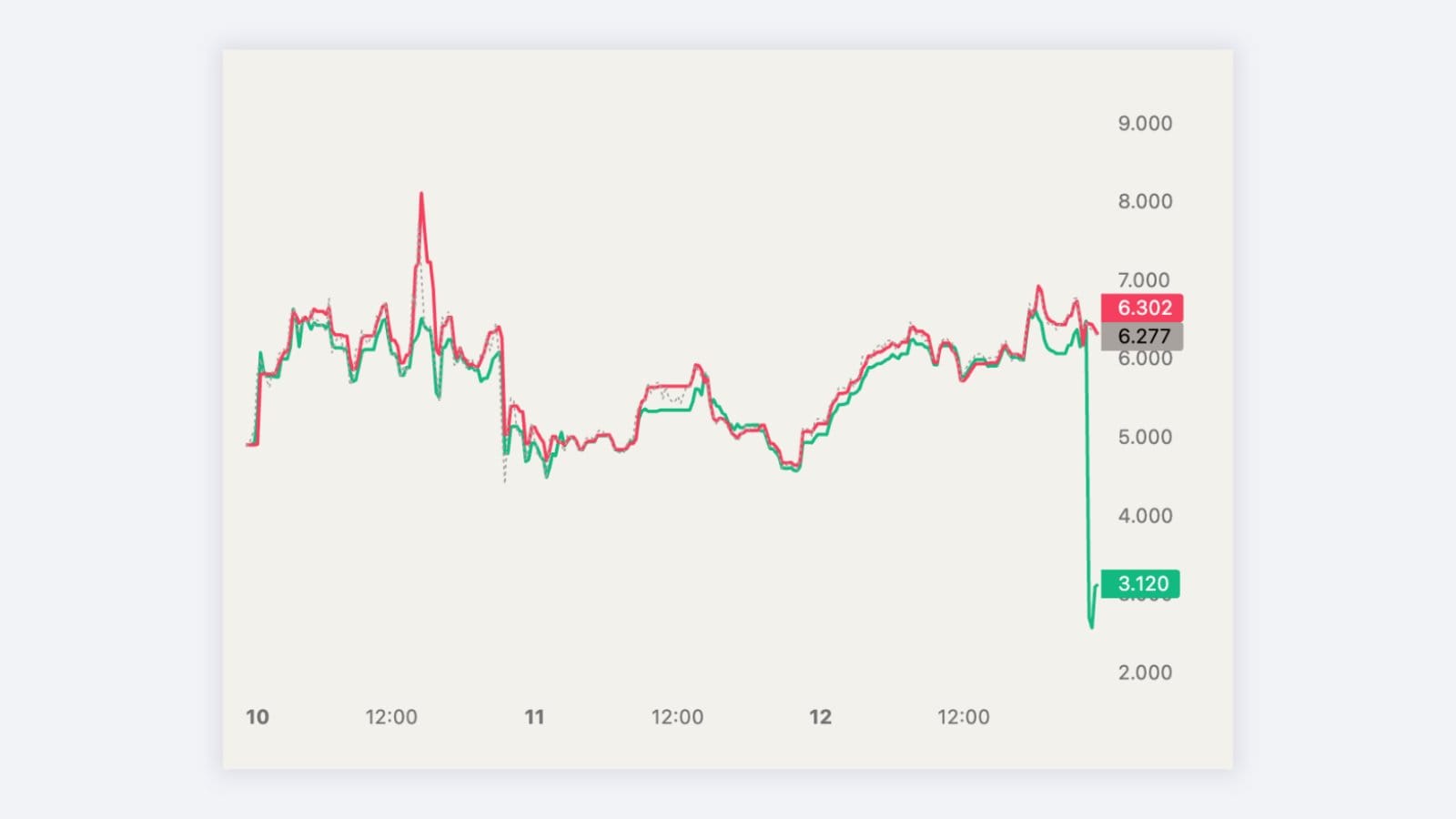
This proposal also saw a late-stage Pass-sell trade which caused the Pass price to drop significantly (to $2.24), yet the Pass TWAP was largely unchanged. This is a perfect example of how TWAP protects a market from manipulation. Even a single late trade (even if it's large) may not be enough to influence the outcome.
This is because TWAP is an average over time. If the TWAP window is 48 hours, a trade that occurs in the last 10 minutes only represents ~0.35% of the total time window. Even if that trade drops the price by a significant amount, the impact on the average price for the entire window is limited.
Conclusion
The TWAP mechanism serves an important purpose to prevent manipulation and through its two phases, it transforms a price feed into an analytical tool. Pre-TWAP shows belief formation; the TWAP window shows belief enforcement; late TWAP activity shows who cared enough to move outcomes; and resolution replay shows how the market behaved. By better understanding these concepts, newcomers and seasoned experts can move beyond observing the final outcome and truly understand market conviction in decision markets. 01Resolved is the platform for analysts to gain insights into decision markets, with detailed analytics for pre-TWAP and TWAP windows coming soon.