

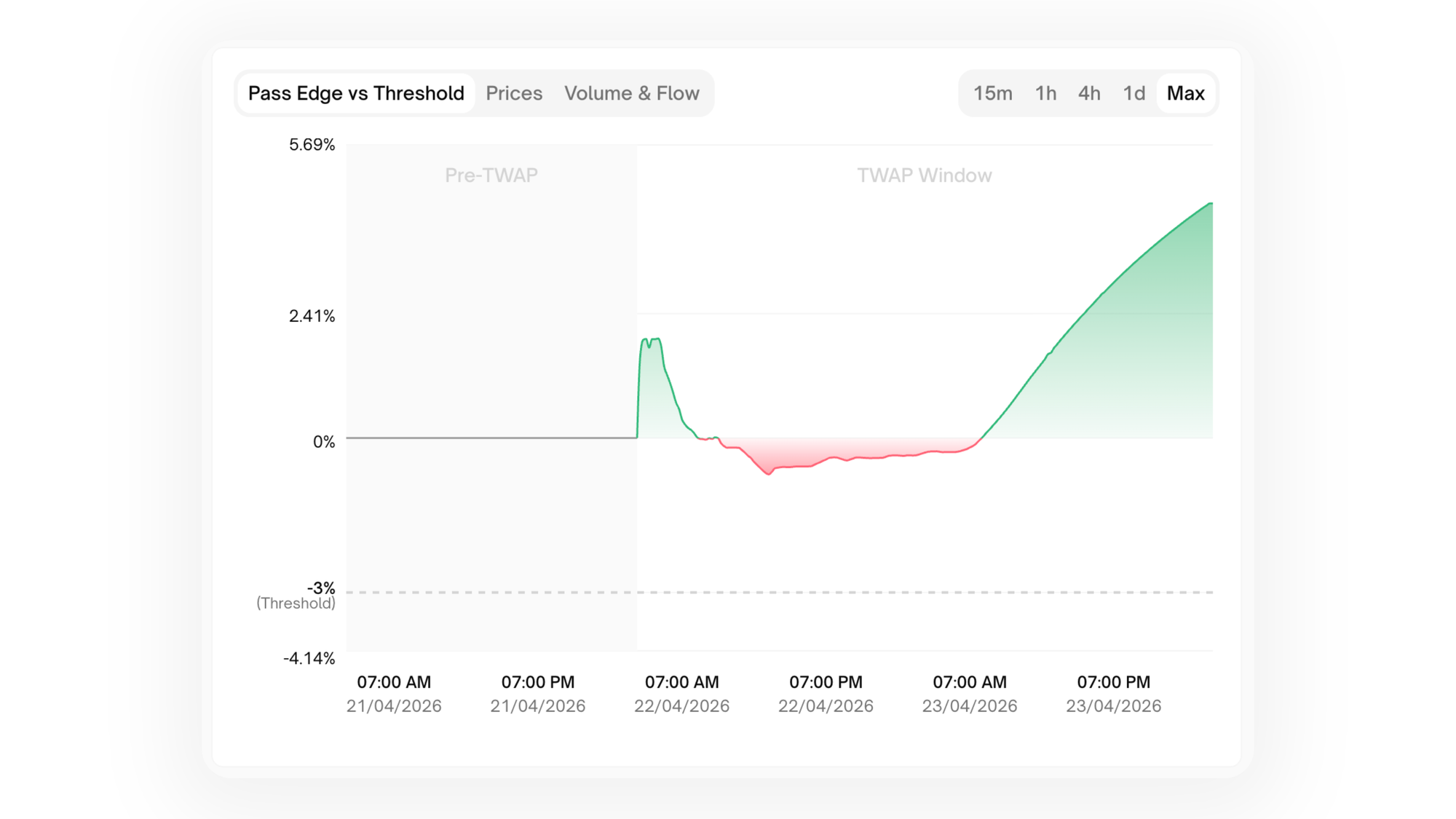
Solomon’s DP-00003 “The Gigabus Proposal” has passed, becoming the highest volume decision market traded on MetaDAO to date.The market processed $2.7M in volume across 2,276 trades from 60 unique wallets. The final TWAP settled with a Pass price of $0.61 versus a Fail price of $0.60, producing a spread of +1.56% against a -3.00% threshold, resulting in approval by +4.56%.
For a significant portion of the TWAP window, the proposal was failing.
The story of how it recovered before the TWAP closed is what matters.
What the Proposal Does
DP-00003 is the third proposal in a series that moves Solomon closer to activation.
It ratifies the Treasury Subcommittee, designates the Company Treasury Vault, establishes a multisig structure, and authorizes the initial transfer of $4.5M USDC into the vault. It also formalizes the DAO’s legal wrapper and ratifies the initial operating framework.
While the proposal bundled several components, the market’s response suggests the primary source of opposition centered on the transfer of $4.5M USDC into a subcommittee controlled vault, rather than the full proposal package.
The Market Faced Failure Early
The timing of this market is critical to understanding the outcome.
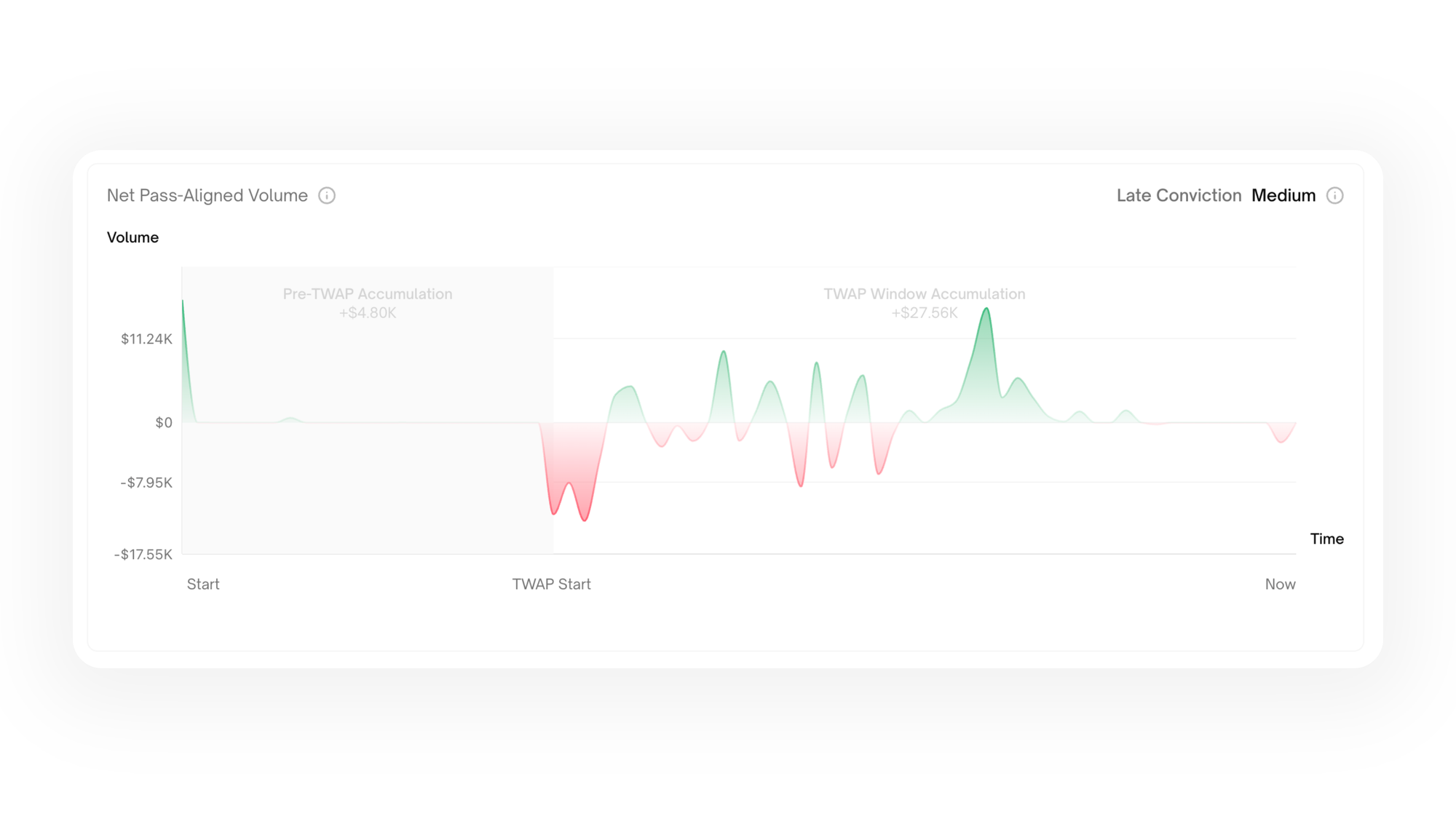
Nearly all activity occurred inside the TWAP window. The heaviest trading period was the first 12 hours of the window, which saw $2.06M (76.81%) of the total volume traded. For reference the next two 12 hour periods saw $324.42K (12.11%) and $248.82K (9.29%) of total volume traded.
During the first 12 hour period in the TWAP window, the Pass side dropped below the -3% threshold, placing the proposal in Fail territory.
The Structure of Early Opposition
The early TWAP window was dominated by a small number of highly active, Fail-aligned participants. In particular:
Trader 9atf….uTLi
- 147 trades (6.46% of total trades)
- $620.23K volume (23.16% of total volume)
- $529.13K Fail-Buy
- $74.06K Pass-Sell
- $17.03K Pass-Buy (post negotiation; more on this below)
- Ended with $586.16K of Fail exposure
This was the largest wallet in the market and the clearest expression of opposition.
Trader HM1t…r9i
- 75 trades (3.30% of all trades)
- $256.65K volume (9.58% of total volume)
- $245.41K Pass-Sell
- $11.24K Fail-Buy
- Ended with $256.65K of Fail exposure
Trader 9yLn…qfPN
- 29 trades (1.27% of all trades)
- $181.30K volume (6.77% of total volume)
- $158.65K Pass-Sell
- $22.65K Fail-Buy
- Ended with $181.30K of Fail exposure
Together, these wallets created concentrated, early pressure that pushed the market below threshold.
What the Market Was Pricing
Given the omnibus nature of the proposal, it was not immediately clear what the market was opposing.
DP-00003 bundled multisig control, capital deployment, and operational structure into a single decision. The early Fail-aligned flow suggests the market was pricing specific risks within that bundle, but the binary structure of MetaDAO decision markets makes it difficult to isolate which component drove that opposition.
The Inflection Point
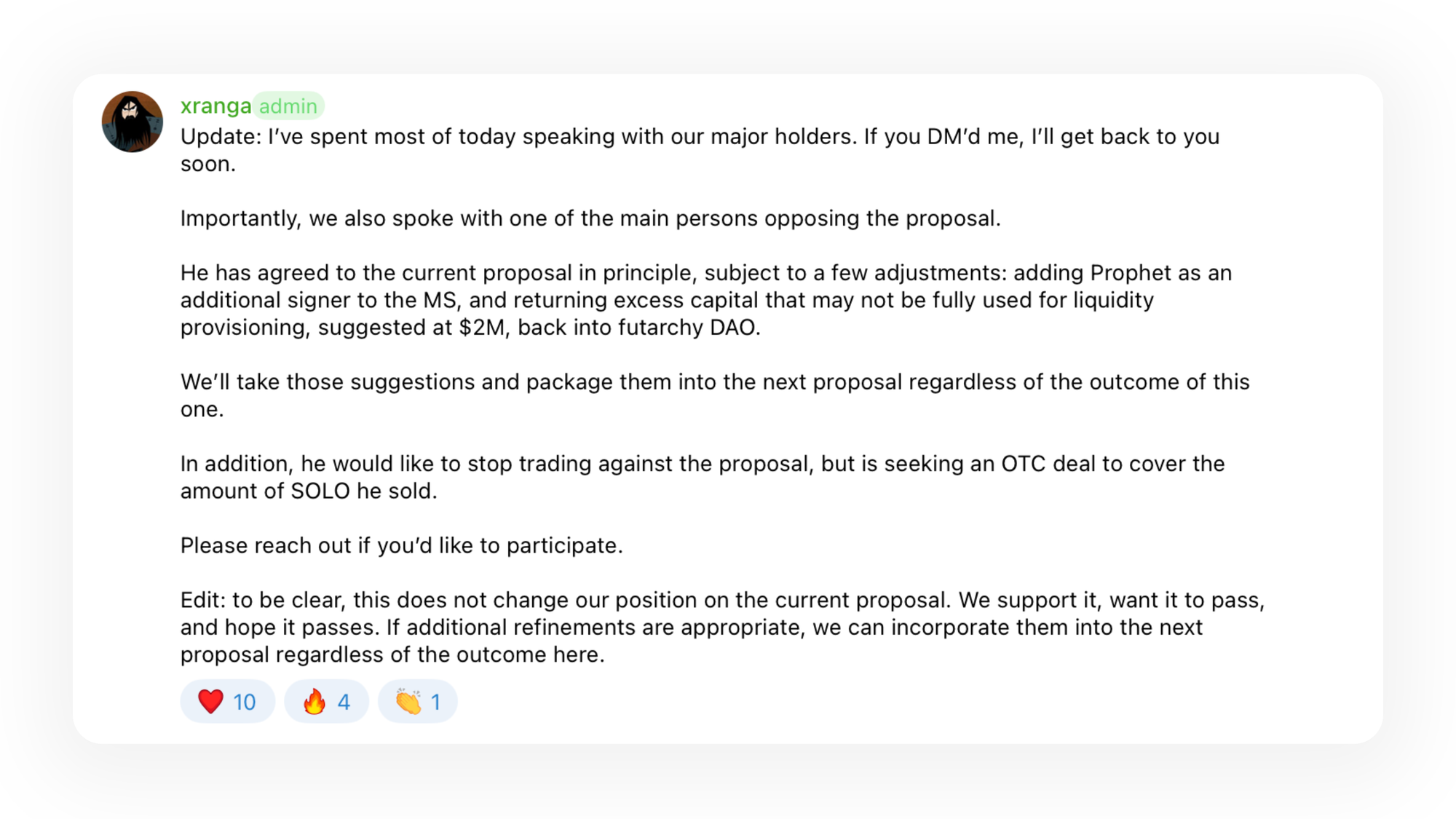
During the TWAP window, the Solomon team engaged directly with major holders, including one of the primary opposing participants.
Following that engagement, the opposing party agreed with the proposal in principle, subject to specific adjustments. These included adding MetaDAO co-founder Proph3t as an additional multisig signer and returning excess capital, suggested at approximately $2M, back to the DAO if not required for liquidity provisioning.
The team confirmed these refinements would be incorporated into a subsequent proposal regardless of outcome.
This rapid engagement and willingness to incorporate feedback changed how the market priced the proposal.
The Late Opposition Re-Entry
Interestingly, the opposition did not fully disappear. There was late Fail-aligned activity even after the negotiation:
Trader 4bbR…pgFh
- 23 trades (1.01% of all trades)
- $65.86K volume (2.46% of total volume)
- $65.76K Pass-Sell
- $100.00 Pass-Buy
- Ended with $65.66K of Fail exposure
This wallet entered during the recovery phase and expressed opposition almost entirely through Pass-Sell. It was not the largest opposing wallet, but it matters because it shows that disagreement persisted even as the market moved toward approval.
When the Market Recovered
After spending much of the early TWAP window below threshold, the Pass side began to recover.
The spot spread moved back above zero approximately 18 to 20 hours before close, while the running TWAP crossed back above the -3% threshold during the same window. From that point, the Pass market continued improving into resolution.
With minimal volume entering the market in the final hours, the TWAP stabilized and held through resolution.
The Structure of Support
Unlike the Fail side, which was defined by a small number of concentrated wallets, Pass support was more distributed.Trader GaDZ…zhqn
- 19 trades (0.83% of all trades)
- $142.96K volume (5.34% of total volume)
- $142.96K Pass-Buy
- Ended with $142.96K of Pass exposure
Trader G5uC…wJqV
- 17 trades (0.75% of all trades)
- $137.94K volume (5.15% of total volume)
- $42.36K Pass-Buy
- $95.59K Fail-Sell
- $0.10 Fail-Buy
- Ended with $137.94K of Pass exposure
Trader 8eS8…JJsv
- 12 trades (0.53% of all trades)
- $132.11K volume (4.93% of total volume)
- $27.30K Pass-Buy
- $104.82K Fail-Sell
- Ended with $132.11K of Pass exposure
Four other notable wallets (6tW7…Rbns, 3wLr…HTRS, 6j77…NEhq, and HmnM…kTW) also contributed meaningful pass-aligned trades - $65.62K, $65.34K, $64.44K, and $61.29K respectively.
Pass support did not come from one dominant wallet. It came from several wallets expressing support through both Pass-Buy and Fail-Sell.
What Actually Decided the Outcome
The final structure of the market explains the result.Early trading in the TWAP window was dominated by concentrated Fail-aligned capital, which pushed the proposal below threshold and into failing territory.
The proposal passed because that pressure did not hold.After the team addressed the core concerns and reframed the proposal through direct engagement, Pass-aligned participants entered across multiple wallets and over time. That distributed support pulled the TWAP back above threshold and held it there through resolution.
Closing Thoughts
DP-00003 did not pass because the market was aligned from the start. It passed because early opposition pushed the proposal below threshold, the Solomon team engaged directly with that opposition, and the terms of support changed.
What began as outright rejection became conditional acceptance. The market repriced that shift, and the TWAP followed. This was not a one sided market. It was a contested decision that was shaped by both capital and coordination, and ultimately resolved to what the market believed to be most value accretive to the $SOLO token.