
Five MetaDAO ecosystem projects have passed token buyback proposals since November 2025, four of which have fully executed, with a sixth currently in a decision market (P2P). One project, Ranger Finance, was liquidated after its buyback was completed. This analysis evaluates each buyback against treasury sustainability, runway impact, and price performance benchmarked against SOL.
The main finding is that while buybacks have tradeoffs, if they are implemented, they must be sized proportionally to what a treasury can absorb. When a project with limited runway proposes spending a significant share of its liquid treasury on buybacks, the price support is often temporary, putting the long term health of the project at risk.
Price Action Around Buyback Proposals
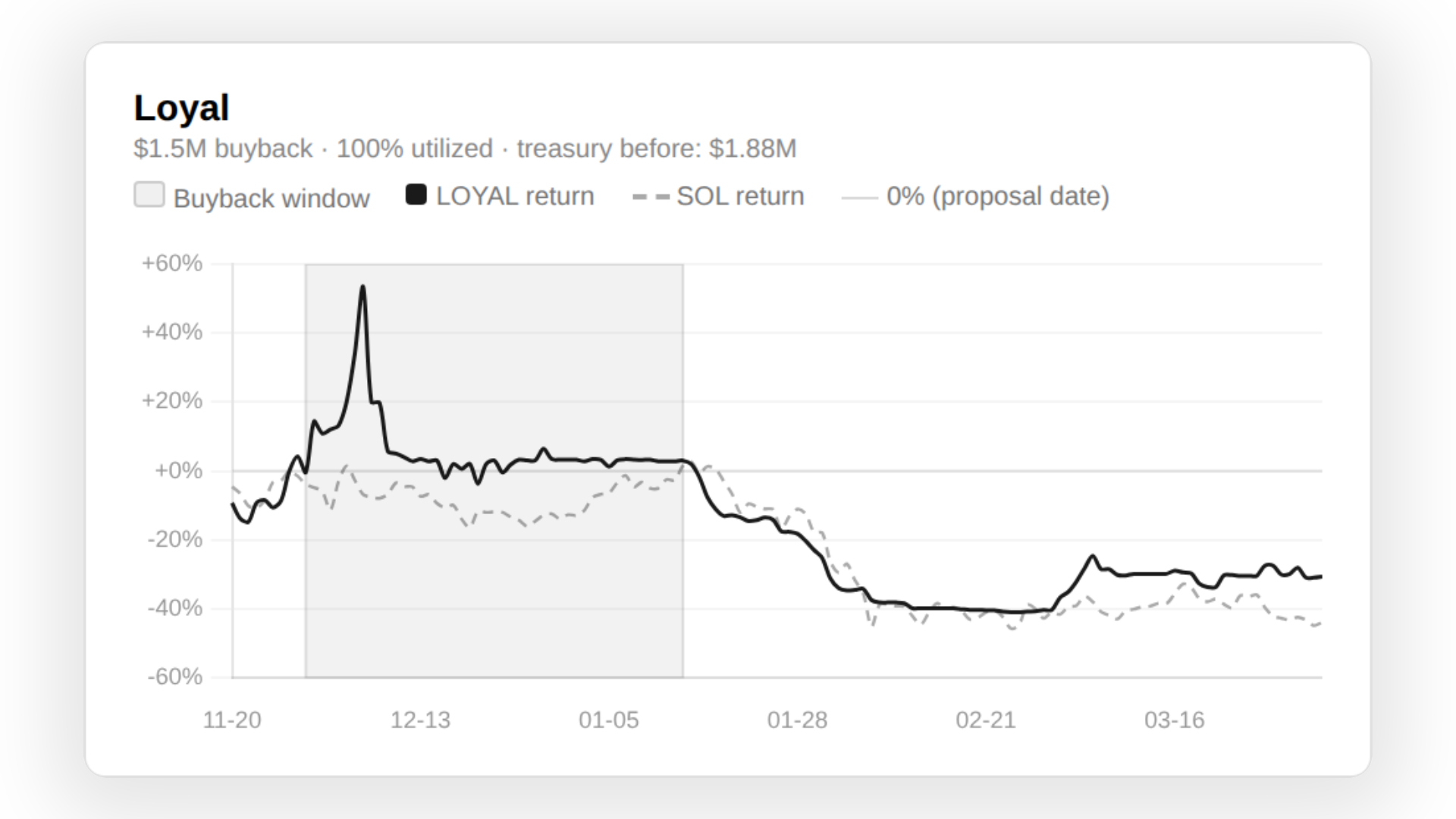
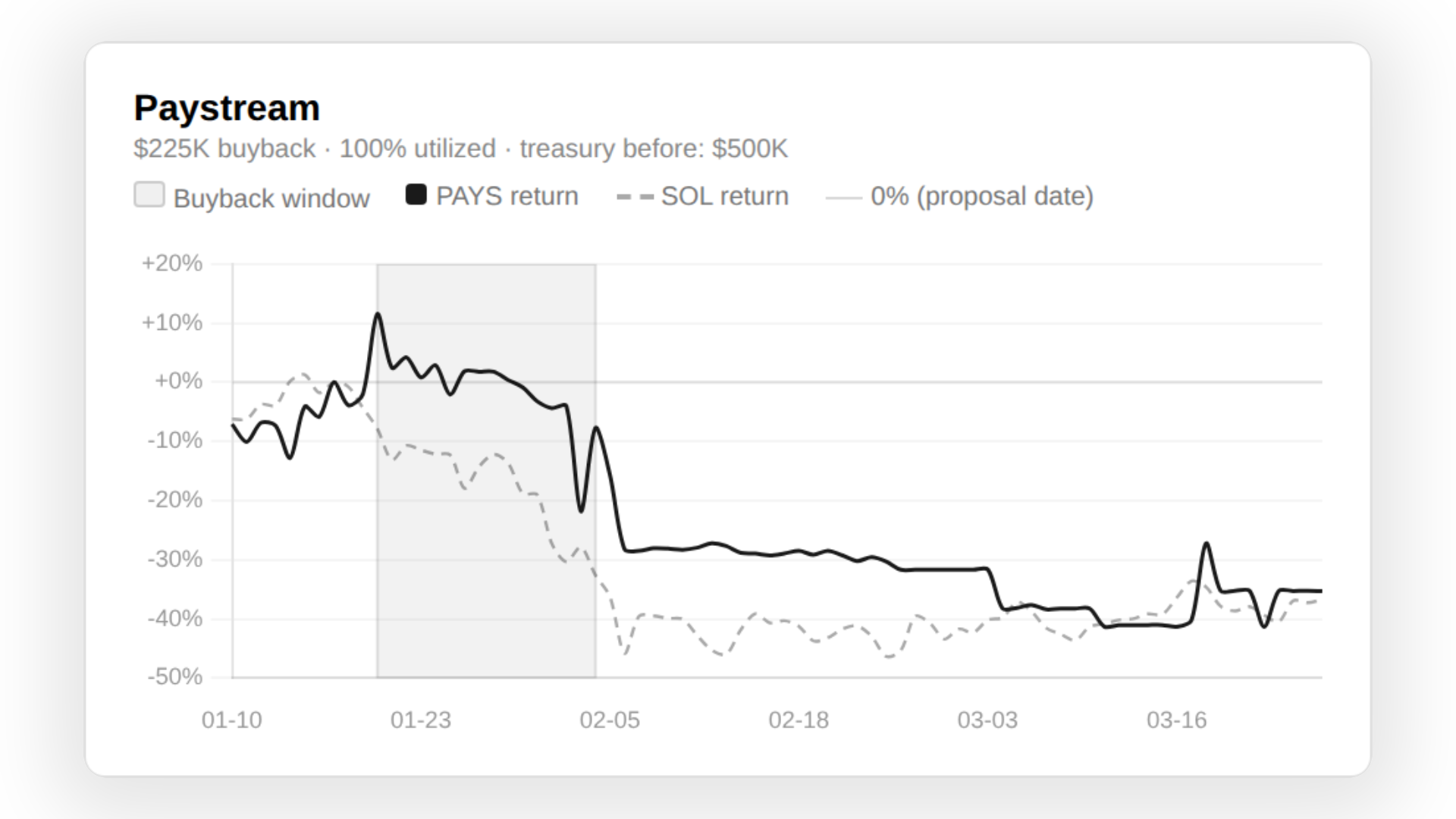
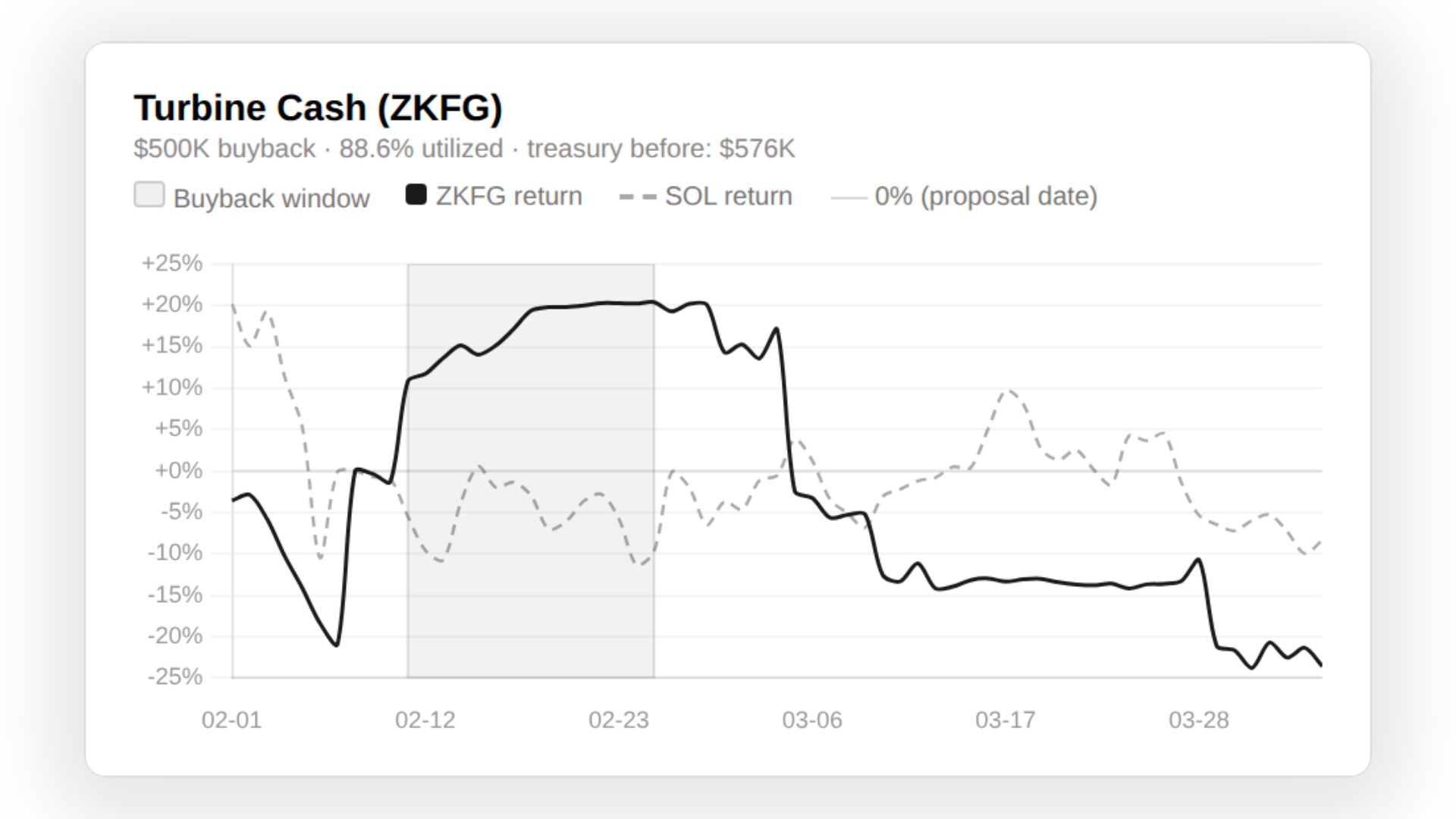
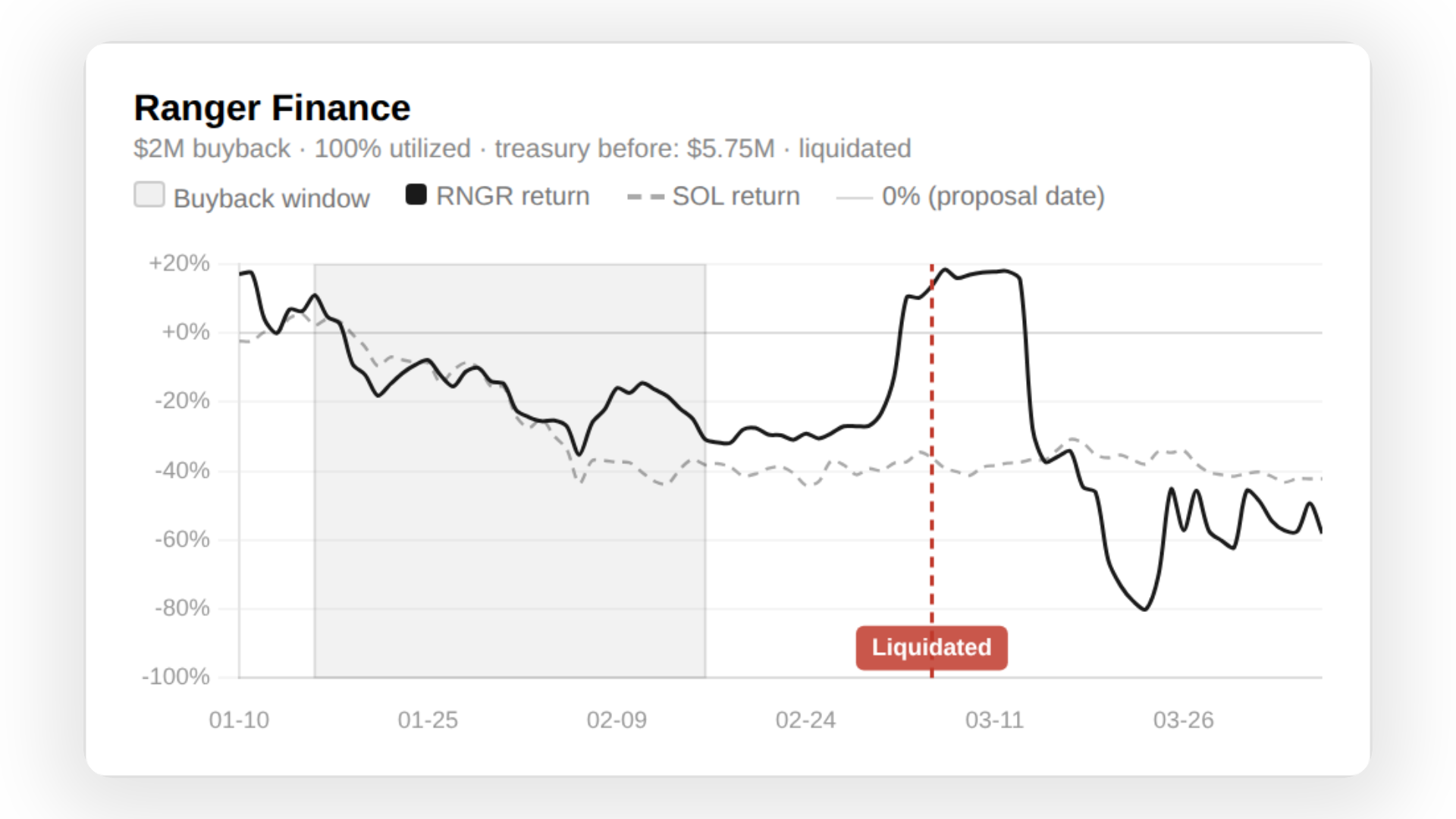
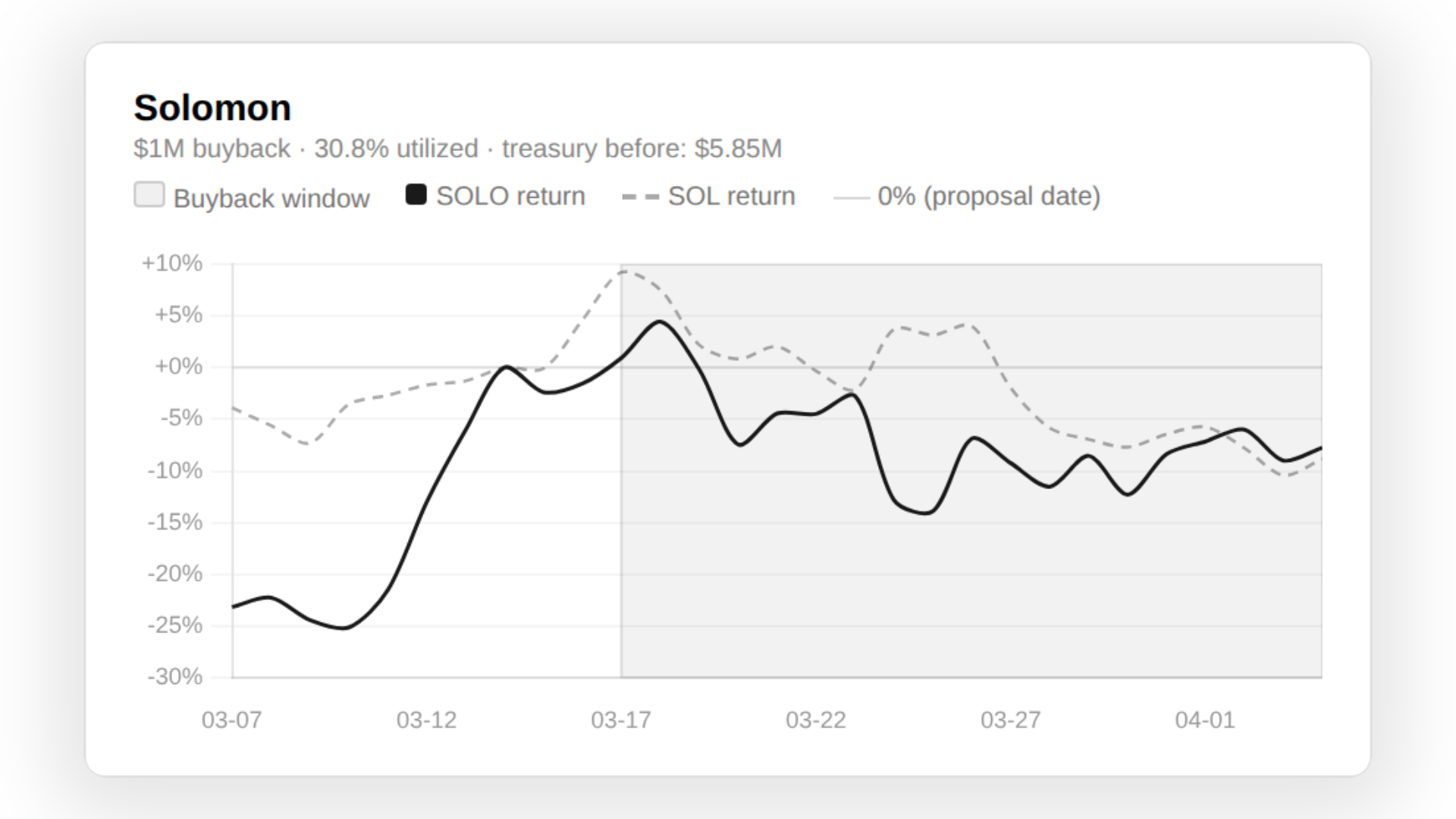
The charts below show percentage returns from the proposal date for each token (shaded black) and SOL (dashed gray), with the buyback execution window shaded. The gap between the two lines represents excess return vs. the SOL benchmark. A 0% baseline marks the proposal date.
Buyback Comparison
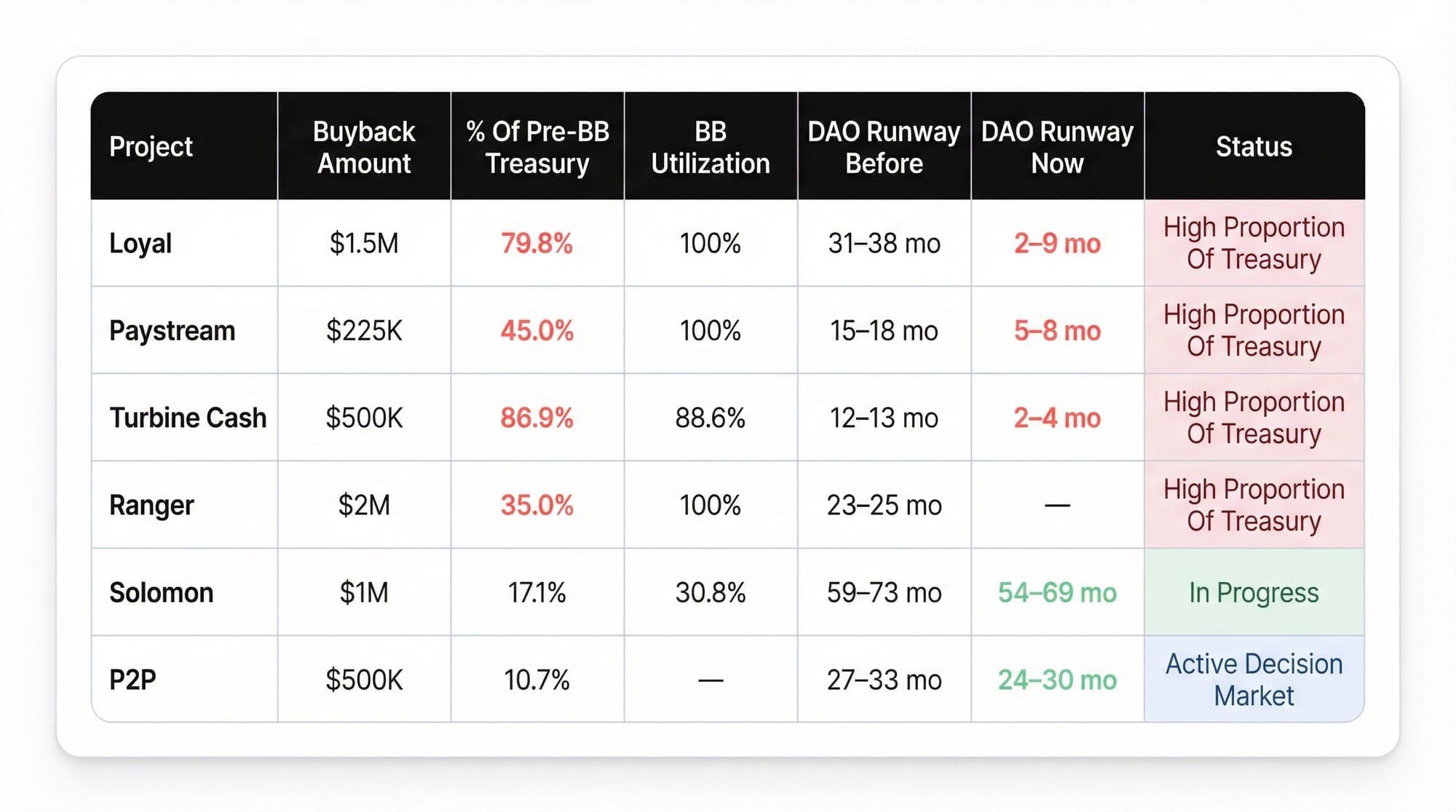
The table below compares key metrics across all five buyback proposals. Runway is shown as a range where the low end uses only liquid non-LP treasury, while the high end includes LP positions.
Case-by-Case Assessment
Loyal ($LOYAL)
Loyal proposed a $1.5M buyback against a pre-buyback non-LP treasury of $1.88M (79.8% of treasury). The buyback was 100% utilized. DAO runway now sits at 2-8 months (depending how you want to factor in LP value). The token saw a brief spike during the execution window (peaking near $0.35) but has since declined to $0.16, a -30.6% move from proposal price. Over the same period, SOL declined -43.8%, meaning Loyal outperformed SOL on a relative basis.
Paystream ($PAYS)
Paystream proposed a $225K buyback against $500K in non-LP treasury (45.0%). Fully utilized. DAO runway now sits at 5-8 months (depending how you want to factor in LP value). The token declined -35.3% from proposal, while SOL was down -36.7% over the same period.
Turbine Cash ($ZKFG)
Turbine Cash proposed a $500K buyback against only $576K in non-LP treasury (86.9%). The buyback was 88.6% utilized (~$443K spent). The proposal also moved 50% of the FutarchyAMM liquidity ($85,673 in USDC) back to the DAO treasury, partially offsetting the buyback cost but reducing market depth. The net treasury impact was approximately $357K. DAO runway now sits at 2-4 months (depending on how you factor in LP value). The token declined -23.6% from the proposal while SOL fell -8.4% over the same period.
Ranger Finance ($RNGR)
Ranger Finance proposed a $2M buyback against $5.75M in non-LP treasury (34.8%). The buyback was 100% utilized. At the time of the proposal, the DAO runway was ~23 months. During the buyback execution window (Jan 16 to mid-Feb), the token declined from $0.65 to roughly $0.45, a -30% drawdown.
Solomon ($SOLO): In Progress
Solomon proposed a $1M buyback against $5.85M in non-LP treasury (17.1%). At 30.8% utilization ((~$308K spent so far), the program is still executing (60-day window ending in May). Depending on how you factor in LP value, DAO runway would drop to approximately 49-63 months at full utilization. The token is down -7.7% from proposal date vs. SOL's -8.8%, meaning Solomon is roughly tracking the benchmark.
P2P ($P2P): Open Decision market
P2P has proposed a $500K buyback against $4.66M in non-LP treasury (10.7%). At full utilization, DAO runway would drop to 24-30 months (depending on how you factor in LP value). The buyback is capped at $0.55, an 8% discount to the ICO price of $0.60. The risk profile is similar to Solomon in that the treasury can absorb the spend without a high amount of risk given currently monthly spend and reserves.
Conclusion
When buybacks consume a large share of liquid treasury, they reduce runway and increase the probability that the project will need to raise capital again under worse conditions (or alter the market depth by pulling liquidity from AMMs). In those cases, the buyback may provide temporary price support but weaken the long-term financial position of the DAO.
When buybacks consume a small share of treasury and runway remains long, buybacks can be a solid capital allocation strategy as the DAO can accumulate tokens during periods of weakness and later sell them OTC to long-term oriented investors.
The difference between those two outcomes is the DAO’s ability to survive long enough for the strategy to work.
For the P2P proposal currently under vote, the metrics suggest sustainability. Only 10.7% of liquid treasury is used and the DAO will have +24 months of post-buyback runway, plus the buyback price is set at a discount to ICO. Whether the purpose of the treasury spending makes sense, is up for token holders to decide.
Data as at April 3, 2026. Treasury values sourced from onchain wallet balances. Price data from CoinGecko. SOL used as benchmark for relative performance.