
Analysis, takes, and signals from the ownership coin frontier.
-
01
-
02
-
03
-
04
-
05
-
06
-
07
-
08
-
09
The Big Picture
"Teams should raise enough to reach the next meaningful proof point, not the maximum the market will give them."
After a busy July, August was a quiet month for fundraising. No project completed a curated raise on MetaDAO, though two closed on Futardio. Kimia raised $60K against $727K committed and Basket $10K against $18K. Outside of MetaDAO and Solana, a major issuance was completed on Base. Umia ran a successful ICO for its own native token raising their max cap of $6M with ease. The category also saw more turnover with Flash Trade planning to wind down unless a buyer steps in to save the project, and Paystream announced plans to cease operations and liquidate the treasury following nine months of funding and multiple pivots.
Decision markets rebounded after a quiet July, with six proposals resolved on roughly $713K of total volume. Two proposals failed, both involving attempts to withdraw funds from a treasury. Umbra rejected a malicious proposal to move $1.5M from its treasury into an attacker’s wallet, while Kimia rejected a liquidation attempt less than three weeks after its raise closed. Elsewhere, treasuries are set to start earning yield: META-040 approved the swap of up to $2M of MetaDAO's USDC into Solomon's USDv and Loyal's autonomous vault went live this month.
Kimia and Ordr both closed heavily oversubscribed raises, but now trade below the cash they raised. Rip Cars went back to the market for $50K from the treasury three weeks after its raise to support the public launch of its platform.
We look deeper at these projects in this month's Call where we argue that a fundraising target should come from the cost of reaching the next proof point rather than from a guess at demand.
The Call
Ownership coin issuers should raise the amount the business can justify and productively put to work at that stage. For an early company, that means raising to the next meaningful proof point rather than funding several stages of the roadmap upfront.
How Much Should You Raise?
“Wen token?” is one of crypto’s oldest questions. But for ownership coins, there is another question that deserves just as much attention: How much should you raise in the ICO?
Traditional token projects often reserve pre-minted tokens in their treasury to sell when more capital is needed. Ownership coins handle subsequent financing differently. New ownership can always be issued, but only if the proposal to do so passes in a decision market.
This creates real incentive to raise a surplus of capital in the ICO. The opportunity to raise future rounds is anything but certain, especially when taking into account market volatility. That friction, however, is part of what makes the ownership coin structure great. To raise again, teams must convince the market that issuing new ownership for additional funding will create value.
The initial raise should provide enough capital to reach a meaningful proof point. If the team reaches that point, the next financing proposal can be judged against stronger evidence. If it does not, investors will have avoided funding additional stages of the roadmap in advance.
Token Network Effects
Chris Dixon's 2017 essay on token networks argued that tokens can help solve the cold start problem by turning early investors into users, contributors, and distributors before the product is great.
For an ownership coin, that network effect runs on four cyclical factors:
- Capital - Launch funds runway and growth.
- Attention - Holders become a distribution channel.
- Users - Some holders become users, and some users become holders.
- Value - Usage produces revenue, revenue increases net asset value ("NAV"), and a rising NAV renews the cycle.
A launch brings capital and attention on day one, but long term users and value have to be earned. That gives a team a reason to launch before everything is proven, since an early holder base can help create demand and distribution. The risk is that early holders are funding more uncertainty.
The earlier the launch, the more specific the raise should be. Investors should know which uncertainty their capital is meant to remove. This can also help limit dramatic liquidation proposals if the team can point back to what they are aiming to achieve with the fundraise in the first place.
The Four Stages
At what stage the business is at determines what has been proven and what the next capital should fund.
At the earlier stages, investors are funding more of the story and less of the evidence. That can still make sense, but both the size and valuation of the raise should reflect it.
The Raises
We went back and looked at 21 ownership coins launched by MetaDAO. All together they raised about $43M. The smallest raises were $10K while the largest was $8M. The four largest launches accounted for about 60% of all the capital raised.
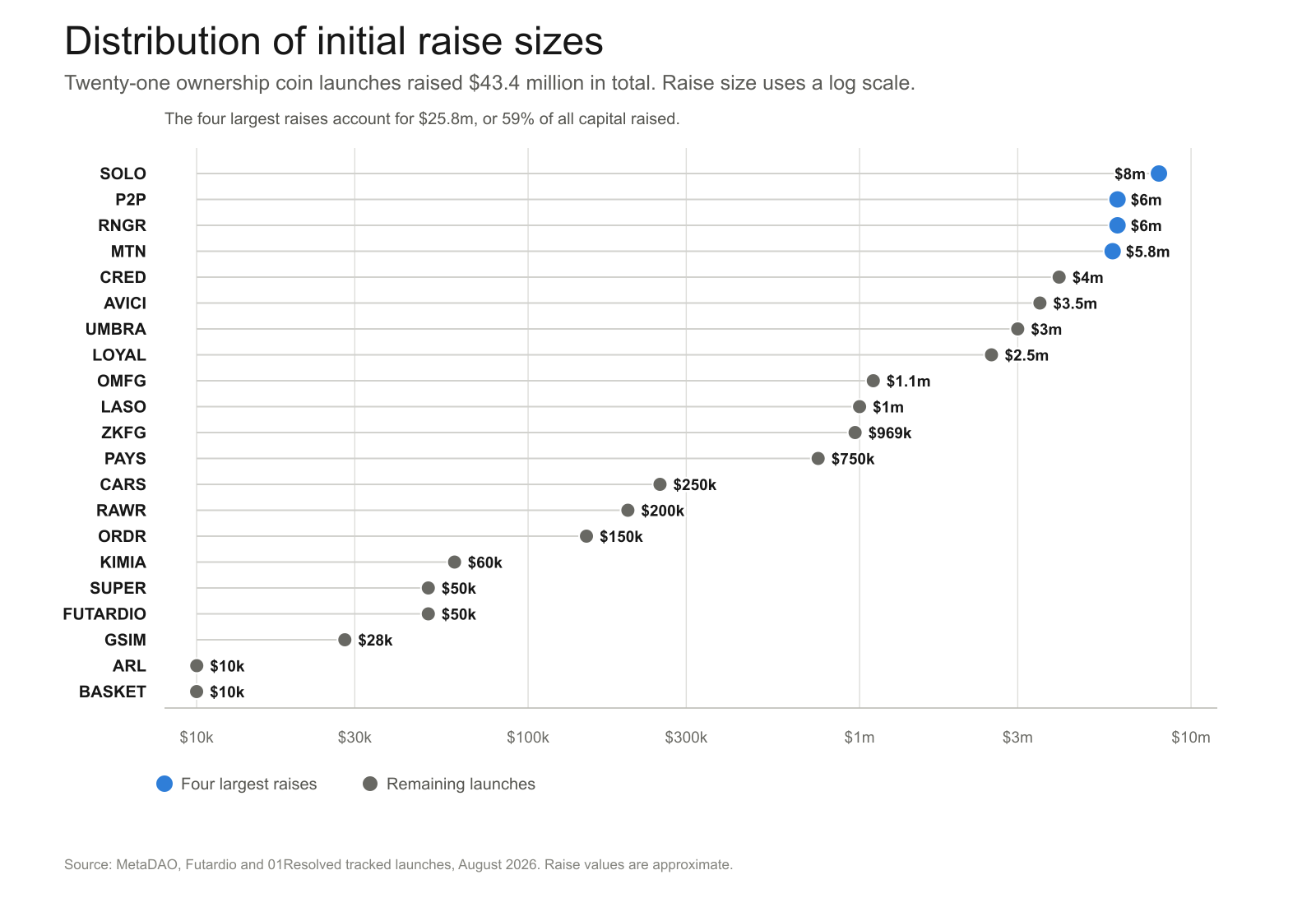
The chart shows how widely distributed launch sizes are. We tested whether initial raise size was correlated with better price and NAV performance - but did not find any clear conclusions.
The absence of a pattern suggests that the market has not yet settled on how much an ownership coin should raise. However, recent launches, like Rip Cars for example, show a staged approach that we believe will become more common going forward.
Rip Cars
Rip Cars launched before the product existed and could have raised far more than the $250K it accepted (roughly $32M was committed). Instead, the raise got the business to market and gives it enough capital to start proving whether people actually want the product.
The token may already be helping on distribution too. Proph3t recently wrote that of the roughly 1,000 people on the Rip Cars waitlist, the majority hold CARS. The launch helped create an audience for a product that had not launched yet.
If Rip Cars works and additional capital can be put to productive use, the team can come back to the market and raise again. By then investors should have more to judge and the company should have a better understanding of where the capital is going. If it doesn't work, investors only funded $250K, rather than the several million dollars the market was willing to give it.
MetaDAO, Umbra and OmniPair also show that ownership coins can raise again when traction supports another round. Additional capital is never guaranteed, but this shows that the initial ICO does not need to fund every stage of the roadmap.
Valuations
Early holders are providing capital while accepting the greatest uncertainty. They are also the holders you want to become users, contributors and distributors. Having too high of a valuation at launch leaves them less upside for taking that risk and doing that work.
Launch at a valuation the project can grow into and one that reduces the odds of a down-only price chart from launch. This should maximize the distribution benefits from holders who are happy, or at least not really disappointed, with early price performance.
As an example, If a team raised privately at a $1 million valuation and has not reached milestones that justify a higher valuation, launching at $5 million would be difficult to defend. Launching closer to the previous valuation gives holders meaningful upside if the project succeeds. Where there are no/few comparable public tokens valuations to benchmark against, begin with a conservative valuation and let the market perform price discovery. A strong project can be repriced upward quickly.
When Capital Is Needed Before Launch
Some companies need capital before it makes sense for them to launch an ownership coin. New funding models are now making this possible.
Spark allows an idea to raise capital through an IdeaCoin before the ownership coin exists. Colosseum's STAMP and Fair.Club provide a path for private funding rounds ahead of an ownership coin ICO.
Rakka from OmniPair put forth a concept that would allow teams to raise publicly, but only have the token trading at some future date. While it has not been implemented, it's an interesting concept that we hope one day makes it into a production environment.
A thought:
— Rakka | Omnipair (@rakka_sol) April 10, 2026
Imagine @MetaDAOProject but with non-transferable token post raise for pre-product/PMF projects (token only tradable in decision markets, not sure if this is possible), so:
- products accumulate attention/anticipation over time
- ships with airdrop farming premium…
Final Thoughts
An oversubscribed ICO makes it tempting to conclude that a team should have raised more. Rip Cars had roughly $32M committed for a $250K raise, but demand alone does not tell you how much capital a business should take.
The amount raised should reflect what has actually been proven and what the capital is meant to achieve. For an early company, that may mean taking enough to get the product into market. For a business with repeatable revenue and a proven way to put another $10M to work, it can mean much more.
Raise to the next proof point, not the maximum the market will give you.
Ecosystem Ledger
Decision Markets
August saw six decision markets resolve on $712.89K of volume from about 5K trades. Sanctum, which sits outside the ownership coin category, added another $501K of volume from their decision market. Of the six ecosystem proposals, two failed. Umbra traders fought off a malicious attempt to drain $1.5 million from the DAO treasury. Meanwhile, Kimia holders rejected a liquidation proposal that would have wound down the DAO and distributed its cash reserves.
Total trade volume was $358K across 255 trades from 20 unique wallets, 40% of them repeat participants. On an economic basis, 46% of volume and 31% of traders were Pass-aligned. The proposal failed the 3% TWAP threshold by ~20%.
A malicious proposal attempting to extract roughly 60% or $1.50M of Umbra's treasury was decisively rejected (more analysis on this in the Signals vs. Noise section below).
Total trade volume was $25K across 206 trades from 102 unique wallets, the largest trader base of any MetaDAO market this month. On an economic basis, 59% of volume was Pass-aligned while 83% of traders were Fail-aligned. The proposal passed the -3% TWAP threshold by ~35%.
Rip Cars was able to draw $50K on top of its monthly allowance to fund Hot Wheels inventory, an office deposit and prepayment, design work and accounting ahead of the platform launch.
Total trade volume was $274K across 2.44K trades from 37 unique wallets, 16% of them repeat participants. On an economic basis, 53% of volume and 54% of traders were Pass-aligned. The proposal passed the -3% TWAP threshold by 9%.
Just over 20% of MetaDAO's stablecoin balance moves from an idle position to a productive one without leaving DAO control. It is also the first significant productive treasury allocation in the ecosystem, with one ownership coin becoming a customer of another.
Total trade volume was ~$45K across 1.94K trades from 28 unique wallets, none of them repeat participants. On an economic basis, volume was split evenly between Pass and Fail, while 63% of traders were Pass-aligned. The proposal failed the 3% TWAP threshold by ~4%.
More traders favoured liquidation, but the economically aligned capital was evenly split and the proposal failed to clear the threshold. With Kimia still trading below its treasury backing, pressure to return capital is unlikely to disappear without stronger guardrails, a buyback or improved operating performance.
Also resolved in August
Basket approved moving 25% of its liquidity from the FutarchyAMM into an Omnipair pool, passing the -3% threshold by ~8% on $43 of volume across 13 trades from six wallets. The move lets BASKET holders borrow against their tokens while routing trading fees to the DAO.
Futardio Cult approved a three-month, $5K renewal of its Blockformer growth partnership, passing the -3% threshold by ~88% on ~$11K of volume across 37 trades from 10 wallets.
Outside the ownership coin ecosystem, Sanctum approved a final 15M CLOUD payout to stakers as it ends staking permanently. The proposal passed the 1% threshold by ~4% on ~$501K of volume across 280 trades from 92 wallets, making it the largest decision market of the month.
NAV Analysis
In this section we highlight two projects in the MetaDAO ecosystem and share some analysis of their NAV.
Credible operating momentum remains strong. They reported $162M of payment volume and $324K of gross revenue in July, taking cumulative volume above $936M before crossing $1B in August. At its stated 20 basis point take rate (0.2%), July implies an annualized gross revenue run rate of approximately $3.9M. CRED trades at an ~89% premium to its $4.16M treasury NAV, implying the market is pricing the future value created by the operating business at roughly $3.7M.
Two things could make that premium more durable, or build a case that CRED remains cheap. First, would be a defined treasury contribution policy and fuller public reporting. Based on Shri’s latest post, it sounds like Credible is now moving toward both, with the team preparing its treasury contribution strategy and evaluating external auditors to begin publishing financial statements.
Secondly, the existing Dune dashboard provides payment volume, but a more full investor dashboard could also report more detailed operating metrics. Credible could complement this with a comparables dashboard covering payments and cross-border platforms. The dashboard would stack key metrics from these platforms against Credible (growth rates, valuation ratios, take rates, regulatory coverage, etc.).
Credible has demonstrated strong payment volume and growth, but that activity alone has not yet increased the Total NAV. A defined treasury contribution policy, fuller operating disclosures, and independent reconciliation would make the link between business performance and token value measurable. The market seems to agree, as the reaction to Shri's update let to a significant price jump. When this all comes together, the current spot price premium to NAV could look cheap in hindsight.
Rip Cars’ treasury sits at roughly $202K and its CARS token trades at a ~240% premium to NAV (AS), but the reported NAV does not yet include assets held by the operating company. The team disclosed roughly $23K of Hot Wheels inventory from its first capital unlock, then was approved through a decision market to access another $50K, with $30K–$40K allocated to additional inventory. If that purchase has been made as proposed, Rip Cars would hold roughly $53K–$63K of inventory, taking estimated Total NAV to approximately $255K–$265K before accounting for any other operating company assets or liabilities.
Using the current adjusted supply of roughly 11.06M CARS, estimated NAV (AS) would rise to between $0.0230 and $0.0239. At a spot price around $0.062, CARS would trade at roughly a 160%–170% premium to NAV (AS) rather than the ~240% currently shown on 01Resolved.
Rip Cars is targeting at least a 5% gross margin and operating costs below $20K per month, implying roughly $400K of monthly gacha volume to cover its stated operating cost target.
Part of CARS’ premium may reflect momentum around crypto gacha, but founder pedigree likely matters too. Investors may be pricing in the team’s prior operating success. That creates a risk if/when the founders shift their attention to Ownership Ventures.
Bringing in strong external operators could reduce that risk, but the handoff will matter. If performance weakens after the founders step back, some of today’s premium may prove to have been attached to the team rather than Rip Cars itself.
Spotlight: Fair Scale
Overview
FairScale is building onchain reputation infrastructure for capital allocators, teams and launchpads.
For ownership coin raises, the use case is investor curation. Founders can consider what an investor has held, traded, built or contributed before deciding who gets access to a raise.
How FairScale Works
FairScale's base wallet score uses 15 onchain signals to produce a reputation score from 0 to 100. Platforms can then add signals depending on what they are trying to measure.
For ownership coins, FairScale measures participation in previous raises and decision markets, including whether investors remain active after backing a project. It can also incorporate relevant X activity and public GitHub history.
The result is a configurable reputation layer that lets teams define what they consider a strong investor and use those signals to determine access.
Umia's Early Bid and Crafts
Umia used FairScale to let MetaDAO ecosystem participants qualify for early access to its ICO using their prior activity. Of 210 wallets that attempted FairScale verification, 113 qualified based on previous MetaDAO activity. Those wallets had previously committed $2.7M to MetaDAO ecosystem ICOs and traded $431K in decision markets.
Crafts is approaching the same problem from another direction. Its Anchor Board gives selected investors early access to raises, with an emphasis on those who can help with diligence, customers, hiring, distribution and follow-on capital. FairScale supplies reputation data that Crafts can use to evaluate that pool.
Why It Matters for Ownership Coins
MetaDAO's Ownership Score has already provided evidence that allocation can affect holder behaviour. In the Rip Cars raise, wallets that received allocations through Ownership Score still held about 63% of what they received 24 hours after the ICO, compared with about 18% for other wallets.
FairScale takes the concept further by allowing teams to combine previous raises, decision market activity, developer history and relevant social activity. Instead of treating every dollar of demand equally, founders can use prior behaviour to help shape the initial holder base.
Conclusion
Investor curation is the first obvious use case, but reputation could extend further into ownership coin markets. The same signals could eventually inform proposal creation, project curation and other areas where access or influence benefits from a verifiable track record.
Signal vs. Noise
Umia’s token launch reached its auction cap on Base, providing the first evidence that ownership coin demand exists outside of Solana. Umia’s infrastructure can be deployed across EVM networks, so future launches are not limited to Base.
If Umia’s next launches perform well, ownership coin ideas could begin spreading faster between ecosystems/networks. Existing platforms may adopt mechanics developed elsewhere, while new launchpads could enter with different approaches to the ICO, governance and/or legal structure.
Robinhood Chain and BNB Chain are possible next destinations for ownership coin ecosystems. Umia could deploy directly on either network, although chain specific platforms may emerge around their own distribution and liquidity.
A malicious proposal tried to extract $1.5M from Umbra, but ultimately failed. The market attracted $358K of trading volume, signalling that participants were willing to defend the treasury. However, the attempt only cost the attacker about $4.5K. This is a big gap between the cost of an attack and its potential payoff.
MetaDAO 2.0 protocol updates are set to address this asymmetry. It's still to be seen if the cost of an attack rises with the share of treasury capital at risk, without making legitimate proposals prohibitively expensive or difficult.
Tokenized equity platforms and issuers captured a lot of attention in past months, creating some confusion about where ownership coins fit. Tokenized shares bring established legal rights and investor protections onchain but often retain transfer restrictions, jurisdiction limits, issuer control and offchain governance. Ownership coins are not a weaker version of equity, they are a different product built around global access, treasury control, onchain governance, programmable token issuance and crypto native markets.
The distinction between tokenized equity and ownership coins sounds binary now, but it will become blurry. Hybrid structures already combine tokenized shares with crypto native mechanisms. Regulation may limit how permissionless or composable these structures can become, but more convergence/overlap is likely.
Ownership coins must prove that their additional capabilities produce better outcomes for investors. If they do, ownership coin architecture could become the preferred model, even where the underlying legal structure includes equity.
Ownership coin premiums and discounts are calculated using the latest token price. In a thin market, a relatively small trade can revalue the token and create a large change in the NAV premium or discount without any equivalent realizable value change. As such, NAV premium and discount movements must be assessed alongside other metrics.
A sustained repricing on meaningful liquidity, or one following a change in revenue growth, treasury assets, key product developments, or decision market activity would carry more fundamental information.
Around the Space
↗ Maintaining Momentum
Proph3t on how MetaDAO is upgrading its smart contracts to enable MetaDAO 2.0, thoughts on founder liquidity and GTM support as it looks to attract more app builders.
↗ Can MetaDAO Reinvent Crypto Capital Formation?
0xResearch with Michael Rinko on why MetaDAO found product market fit in capital formation, where futarchy improves on token voting, which founders should raise this way, and how AI changes who is capable of building a fundable company.
↗ How to Fix Capital Formation
Bankless Ventures looks at why tokens failed when they became disconnected from the business, then makes the case for tying the token to the treasury, IP and decision making. MetaDAO is the working example on Solana, with portfolio company Umia adapting the model for EVM.
↗ MetaDAO Ownership Coins
Basis Point looks at ownership coins from an investor's perspective, including same-price entry, performance based founder incentives and treasury protection.
↗ Ownership Report #16: Umia
Oxytocin, NFTboi and Fra walk through Umia's continuous clearing auction on Base, gated early bidding, multiplex decision markets and legal structure.
Ownership Report #16: Umia (@umia_finance)
— Ownership (@ownershipfm) August 21, 2026
Umia is bringing futarchy to the EVM, and we got Oxytocin (@0x_Ytocin), NFTboi (@nftboi_) and Moncesco (@fra_mosterts) on to walk through the full stack. The token auction runs on Base as a continuous clearing auction, with zkTLS proofs… pic.twitter.com/Fpv4KaVd4u
By the Numbers
Value
(Adjusted Supply Method)
to NAV