Analysis, takes, and signals from the ownership coin frontier
-
01
-
02
-
03
-
04
-
05
-
06
-
07
-
08
-
09
The Big Picture
May was a distribution milestone for the ownership coin category. $META was listed on Coinbase and KuCoin, the first tier one exchange listings for an ownership coin. For most tokens, an exchange listing is a liquidity event. For $META it is something more, it's an opportunity to onramp a mainstream audience into a new class of assets where token holder protections and ownership rights are real.
The broader ecosystem had one of its more active months on the product side. Avici crossed $20M in cumulative card spend. Loyal doubled weekly active extension users. Omnipair crossed $1M in trading volume. Jurassic Finance closed the largest ICO on Futardio to date with $15.2M in committed demand against a $200K cap. The momentum is real, but the missing piece is that most of it is being communicated through community announcements without structured reporting. It is hard to benchmark progress or compare projects when the reporting surface is inconsistent.
That gap is what this month's Call is about. More distribution brings more outside capital and scrutiny. If the ecosystem wants to convert that attention into lasting investment, financial legibility has to become the standard, not the exception.
"If the ecosystem wants to convert that attention into lasting investment, financial legibility has to become the standard, not the exception."
The Call
Transparency is not the same as legibility, and most onchain organizations only offer the former. If the market is expected to price and govern ownership coins, it needs a financial record it can actually read.
The Market Cannot Price What It Cannot Read
Every onchain organization claims transparency. But transparency is a weaker standard than legibility.
A block explorer can prove a transfer happened but it can't explain what it was for. A dashboard can show activity but it doesn't necessarily explain the financial reality of the organization behind it.
This matters because ownership coins aren't just projects with public wallets, they're market governed organizations. If the market is expected to price, fund, and oversee them, then the market needs financial legibility - the ability for an outsider to understand the project as a financial entity.
In this month's call we will argue why financial legibility is the missing layer for ownership coins, what the minimum reporting surface looks like, and why this category can actually produce a better financial record than public markets are structurally able to.
Why Illegibility Is Expensive
Public companies report on a quarterly delay against books no outsider can verify. Ownership coins don't have to copy that model. There's reporting native to the category and it can exceed what public companies are capable of.
When a project is financially illegible, uncertainty gets priced in. Investors who have a hard time understanding a project discount the token. Then the teams who issue the token often think of that discount as a market problem but in many cases it's a reporting problem.
Illegibility also weakens the promise of decision markets. The premise of ownership coins is that markets can make better decisions than committees, but if the market doesn't have a financial baseline, proposals trade on vibes. Anything with real financial implications gets debated without a shared understanding of the financial impact.
Then there is reconstruction and fire drill work. Deferred books don't disappear, they become a large cleanup project at a later date. Cleanup usually arrives at the worst possible moments such as before a fundraise, around a hard proposal, or when a project suddenly needs to defend itself (like during a community controversy). Rebuilding months of financial history under pressure costs more, produces worse data, and pulls the team away from building the core product and selling to customers.
There is also a trust cost. When something goes wrong, a legible project can point to its record and let people judge for themselves. An illegible project has to be explained from scratch. Even when the issue is only disorganization, a lack of reporting can be interpreted as "they must be hiding something."
What Mature DAOs Already Do
The more mature DAO ecosystems already have a good reporting baseline. However, even these projects fall short on key pieces of the financial legibility picture, but they've set a reasonably high bar.
Arbitrum, Sky (MakerDAO), Gnosis and ENS publish financial reporting packages.
The common thread between all these mature DAOs is that they treat finance as an operating function and not an occasional exercise.
What's Missing
The missing piece across the projects we’ve looked at is the organizational surface. Financial statements and structured key metrics are still rare. NAV, revenue, expense, and financial summaries are inconsistent or absent. Account registries are listed in docs or shared as one-offs in Telegram chats. Governance to spend linkage is rarely maintained as a record.
The result is that projects are wallet visible but business illegible, but this is fixable.
The Reporting Surface
The solution for being illegible is a maintained financial record. Projects should be able to publish five things on a recurring basis:
- A wallet and entity registry
- A treasury/NAV view with explicit native token treatment
- A classified transaction history rolled up into a summary
- Governance approved spend linkage
- A monthly and quarterly statement package
That's the minimum surface area for financial legibility and investors, project teams, and markets all benefit from it.
Comparison To Public Markets
We believe ownership coins as a category can produce a more verifiable financial record than public markets are structurally able to.
A public company financials are a quarterly snapshot, filed on a delay and attested by an auditor. An ownership coin starts from an opposite position. The ledger is already public, transactions trace back to hashes, the record can be verified by anyone and reporting can be continuous rather than quarterly.
The same reporting that gives outsiders legibility also helps insiders run a better business. Regularly updated books sharpen proposals and decision markets. A more clear view of treasury health improves capital allocation. Recurring statements reduce investor diligence friction. This is a key area where what investors want and what disciplined teams do overlap.
Final Thoughts
This is the work we have been building towards at 01Resolved. We came to it as founders, investors, and finance operators. Our team has witnessed from different angles what it costs a project to be illegible.
If you run an ownership coin, OpenBooks is how we can help you get there by helping you produce a maintained financial record that you and your investors can both read.
Ownership coins shouldn't wait to become legible, OpenBooks can become part of the standard operating stack.
Tracked: MetaDAO Ecosystem
Product updates and headlines from the MetaDAO ecosystem.
MetaDAO
MetaDAO spent May extending distribution not only for META, but for the entire ownership coin ecosystem.
- $META began trading on Coinbase and KuCoin.
- Integrated the futarchyAMM into DEX Screener, giving ownership coin pools native visibility on the largest onchain market data platform.
- Published the Q1 Token Holder Report, reinforcing the thesis that ownership coins need full financial reporting alongside visible governance, not just one or the other.
- Announced the MetaDAO Owners Meeting in San Francisco on July 10th, 2026.
MetaDAO: Overview | Financials | Decision Markets
Avici
Avici spend metrics reached new highs in May, while they shipped a number of new product enhancements.
- Crossed $20M in cumulative card spend across thousands of merchants and countries, and posted a $494K single-day high.
- Ranked the fastest growing crypto card last week ahead of Hyperbeat, Plasma One, and Karta.
- Launched Avici Web with private keys staying on mobile and signing preserved on the device, moving the product off mobile only without sacrificing the security model.
- Shipped currency switching across USD, EUR, GBP, AED, and others.
- Opened in-app access to META, OMFG, UMBRA, AVICI, SOLO and other ownership coins at 0% fees.
Avici: Overview | Financials | Decision Markets
Loyal
Loyal turned shielded balances, smart accounts, and policies into a single default experience this month.
- Launched the web app with USDC shielding wired directly to yield at up to 8% APY through Kamino, no separate vault and no second click between privacy and earning.
- Users who connect through Loyal’s web app now receive a Squads smart account and agent spending policy control without requiring a complex signup flow.
- Launched early access for the Loyal app on Google Play Store.
- Doubled the number of weekly active Loyal extension users from 2k to 4k.
Loyal: Overview | Financials | Decision Markets
Omnipair
Omnipair shipped on multiple fronts in May, with the team explicitly framing the pace as part of closing the execution gap between plan and delivery.
- Crossed $1M in trading volume, the first major volume milestone since launch.
- Closed first OTC sales following OMFG-005, with Theia, DBA, and Colosseum acquiring a combined 1.25M $OMFG at $0.28 per token, a 10% premium to spot, raising $350K for the DAO treasury.
- Shipped liquidation alerts for Telegram, email, and Discord, enabling users to set a health threshold and get notified before positions get liquidated.
- Launched BASKET-USDC with swap, lend, and margin-trading support, the Solana multi-asset index protocol proposed by founder rakka that lets traders long or short whole categories like ownership coins, LSTs, privacy, DeFi, RWA, or prediction markets.
- BASKET completed the first oversubscribed Spark raise, hitting its $10K goal in under 24 hours and closing at $21,275 from 55 investors, 212.8% of the minimum and over the $20K hard cap, with allocation split across the ideator slot, pro-rata, and a tier-weighted system rewarding wallets holding $SPARK, $OMFG, $BORG, $ZC, or $META.
Omnipair: Overview | Financials | Decision Markets
Umbra
Umbra expanded privacy into agent execution, while bringing on its first strategic backers and opening a referral path into the upcoming web app.
- Partnered with Streamflow to launch private token vesting on Solana, applying Umbra's privacy layer to one of the largest token distribution mechanisms in crypto.
- Shipped Umbra plus Zerion CLI for autonomous agents, giving agent transactions a private execution path instead of fully public onchain history.
- Launched the Ownership Hub, a single surface for progress updates, platform data, investor updates, and ecosystem growth.
- Opened the Umbra Web referral program, with waitlist users earning leaderboard points toward early access.
Umbra: Overview | Financials | Decision Markets
Jurassic Finance
Jurassic Finance had the largest ICO on Futardio to date, drawing eight figures of committed demand against a six figure cap and ending a two month silence on MetaDAO's permissionless launchpad.
- Closed the $RAWR raise with $15.2M committed from 906 wallets, 7,644% of its $200,000 target, the most in demand ICO the Futardio launchpad has produced since going live in March.
- Next, Jurassic Finance will be raising for $TRCH1, a tokenized Triceratops head, which is targeted for Q3 2026.
- Jurassic Finance announced they are onboarding three advisors from the RWA, tokenization, DeFi, and Solana ecosystems, each receiving 1% of Labs drawn entirely from the core team's performance package and subject to the same unlock conditions.
Jurassic Finance: Overview | Financials | Decision Markets
P2P Protocol
P2P had two notable moves in May. It closed its first buyback program and launched a rewards loop that pays users back in LotPot credits for every buy order on the network.
- Completed the $P2P buyback program on May 7, deploying $500K USDC over 30 days via Jupiter recurring orders to acquire 940.7K $P2P.
- P2P also launched LotPot rewards with every buy order on the P2P network now earning 2% back as LotPot credits, redeemable for free shots at the $1.14M global jackpot.
P2P Protocol: Overview | Financials | Decision Markets
Solomon
- Solomon joined the Global Dollar Network, adding USDG as collateral backing USDv. GDN membership gives Solomon direct access to the counterparty set, exchanges, custodians, and payments firms, that controls where onchain dollars actually move, which matters for distribution.
Solomon: Overview | Financials | Decision Markets
SuperClaw
SuperClaw continues to grow its autonomous trading agent lineup.
- Launched the Memecoin Trading Agent powered by KOL and whale signal data from tryfomo and kolscan.
- Integrated with PhoenixTrade perps, bringing autonomous perp trading with built in strategies and self-improving agent logic.
- Added the Solana Foundation Tokens API to power upcoming xStocks letting agents research, analyze, and trade tokenized stocks including pre-IPO companies, fully onchain.
SuperClaw: Overview | Financials | Decision Markets
ZINC Cash (ZKLSOL)
ZIN Cash launched $ZINC and deployed its private, proof-of-work mining game, encrypted by Arcium:
- Hit 50,000 SOL (~$4,140,000) in lifetime mining round volume
- Over 155,000 encrypted computations processed through Arcium, making ZINC the #1 program in the Arcium ecosystem
- Every round charges a 10% fee on deployed SOL: ~70% goes to buyback-and-burn, 10% to Stockpile, 10% to the Shift Boss treasury, and 10% to affiliates (rolls to buyback if no referral)
- Treasury take is 1% of total round volume either way, meaning 50,000 SOL in lifetime volume represents ~500 SOL (~$41,400) that should be flowing to the $ZKFG treasury
ZINC Cash: Overview | Financials | Decision Markets
Tracked: MetaDAO Ecosystem
Analysis on this month's resolved proposals. Complete decision market analytics can be found on 01Resolved.com.
Total trade volume was ~$24K across 97 trades with 15 unique wallets. Economically, ~89% of trade volume and ~62% of traders leaned Pass. The proposal passed the TWAP threshold by +11.11%.
UMBRA-003 approved a 1M $UMBRA strategic OTC allocation and Meteora LP rebalance. After passage, Theia bought 666,666 $UMBRA at $0.45 and @Cryptopathic bought 30,612 $UMBRA at $0.49 as Umbra’s first angel investor. The proposal also restructures the imbalanced LP, sends proceeds to the treasury after pool funding, and burns excess or unsold $UMBRA.
Total trade volume was ~$23K across 144 trades with 15 unique wallets. Economically, ~76% of trade volume and ~64% of traders leaned Pass. The proposal passed the TWAP threshold by +14.20%.
The proposal approved the minting of 1.8M $OMFG for strategic OTC sales, and Omnipair completed its first set of sales shortly after passage. Theia acquired 535,715 $OMFG, DBA acquired 535,715 $OMFG, and Colosseum acquired 178,571 $OMFG, all at $0.28 per token, bringing the completed raise to $350K. The decision market resulted in extending Omnipair’s runway, giving the protocol more capital for liquidity expansion, integrations, security, and continued development ahead of its next growth phase.
Total trade volume was ~$387 from 2 trades. Economically, 100% of trade volume and 100% of traders leaned Pass. The proposal passed the TWAP threshold by +8.08%.
The proposal approved a 30-day, $2,000 trial to hire @vukanox and his team for social media and graphic design support. The goal is to increase visibility for Futardio Cult as the first meme coin to emerge from the MetaDAO ecosystem.
Total trade volume was ~$31K across 263 trades with 10 unique wallets. Economically, ~61% of trade volume and ~58% of traders leaned Pass. The proposal passed the TWAP threshold by +6.10%.
The proposal approved a $360,000 USDC, 12-month engagement with Groom Lake for intelligence, security operations, and incident response support. The scope includes founder due diligence for teams raising on MetaDAO, counterparty risk research, OPSEC reviews, infrastructure monitoring, phishing response, and 24/7 incident support. The agreement is priced at $30,000 per month, assessed quarterly, and can be terminated by either party with 30 days’ notice.
Total trade volume was ~$694 across 19 trades with 7 unique wallets. Economically, ~99% of trade volume and ~58% of traders leaned Pass. The proposal passed the TWAP threshold by +0.87%.
Paystream's monthly cash allowance has been cut from $33,500 to $15,000 and 75% of the liquidity pool is being withdrawn. Up to $166,000 is being used for a Jupiter DCA buyback program, leaving the project with 6 months of runway at the new rate, assuming non-native assets in the LP position are included in total treasury value. To offset the reduced cash, the team will receive 3,000,000 additional PAYS in performance-based compensation.
Watchlist: Other Launchpads & Frameworks
Overview
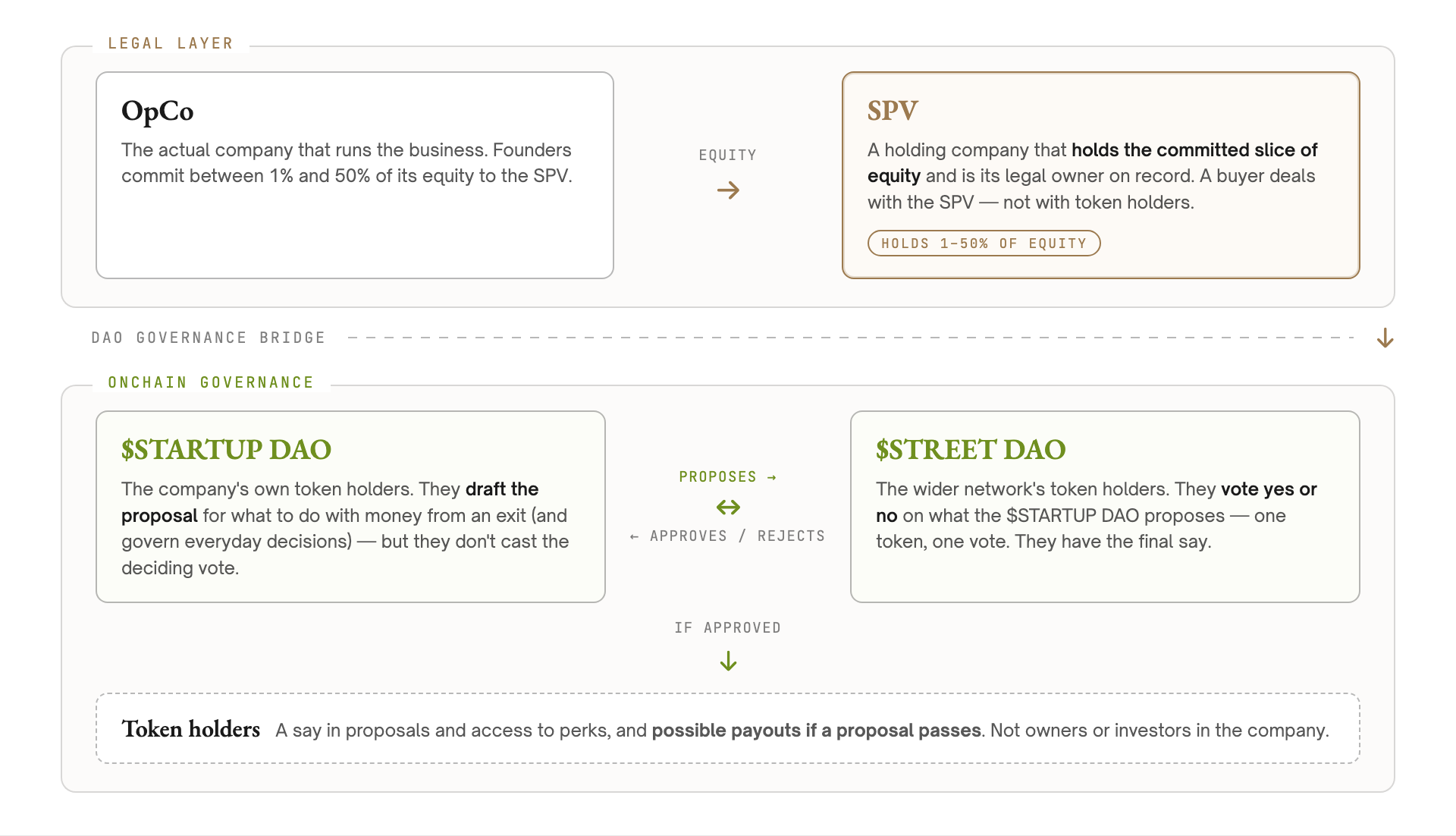
Street gives startup founders a launchpad to open a market for their company, and a new token standard underneath it called ERC-S. Together they take a different approach from others in the ownership coin space.
Instead of a token representing equity in a company, Street keeps the company's shares in a separate holding company, an SPV, that legally owns them. The token acts as a governance and utility asset alongside the business. It doesn’t represent any legal ownership. If the SPV ever receives money, such as from an acquisition, token holders vote on what happens to it.
Launch Mechanics
Founders decide how much of the company to allocate to the SPV. They can commit up to 50% of their equity or start as small as 1%. As shown on the Street website, the amount of ownership corresponds with various levels of “web3 commitment / enablement”.
Street can be used by teams at all different stages; from pre-seed to series A+. It can also be used by founders with an existing token. The Street website mentions that token supply, holders and operations can all stay intact.
There are limited details on the exact sales mechanics for a new deal; including allocation, pricing, etc. These details are likely covered in project-specific deal rooms that investors with Street accounts are able to review ahead of participation. Deals are open to both accredited and unaccredited investors.
For individuals well-connected to founders, Street has a rewarding scout program. Any referral that leads to a successful launch will entitle the scout to a $20,000 payment plus a token allocation.
Why it Matters
The Street pitch is to let a founder open their company's first public market on their own terms, rather than leaving it to form somewhere they don't control, such as Polymarket or Kalshi. On its own that is not a major innovation because plenty of platforms can launch a token with a live price. The difference is what the token is, what happens to it when the company gets acquired or exits, and who Street is positioning for.
From what’s on their website, Street is taking a more founder-friendly approach. Founders don't have to hand control to the market, and Street absorbs the regulatory filings and disclosures itself, claiming both regulatory and institution-readiness.
That combination is aimed at a particular kind of investor. One who wants a more iron-clad structure but also exposure to a project's upside, while still keeping the liquidity of a tradable token.
Street teased its next launch at the beginning of May, which is currently an unnamed peptides company. The Street team mentioned it will be "stealth at a fair reasonable price for everyone to be able to participate and without prior unaccredited or public capital raising."
Peptides have become one of the most widely discussed topics in recent months driven by social media narratives, longevity trends and even political debate. The launch of a tokenized peptide startup into the peptide macro backdrop should make for an interesting sale, and one we are sure to follow.
What Happened
GnosisDAO holds a treasury worth about $220M. A community member named Wismerhill, of the “RFV Raiders”, proposed GIP-150. The proposal would let any GNO holder hand back their token and take their fair share of the treasury in cash. Any tokens sent back would be burned. It was estimated that the treasury was worth ~$170 per GNO, while the token was trading at about $130. In other words, the market was pricing GNO well below what the DAO actually held.
The proposal was tested in two ways at once. A binding Snapshot vote would decide whether it actually happened. Alongside it, Futarchy.fi ran an “advisory” decision market asking holders whether the proposal would be good or bad for GNO holders. The Snapshot vote was resolved on May 12 at ~28% Yes and 72% No. It failed.
Transparency Without an Exit
Reporting a treasury's value, its NAV, is useful. It helps holders analyze relative over or under valuation, whether the treasury is growing, and how projects compare. But for protection, it is only valuable to holders if they have some way to claim that value when the market consistently underprices the token relative to NAV. Otherwise, it is just information. GIP-150 was an attempt to turn a reported number into an enforceable right.
The Case for Pro-Rata Redemptions Over Buybacks
In the past, in the broader ownership coin ecosystem, we have seen examples of full treasury redemptions/liquidations and buybacks to close the gap between spot price and NAV. Wismerhill made a good argument for why pro-rata redemptions are a better alternative to buybacks. Some of the key points we wanted to surface for the broader ownership coin ecosystem to consider:
- Buybacks need a liquid market while redemption doesn't - A buyback has to go through the open market. If trading is thin, buying a meaningful amount pushes the price up against itself and hands value to whoever is selling. Redemption skips this and just distributes the assets. Think of it as the difference between propping up the price and cashing people out directly.
- Buybacks aren't fair to everyone while redemption is - A buyback only helps whoever sells at the right moment. Redemption gives every holder the same right to take their share, at the same value, when they choose.
- Redemption is good for the people who stay - Since it's not a full liquidation, those who want out get their share now. Those who believe in the project keep their tokens. And because the proposal called for redeemed tokens to be burned, those who remain end up with relatively more ownership.
Who Owns What?
Most of the treasury is easy to identify and use for redemption as it's clearly reported on a Gnosis dashboard. But Gnosis also has an operating company with assets and illiquid investments which are harder to account for and sell.
This is an exact case study that is relevant for our work at 01Resolved, because it forces a question that's hard to answer without proper accounting: who decides what belongs to the DAO versus the operating company, and how is it valued? A redemption mechanism is trustworthy if the books behind it are.
Why the Vote Failed and What it Revealed
There was controversy surrounding who voted no for the proposal. Community sleuths discovered the largest no vote was linked to a Gnosis cofounder. Their vote represented ~32% of all voting power. Wismerhill showed that without leadership's tokens, the vote would have flipped to roughly 78% in favor of the proposal passing.
This is a weakness of token voting. One large holder can decide the outcome without putting their capital on the line. With a decision market determining the outcome, instead of Snapshot, the proposal may have gone a different way.
Where the Decision Market Fell Short
In parallel with the Snapshot vote, Futarchy.fi ran an “advisory” decision market pricing GNO conditional on the proposal passing or failing. It surfaces the financial reporting problems we mentioned in the call.
Valuing the liquid part of the treasury is easy if everything is tracked properly, it is all onchain, and publicly visible in a dashboard. The illiquid, offchain assets part of the claim are the harder part. If it is hard for traders to price these assets with high confidence, the decision market leans on the easy part and discounts the rest.
The takeaway for ownership coins using decision markets is that the market can only price what someone can value. The NAV accounting that makes a treasury legible is not easy, but matters for market integrity.
Other Spotlight
Most prediction markets do one thing. They let people bet on whether something will happen. Ride Markets goes a step further and lets a market actually decide whether and how a fund spends its money.
Ride Markets: How It Works
Mechanism Primer
Someone - a caller - proposes a trade, like "SOL hits $125 in 24 hours." To open the market, the caller posts a bond. That bond is skin in the game, so you don't get to make a call for free.
Everyone else then backs YES or NO with real money. When the deadline hits, two separate things settle at once. First, in the betting pool, the winning side splits the loser side, with early backers paid more for taking the risk before the answer was obvious, and a small cut (1%) is for the fund’s treasury. Second, if the fund actually placed the trade and it made money, that gets split as well. 30% goes to the caller, 70% is kept in the fund.
Why This Is Different
Decision markets usually ask if a proposal will increase or decrease the value of a token. Ride asks whether a trade is good enough that a fund should put money behind it. Crypto is full of public trade calls from people who are loud, vague, and selective about what they remember. Ride puts a price on them.
Where it Can Go
Having placed a few winning trades on Ride ourselves, we find it a fun place to express conviction. But beyond setting up and settling the trades, there is a wider design space. In the future DAOs, or any pooled fund, could in principle let markets weigh in on where money goes, rewarding the people who are consistently right and sidelining the ones who aren't. The opposite is also possible - bad decisions can be blocked. Exceptional callers in either direction are building their public record on the Ride leaderboard in real time. At some point, that could become a signal for who gets trusted with larger scale capital - and who knows, if our calls continue paying off we may be part of it.
Signal vs. Noise
$META hit Kucoin and Coinbase. Tier-1 exchanges are now listing an ownership coin and it's likely we see subsequent ownership coin exchange listings which broaden distribution in the months ahead.
MetaDAO co-founder Kollan teased screenshots of “curated” launches on X. It looks as though a sponsor model will allow entities to cosign raises. Colosseum was teased, which also has a recognized name and established pipeline of new projects.
While sentiment has been positive in the ownership space. Most project recaps/updates are positive but lacking numbers - active users, revenues, etc. The developments are great and should be one part of the story, but the story should also be told through numbers.
Around the Space
Reading & Listening Worth Your Time
Papers, podcasts, and posts, worth reading this month.
↗ Toly on Using Futarchy to Bootstrap a Fair Token Launch
A working Solana program that uses MetaDAO's decision markets to distribute a token's initial supply. To vote on where the tokens go, you put real capital at risk. There is no yield or rewards. The capital is purely the cost of the vote, which is what keeps it Sybil-resistant. Withdraw any time, but you forfeit your vote.
Do you want a whole single grape or a slice of the watermelon? The perfect way to bootstrap a network should offer every participant a slice of the watermelon, so they chose to participate in network as apposed to trying to build their own thing. You must have minimal rent…
— toly 🇺🇸 (@toly) May 29, 2026
↗ AGI and Decision Markets are What Matter in 2026
Proph3t argues that powerful new technologies consistently break existing institutions before better ones emerge, and AGI could make that catastrophic. He argues that decision markets can replace appointed decision makers and voting with market based incentives to find the best outcome. MetaDAO's bet is to build organizations native to that model instead of retrofitting existing ones.
— Proph3t (@metaproph3t) May 29, 2026
↗ Decision Markets and Onchain Capital Formation
MetaDAO's Proph3t sits down with The Index to breakdown how decision markets are changing the way projects launch tokens, manage treasuries, and why onchain capital formation may look very different from traditional VC.
Solana fundraising is evolving.@afkehaya sits down with @metaproph3t of @MetaDAOProject to explore decision markets, token launches, treasury oversight, and why onchain capital formation may look very different from traditional VC.
— The Index Podcast (@theindexshow) May 5, 2026
Watch on The Index Podcast 🎙️ pic.twitter.com/9kUYwBsFhD
↗ Ownership Podcast S1 E8: Arad (Lightcone)
Arad from Lightcone shares why a lack of information causes decision markets to fail, how to think about impact markets, and why the oracle problem isn't really an oracle problem.
Ownership Podcast S1 E8: Arad (Lightcone)
— Ownership (@ownershipfm) May 25, 2026
"The Pioneer of Impact Markets"
00:00 - Intro
02:44 - Internet-Native Governance
05:45 - Polymarket and the Futarchy Moment
08:47 - When Futarchy Fails
13:35 - What is @lightconexyz?
20:05 - The Two Universes Model
22:40 - The Oracle… pic.twitter.com/M2K7xTH6pb
↗ Ownership Radio Ep. 13
Mango shares his thoughts on Zinc Cash’s mainnet launch, Paystream discusses the restructure proposal and what comes next, Fraudsworth and Umia Finance round out the conversation.
Ownership Radio #13. Sunday. 3PM UTC.
— Ownership (@ownershipfm) May 29, 2026
Four builders. Four different corners of the ecosystem. One stage.
> @mango_ from @zinc_cash, fresh off Zinc's mainnet launch
> @Paystreamlabs joins us to discuss the latest proposal and what comes next
> @MetalLegBob from @fraudsworth… pic.twitter.com/CKhjisFeJU
By the Numbers
Value
(Adjusted Supply)
to NAV