

On July 21, MetaDAO assigned Ownership Scores to more than 115,000 wallets. The score received its first live test in the Rip Cars ICO, which closed with $31.97 million committed against a $250,000 minimum. This post breaks down the full dataset, what it reveals, how the score played out during the raise, and what participants did with their tokens in the first 24 hours of trading.
Why Ownership Score Exists
Teams want a tokenholder base whose behavior signals long term alignment from day one. The Ownership Score is MetaDAO’s attempt to identify and reward that alignment.
Each day, the dollar value of a wallet’s ownership coin holdings is added to its score, while its existing score decays by 1%. This prevents wallets from preserving a score indefinitely without continuing to hold. The calculation also applies different weights to MetaDAO ecosystem coins. META currently has a 25% weight, while the weights assigned to other tokens may change over time.
The mechanics were published July 20, but the score captures holdings from prior months. Everyone on this leaderboard earned their rank before knowing it existed.
Up to 50% of the Rip Cars raise was allocated by ownership score.
Ownership Score Dataset Findings
Below are some findings from the Ownership Score dataset.
Score Distribution
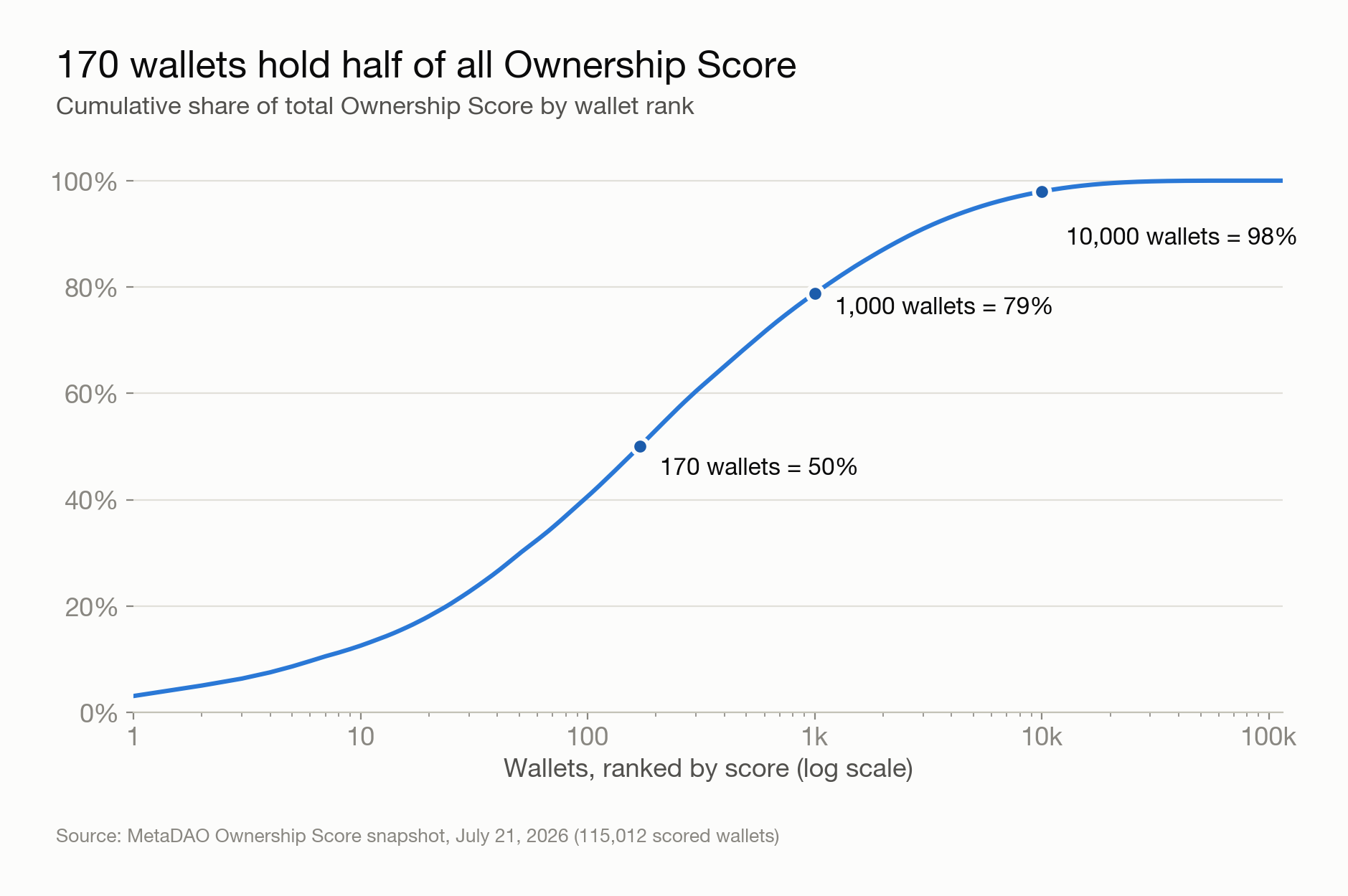
170 wallets (0.15%) hold 50% of all points, while the top 1,000 hold 78.8%. The median wallet has 24 points; rank one has 133.4 million. This concentration of points to a small percentage of wallets is typical of any wealth linked score. The open question is whether that's a good or bad thing for the allocation set aside for Ownership Score holders. A concentrated allocation is a problem if the big wallets flip and a feature if they hold the majority. Rip Cars gives us the first look (more below).
Portfolio Effect
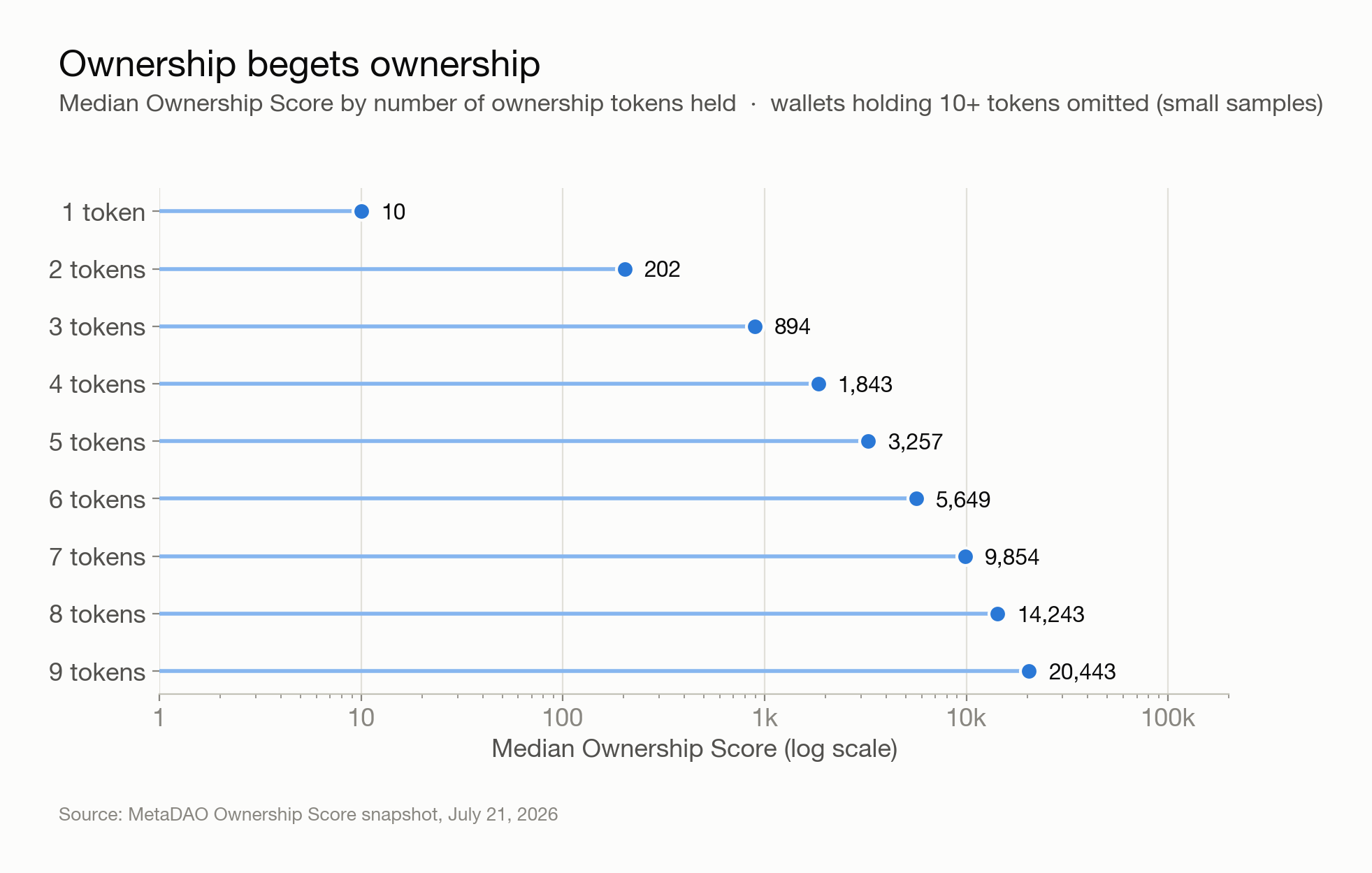
21% of wallets hold two or more ownership tokens, and median score scales with breadth: one token, 10 points; two tokens, 202; five tokens, 3,257; nine tokens, 20,443.
What It Takes to Rank
Ranking in the top 10,000 ownership score wallets requires about 14,700 points, equivalent to roughly $150 of fully weighted ownership tokens held steadily for a year. The top 1,000 wallet needs about 559,000 points, equivalent to $5,700 held the same way, and the top 100 about 7.35 million points, or $75,000. Because META receives only 25% weight, the required META holdings would be larger.
The Rip Cars Test
The Rip Cars ICO closed with ~$32M committed from 723 wallets. This is a 128x oversubscription against its minimum target. Four findings stand out as it relates to the Rip Cars ICO and Ownership Score overlap.
1. The overlap looks big until you weigh it - 506 of the 723 contributors (70%) carry some Ownership Score. They committed $24.7M (77% of the raise); the other 217 wallets committed $7.3M. Only 42 wallets that participated brought more than 1M points. The wallets in this raise collectively held just 7.6% of all Ownership Score in existence.
2. The top scorers mostly didn’t participate - Of the top 100 scored wallets, 14 participated. Of the top 1,000, 53 participated.
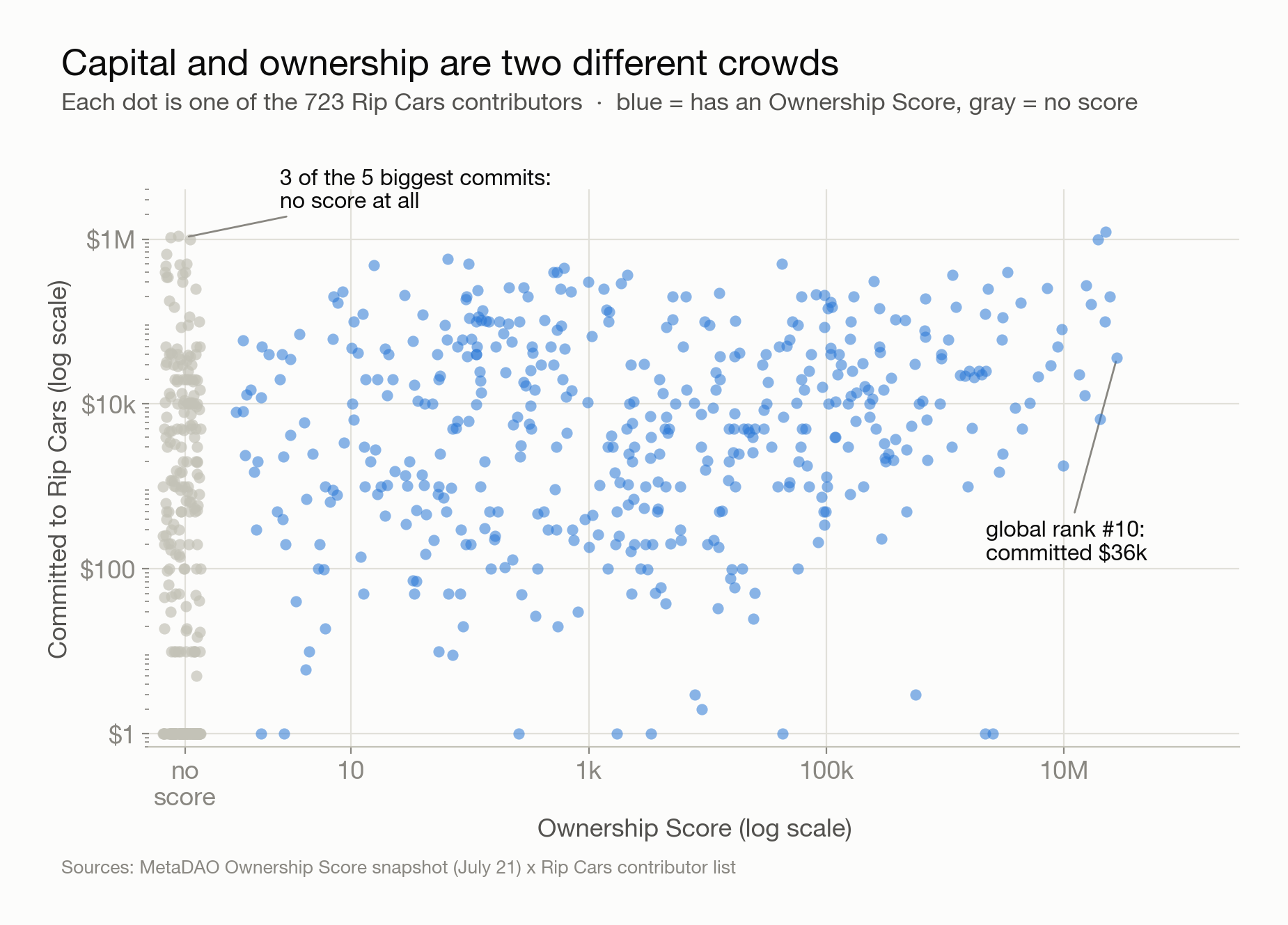
3. Capital and Ownership Score are two different crowds - 3 of the 5 largest commitments ($1.1M, $1.05M, $1M) came from wallets with no Ownership Score at all, and 3 more of the top 10 committers carried scores under 100 points. The highest scored participant (rank 10 globally, 27.8 million points) committed $36,233.
4. Newcomers - 276 wallets (38%) were first time backers, committing $8.1M (25% of the raise). All 217 unscored wallets were newcomers, but 59 newcomers arrived already scored, having bought and held ownership coins without ever participating in a raise. Some community members framed newcomer friction as the score's biggest flaw. Based on this evidence the door to newcomers was kept open.
The First 24 Hours: Do the Holders Hold?
CARS became claimable at launch on July 25, and 722 of the 723 participant wallets claimed their allocation. Priced at $0.025 in the ICO, the token reached about $0.0635, about 2.5x, on the first day before settling near $0.045. That is exactly the setup that makes ICO flipping attractive. We pulled the transaction history of participant wallets for the first 24 hours.
CARS allocated to the ICO was distributed in two ways; half for ownership score holders, and half for everyone else. Wallets that received the allocation via ownership score still hold about 63% of what they received, while other wallets only hold about 18%.
Of the participants in @ripcarsio's fundraise:
— Proph3t (@metaproph3t) July 27, 2026
- Wallets who got an allocation because of their ownership score hold 63% of the tokens they received
- Other wallets hold 18% of the tokens they received pic.twitter.com/uVto4tVWgI
Looked at it in a different way, 56% of scored wallets sold something on the first day, compared to 29% of unscored wallets. That sounds backwards, but it isn't (more on this below). When looking at the number of tokens sold, both cohorts sold ~42%. Note that the median contribution for unscored wallets was quite small ($46 vs $6,451 for scored).
An interesting signal emerges once you split our scored wallets into quartiles.
Quartiles 1, 2, and 3 dumped +60% of their allocation within a day, and 76% of the lowest quartile exited entirely. The top quartile saw only 26% of tokens sold and 50% of wallets exit.
So far it looks as though there is evidence the ownership score routed tokens to the wallets less likely to dump them on day one.
Some Caveats
- After the snapshot, reports surfaced on X of individual scores being incorrect.
- Tokens can be transferred to different wallets but have the same owner.
- Rip Cars is the only Ownership Score raise so far, and MetaDAO has said the formula may change.
- The selling analysis covers the first 24 hours of trading only.
Final Thoughts
The Ownership Score experiment produced a twist. The retroactive design rewarded conviction, since nobody knew the score existed while they were earning it. Newcomers showed up, but many of the people the score was designed to reward did not participate. In fact, two thirds of the Rip Cars ICO capital came from wallets with little or no history of holding ownership coins.
Does that mean the score failed? The first 24 hours of trading suggests otherwise. The tokens the score allocated largely haven’t moved (those who received 5M CARS via Ownership Score are still holding 63% of what was received, compared to 18% in the other cohort). The breakdown of holding activity by total score tells a similar story. The highest scoring quartile only sold about a quarter of their tokens, while the lowest quartiles sold most of their holdings.
The Ownership Score remains a crude measure of a “good tokenholder”, and just having a score means little. But used to weight an allocation, this raise suggests it beats allocating without it.
Several changes could be tested, although each would involve tradeoffs:
- Wallets that fully cash out lose their score faster.
- Use time weighted average prices instead of spot prices.
As far as we know, MetaDAO hasn't committed to anything past this raise. If the score sticks around, the interesting question that arises is whether every raise uses it, or does each team choose?
What We'll Be Watching
A few things we plan to track:
- Do the holders keep holding? We will rerun the same analysis at 1 week and 1 month to track retention.
- Ownership Score mechanism changes.