

A wallet accumulated 500K UMBRA, opened a proposal seeking roughly 62% of Umbra's Total NAV. The proposal failed but what is notable was that it only cost the attacker $4,623. A small amount in contrast to the potential gain. In this article we deep dive into the decision market and offer some solutions for how malicious proposals can become more difficult to act on.
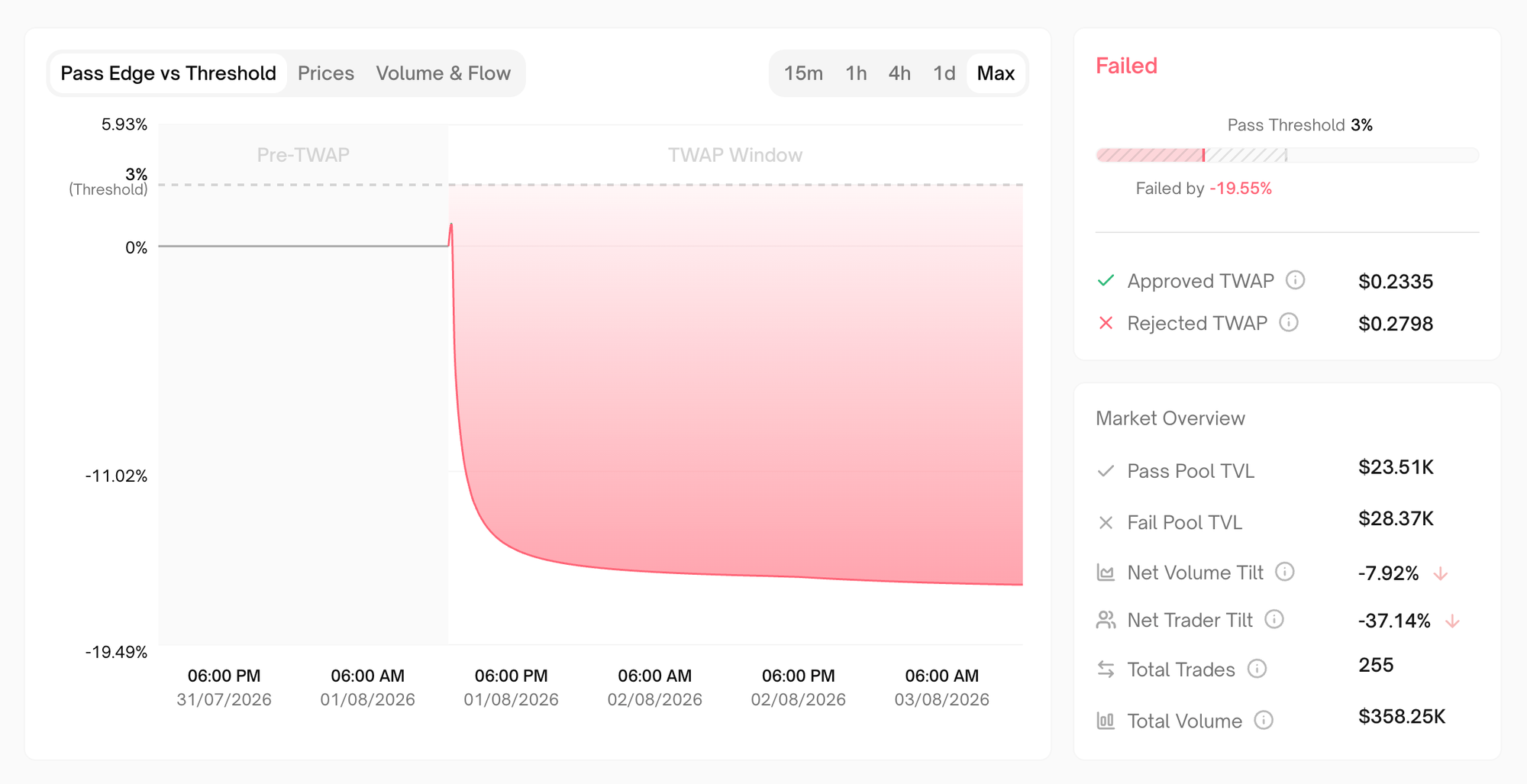
A proposal to move $1.5M, roughly 62% of Umbra’s treasury at the time, out of the DAO’s control has failed. The Pass TWAP settled at $0.2335 against a Fail TWAP of $0.2798, a spread of -16.56% against a +3.00% pass threshold, resulting in the proposal failing by 19.55%.
The Numbers
$358.26K in total volume moved through the market across 255 trades from 20 unique wallets. Pass-aligned volume was ~46% against ~54% fail-aligned, a split that suggests a contested market.
Roughly 27% of total volume traded in the pre-TWAP window, leaving 73% in the TWAP window. The attacker positioned early, but was met with strong opposition as soon as the TWAP window opened.
The Wallet That Opened the Proposal
Trader EJGW…Uvaxs first appeared onchain on July 27th, four days before the proposal opened, with no prior history and no activity after the decision market was resolved. The wallet was funded entirely through deBridge, receiving ~322 SOL and $124.33K USDC. The source was $148.93K of USDC sent from two Base wallets.
The trader then accumulated UMBRA through the MetaDAO FutarchyAMM between July 27 and 31. They bought ~509K UMBRA for $143.07K, then sold 8.69K UMBRA back for $2.72K, trimming the position to exactly the 500K required to open a proposal, at a realised average price of $0.2807.
The accumulation also moved the token price, from $0.2439 on the first purchase to $0.3292 on the last.
On July 31, the wallet executed the proposal, by staking the 500K UMBRA. Seconds later, the wallet recovered the staked position.
The same tokens that were used to meet the staking requirement were deployed into decision market trades a few hours later.
The Structure of the Attack
A single wallet drove much of the activity that attempted to pass the proposal. Here is a breakdown of their activity.
Trader EJGW…Uvaxs
- 46 trades (18.04% of total trades)
- $139.74K volume (39.01% of total volume)
- $4.00K pass-buy
- $135.74K fail-sell
- Ended with ~$139.73K of pass aligned exposure
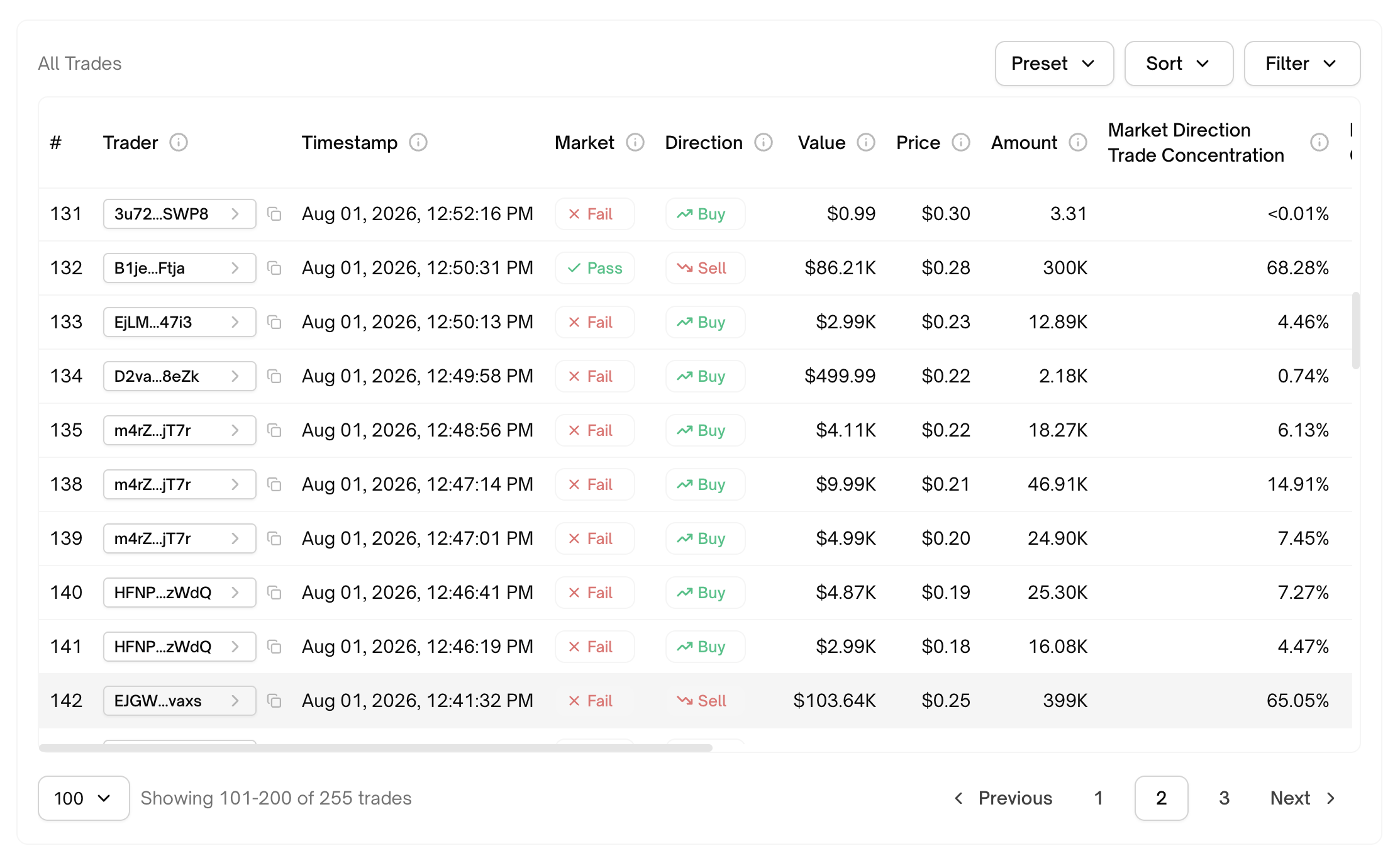
The pass-buys began minutes after the wallet created the proposal. There were 40 trades placed, each exactly $100, roughly a minute apart.
The 500K UMBRA went into the fail-sell market across four trades; 1K, 75K, 25K, and finally 399K.
The largest sale landed nine minutes into the TWAP window on August 1, placing the pass market at $0.2923 and the fail market at $0.2599 creating a spread of 12.5% in favour of pass.
That position did not hold for long. Within fifteen minutes the pass market had fallen to $0.2459 and the fail market had recovered to $0.2958. The spread in favor of failure remained through to resolution.
The Structure of the Defence
4 wallets carried the fail side, with $164.90K in net opposition between them.
Trader B1je…AFtja
- 1 trade (0.39% of total trades)
- $86.22K volume (24.07% of total volume)
- $86.22K Pass-Sell
- Ended with $86.22K of Fail exposure
Trader m4rZ…fjT7r
- 12 trades (4.71% of total trades)
- $41.89K volume (11.69% of total volume)
- $31.72K Fail-Buy
- $10.17K Pass-Sell
- Ended with $41.89K of Fail exposure
Trader exeC…gGAKn
- 51 trades (20.00% of total trades)
- $18.59K volume (5.19% of total volume)
- $11.93K Pass-Sell
- $6.66K Fail-Buy
- Ended with $18.59K of Fail exposure
Trader 7a1r…VeXZ7
- 2 trades (0.78% of total trades)
- $18.20K volume (5.08% of total volume)
- $15.00K Fail-Buy
- $3.20K Pass-Sell
- Ended with $18.20K of Fail exposure
While the attack was driven by a single wallet, the defence was distributed. A decisive trade came from trader B1je…AFtja who sold $86.22K of pass tokens at $0.2874 and the next pass trade printed at $0.2473, a 14% drop that inverted the spread within minutes of the TWAP window opening.
What the Attempt Cost and Demonstrates
During the decision market, the attacker sold $135.74K in the fail market. The position cost them $140.35K to assemble and returned $135.74K, a round trip loss of ~$4.62K. Had the proposal passed, they would have lost about $2,463 but taken $1.5M from the treasury.
That cost came from moving thin markets, which is also what pushed UMBRA spot down. The conditional pools held $52K between them, and what it costs to move prices is set by that depth.
Thankfully enough capital took the other side this time.
While it's the first malicious proposal we have covered, it may not be the last. What could be done to improve the mechanism against attacks going forward:
- A % of stake locked for the duration of the proposal
- A pass threshold that rises with the share of treasury requested or type of treasury action
- Deeper pools for certain proposal types