

Token-weighted voting powered the first era of onchain decision making, but as DAOs grow in scale and economic importance, its weaknesses have become impossible to ignore. This article breaks down why token voting fails token holders, how decision markets (futarchy) work as a replacement, and what rich market data from real proposals reveals about this emerging model. You will also learn how 01Resolved is building the intelligence layer that makes these signals legible.
The Problem with Token-Weighted Voting
Token-weighted voting is familiar, simple, and easy to deploy, which is why it is currently the most widely adopted model. But token voting rewards sentiment over accuracy. Because voting is costless, participants often vote based on personal preference, community pressure, or short-term price expectations. A longer-term viewpoint isn't always incorporated into these decisions and the challenges compound as DAOs scale.
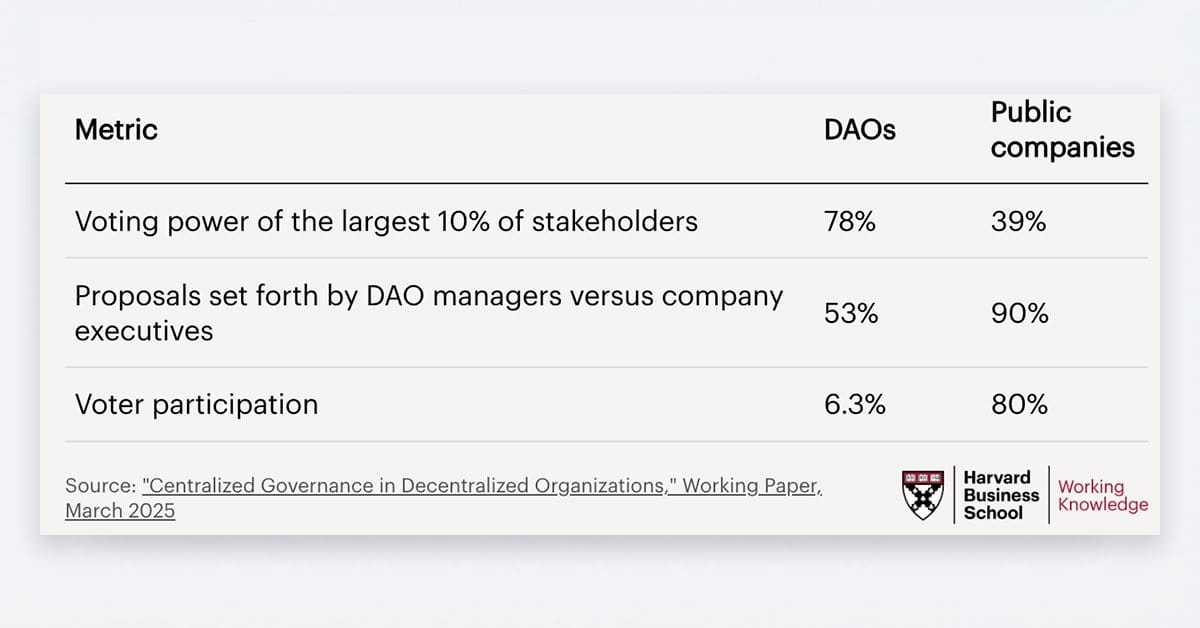
Low Participation, High Concentration
Many token holders know their vote won't swing outcomes, leading to low turnout and concentrated power amongst whales or delegates. A research paper by Harvard Business School found that governance decisions from popular DAOs can be dictated by a limited number of participants.
Manipulation Becomes Cheap
In token-weighted voting, bridged and borrowed tokens compounded by low participation becomes an attack vector. An example of this is from a 2024 Compound Finance DAO proposal which passed, allocating a whale and accomplices $24 million of $COMP to a yield-bearing protocol.
$24 million Compound Finance proposal passed by whale over DAO objections https://t.co/e1T4BIP8c2
— The Block (@TheBlockCo) July 28, 2024
Fragility in Mature Markets
Community trust and social cohesion help early-stage networks. But as ecosystems grow, speculation dilutes these defenses. Token-weighted voting vulnerabilities worsen over time.
Governance was intended to uphold token value through sufficient decentralization, but instead, the fate of the token was controlled by those with the deepest pockets.
A New Token Holder Protection Model
Traditional governance via token-weighted voting was supposed to give token holders a sense of ownership and control, but it fell short of achieving this. Thankfully a new model, realized by MetaDAO, has emerged with decision-markets ("futarchy").
Instead of micro-managing operations through governance, the team has operational and strategic autonomy, while decisions that affect the token and treasury (e.g. minting, spending, etc.) are protected by DAO.
Decision markets transform governance from symbolic voting into economically backed forecasting. Instead of asking "Which option do you prefer?" they ask: "Which outcome do you believe will maximize token price? And are you willing to back that belief with capital?"
How Decision Markets Work
For every DAO decision, there are two live markets and directions:
- Pass market: Buy or Sell the token if the proposal passes
- Fail market: Buy or Sell the token if the proposal fails
If Pass trades above a threshold, the proposal executes, and participants who chose Buy or Sell have those orders executed (and conversely if the proposal Fails). As such, decision markets function as token holder protection by way of market oversight. Price becomes the signal and aggregate belief the decision is more value accretive for the token.
Decision Markets in Practice: Two Real Proposals from MetaDAO
Proposal 1
The sentiment of "Engage in $6M OTC with DBA and Variant?" proposal showed participants favoring the Pass-sell market as indicated by this market-direction having the highest volume. The Pass-buy market direction had the most amount of participation, but ~$55k less volume.
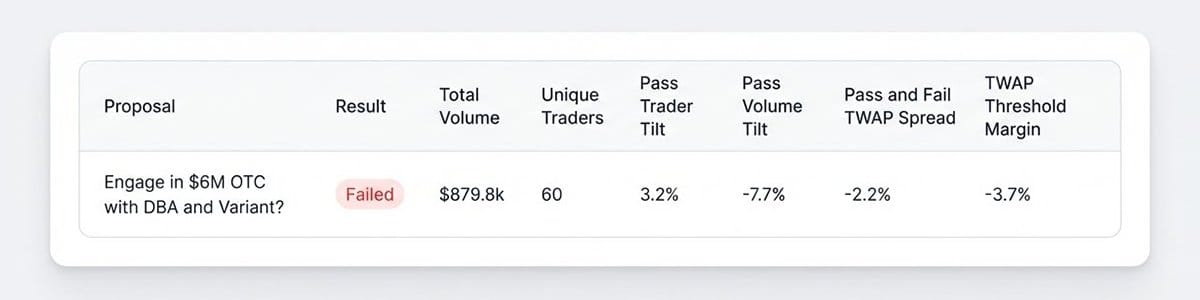
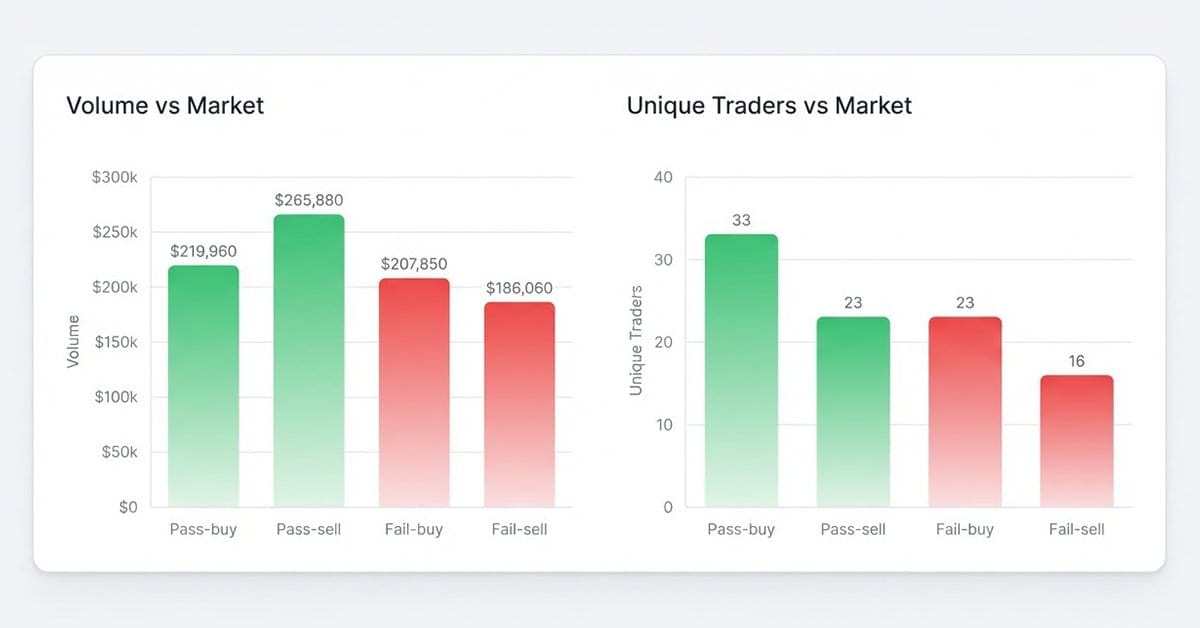
The market feedback was heard by rejecting the proposal and a new proposal was created with different terms that was approved (see below).
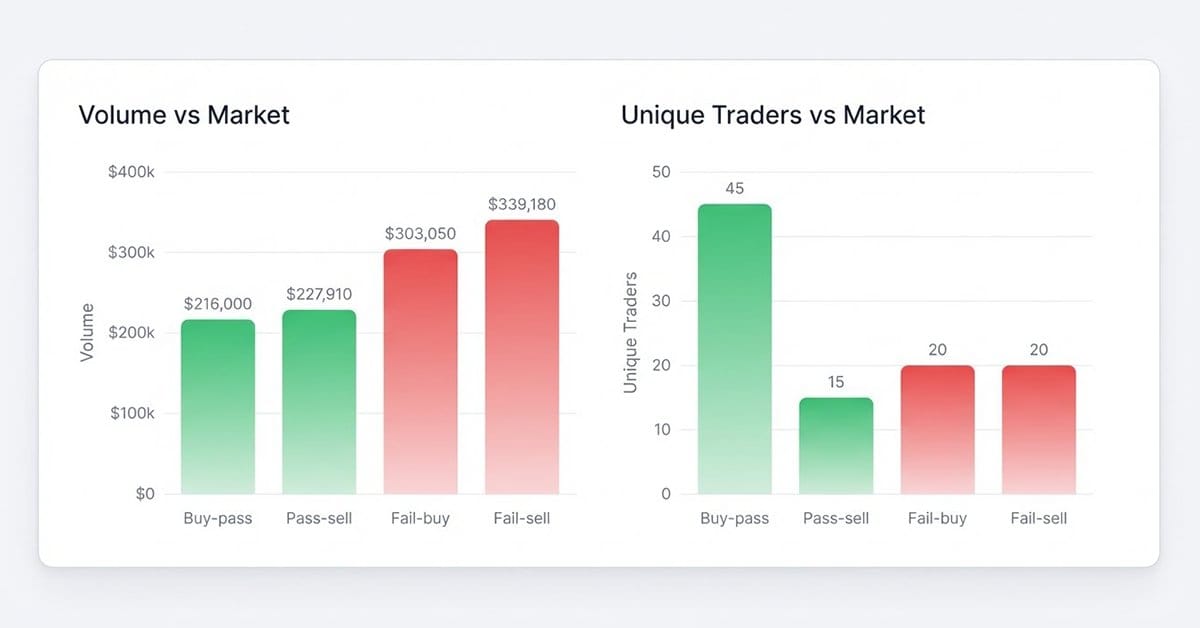
Proposal 2
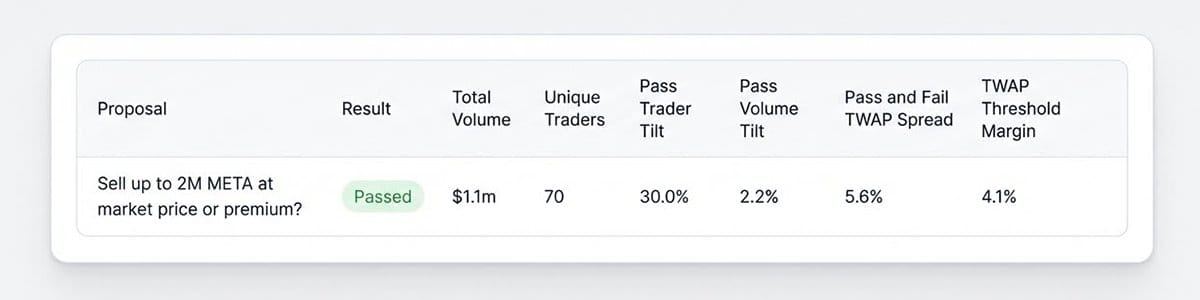
In the "Sell up to 2M META at market price or premium?", the outcome was driven by larger holders in the Fail-sell market-direction. In total 20 traders contributed ~$340k to this market. This signals existing holders wishing to either exit or reduce positions in the event of a rejected proposal.
The market-direction with the most participation was Buy-Pass which saw 45 trades contribute ~$215k worth of volume. This signals that either new holders want to establish a position or existing holders want to increase their position in the event of an approved proposal.
The outcome was by no means heavily one sided: the pass volume tilt was only 2.2% and TWAP Margin Threshold 4.1% indicating mixed conviction in the proposal.
As you can see from the decision markets there is rich market data that can be analyzed that extends beyond simply who used existing tokens to vote for what option.
Why Decision Markets Outperform Votes
Skin in the game produces better signals. In token voting, a whale can vote with zero research. In decision markets, every opinion is a trade with upside and downside. Traders compete to surface accurate information because accuracy pays.
Economic pressure defends against attacks. To manipulate a token vote, an attacker just needs tokens or access to borrowed ones. In decision markets, manipulation requires continually buying out honest traders at rising prices. In this case, truth is economically defended.
"As long as the market power of people willing to earn a profit by counteracting manipulation exceeds the market power of the manipulator, the honest participants will win and extract a large quantity of funds from the manipulator in the process." (An Introduction to Futarchy, posted by Vitalik Buterin on August 21, 2014)
Information beats capital. A trader with superior insight, even with small capital, can influence the market, profit from being right, and meaningfully shape outcomes. This rewards information over wealth concentration.
Scale improves accuracy. As ecosystems grow with more projects, proposals, and participants, decision markets increase in resolution and accuracy. More participants create more activity, which generates better signals.
Beyond Governance: A Truth Discovery Layer
Decision markets aren't simply a governance upgrade, they create an intelligence layer for onchain ecosystems. Thousands of Pass/Fail markets generate a dataset that has never existed before, becoming useful for rankings, trader reputation systems, and analytics.
Projects gain market signals about decisions, risk, and treasury allocations. Established projects adopting decision-markets can transition from governance to a truth engine. The entire system is more transparent for holders, founders, and analysts.
01Resolved is the intelligence layer for ownership coins and decision markets. It makes decision markets more efficient by empowering traders with the information to make their position clear.
Much like prediction markets have proven to be a more accurate source of truth for real-world events, decision markets are emerging as a stronger mechanism for token-holder protection through continuous market oversight. Where token-weighted voting fails to protect holders, decision markets generate verifiable, high-resolution signals about what the market believes will actually drive token value. 01Resolved makes these signals legible, highlighting conviction, tracking behavior over time, and revealing patterns that reflect organizational health and alignment.
By providing participants with access to information, 01Resolved separates signal from noise in the next generation of onchain organizations.
Conclusion
Token-weighted voting was designed to give holders ownership and control, but concentrated power, low participation, and cheap manipulation have undermined that promise. Decision markets replace symbolic voting with economically backed forecasting, where accuracy is rewarded and manipulation is costly. The rich market data produced by Pass/Fail markets creates a truth discovery layer that scales with ecosystem growth. 01Resolved is built to make those signals accessible to every participant.