

Two team-sponsored proposals just passed easily from the MetaDAO ecosystem: Solomon’s DP-00002 and Omnipair’s OMFG-004.
What stands out is not just that they passed. It is when the market did its work.
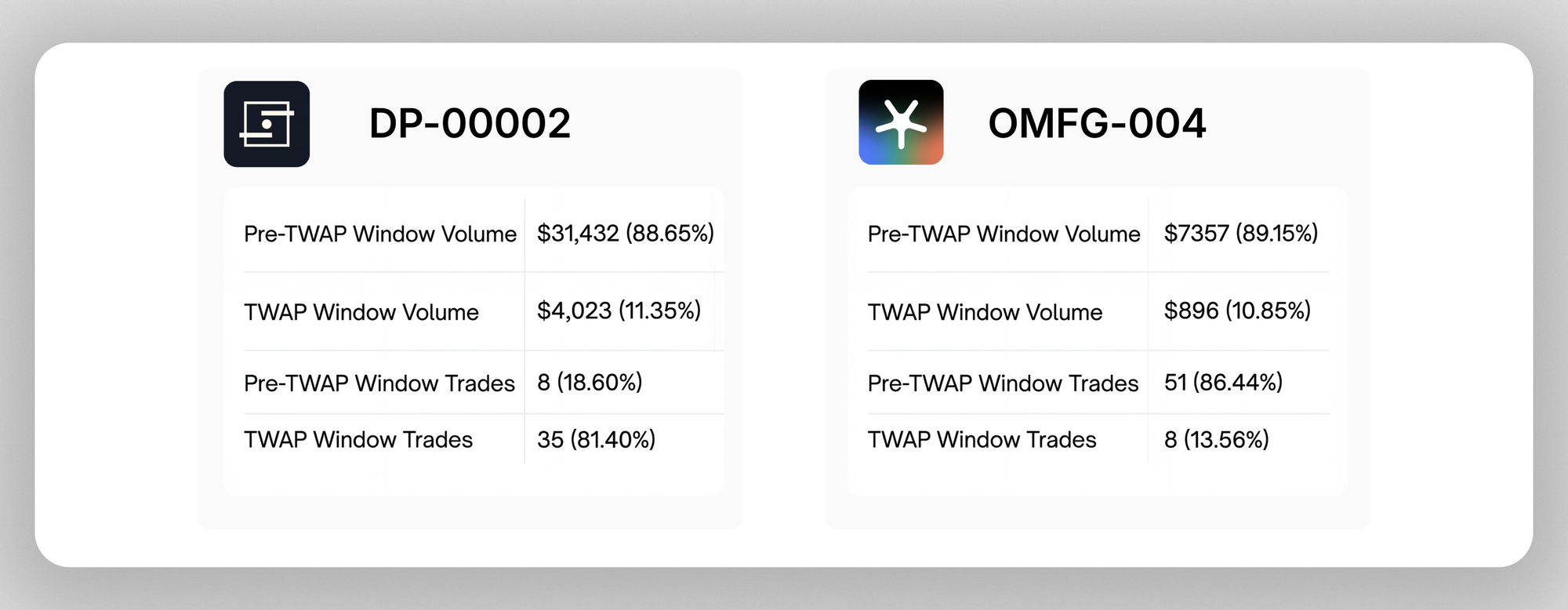
Across both proposals, 88.75% of total volume hit in Pre-TWAP. This left 11.25% of volume during the TWAP window, the period of time that determines the outcome.
That does not mean Pre-TWAP decided the outcome directly, but in uncontentious decision markets, early flow can still shape the outcome by widening conditional market prices before TWAP begins.
In the case of Solomon’s DP-00002 and Omnipair’s OMFG-004, early volume flow in both markets leaned strongly toward pass.
The Numbers
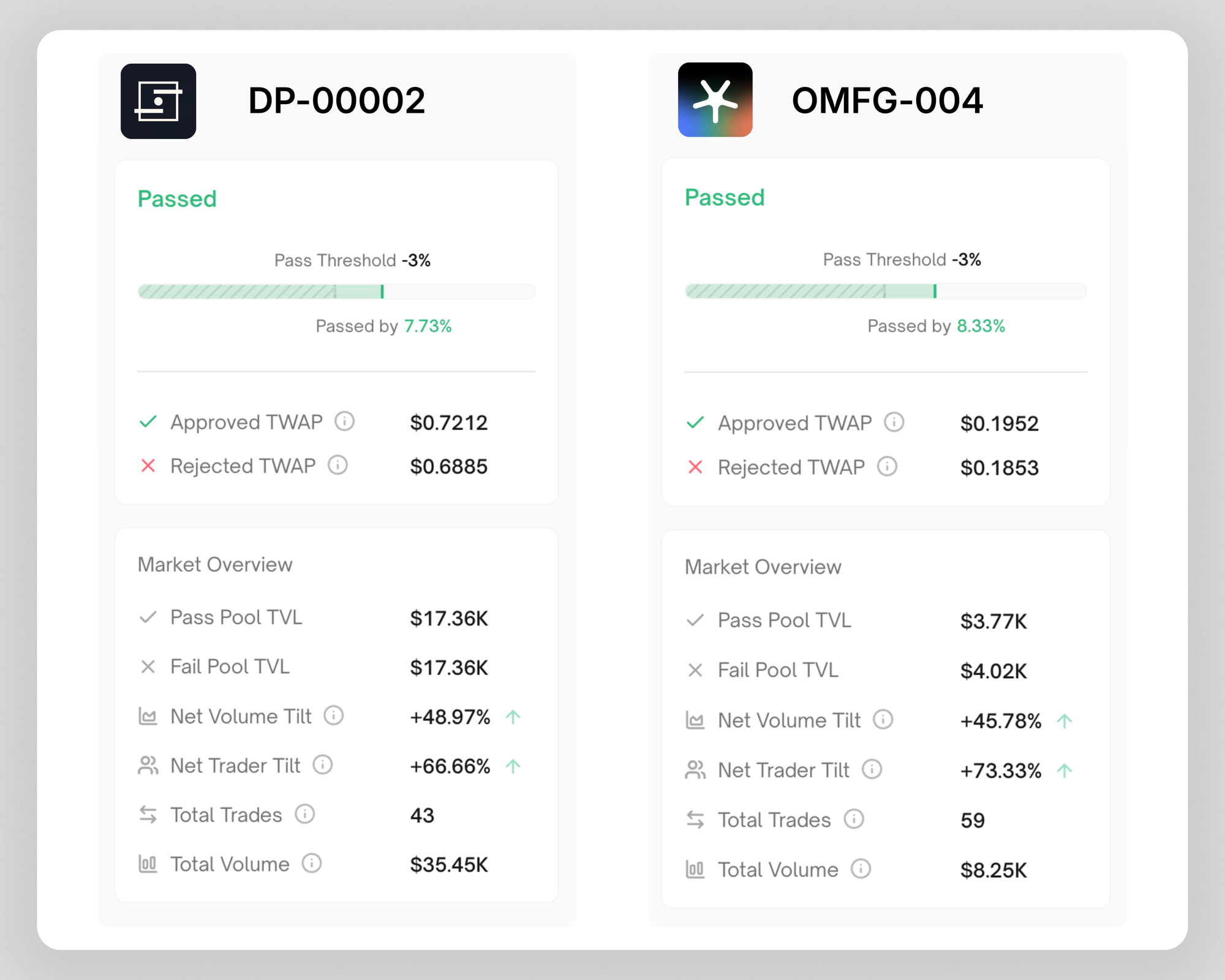
The two proposals cleared the -3% TWAP pass threshold by wide margins: 8.34% for OMFG-004 and 7.75% for DP-00002. Neither outcome was close.
Even though the volume was nearly identical, the trade structure was not. The participation gap between the two decision markets is stark: OMFG-004 had 11 unique traders. DP-00002 had 4.
OMFG-004 saw 51 trades averaging ~$144 each during Pre-TWAP, while DP-00002 saw just 8 trades averaging ~$3,929 each.
At first glance, this suggests different participation profiles, but a closer look at the trades show a more consistent pattern. A single wallet appears repeatedly across both markets: trader AWjCyS...y1SC5.
In OMFG-004, this wallet executed dozens of tightly clustered trades around ~$100 each, often within the same minute. In DP-00002, the same wallet entered early with several large trades before shifting into smaller, repeated executions during the TWAP window.
This behavior is consistent with programmatic trading rather than conventional traders expressing directional conviction.
Different surface level structures. Same underlying participant.
The Wallets That Mattered
Three wallets appeared across both proposals. Their behavior tells most of the story.
Trader 3tbPup...iDUH7 placed the largest single trade in both markets: a $14,241.60 fail-sell in DP-00002 and a $1,673.47 fail-sell in OMFG-004. Both were early Pre-TWAP entries, both fail-sells, both executed before any other meaningful activity had arrived. In DP-00002, this single trade accounted for roughly 40% of total proposal volume. This wallet entered early in both markets with large, pass-aligned positioning, contributing significantly to initial price formation.
Trader AWjCyS...y1SC5 was the most active wallet by trade count across both proposals, accounting for 40 of 59 trades in OMFG-004 and 39 of 43 in DP-00002. In OMFG-004, it placed 20 pass-sells and 20 fail-sells with values clustering around $95 to $103 each, netting out to a near-neutral position (just $98 net fail-aligned). In DP-00002, it ran a similar pattern but with a larger Pre-TWAP entry: five trades totaling $17,103 before shifting to 34 small sells during TWAP at ~$98 each. The cadence, sizing, and paired pass-sell/fail-sell execution are consistent with an arbitrage operator. Strip out this wallet’s activity and the 51 Pre-TWAP trades in OMFG-004 compress to roughly 17 independent trades, and DP-00002 drops from 43 trades to just 4.
Trader Cj1jSc...t9jNc appeared in both proposals with small but consistently pass-aligned positioning: a fail-sell paired with a pass-buy in each market ($95.26 total in OMFG-004, $87.93 in DP-00002). Notably, this wallet placed the only pass-buy in DP-00002. Minor in volume, but directionally unambiguous.
Beyond the cross-proposal wallets, several others stood out in individual markets.
Trader Eztko4...F2wSK placed two pass-buys in OMFG-004 totaling $1,715.50, making it the second largest pass-aligned wallet in that proposal.
Trader DkM6Yc...3wiVK placed a $684.69 fail-sell during DP-00002’s TWAP window, the only meaningful non-AWjCyS trade during that period and pass-aligned.
And trader GMY1E3...Z2NRq placed the only meaningful late TWAP trade in OMFG-004: a $209 pass-sell in the final 2 hours, fail-aligned but too late and too small to materially impact the outcome.
Taken together, these wallets show that early price formation was driven by a small number of participants, with one systematic trader dominating execution and others reinforcing direction without meaningful opposition.
No One Bet on Fail
Neither market saw a single fail-buy across the entire proposal lifecycle.
That means there was no direct capital expressing conviction that either proposal should fail. Without fail-buy pressure, there was effectively no price discovery on the downside. The market was not testing whether these proposals should fail. It was only expressing how confidently they would pass.
Most of the “fail” activity was actually fail-sell, which is economically pass-aligned. In both proposals, a large share of Pre-TWAP volume came from fail-sell activity, especially in DP-00002, where fail volume represented 74.32% of total volume. Traders were expressing pass conviction by exiting exposure if rejected rather than buying spot if approved.
The net pass volume tilt landed at 45.79% for OMFG-004 and 48.98% for DP-00002, both comfortably directional despite the vastly different scale of each market.
The Final 24 Hours
The final 24 hours make the story even clearer.
OMFG-004 saw just $309 of volume in the final 24h. DP-00002 saw $0.
By then, the market was not debating. It was done.
For context, the recent Liquidate Ranger Finance proposal saw $693.44K across 246 trades from 60 unique traders. These two markets combined barely cleared $43.7k. That gap is the signal. When proposals are well-structured and uncontested, markets do not need to debate them. Low volume here meant fast consensus, not a fragile one.
Pre-TWAP Shapes What TWAP Inherits
That points to an important dynamic in decision markets: Pre-TWAP does not finalize the outcome, but it can still matter a lot.
If pass-aligned traders push the fail price down before TWAP starts, opposition becomes increasingly capital-intensive. The cost of reversing an established position grows with every dollar of pass-aligned volume that lands early.
Pre-TWAP volume also acts as a signal. When traders see heavy pass-aligned positioning before the formal window even opens, the message is clear: capital is committed, conviction exists, and opposing this outcome means fighting an established position. That signal alone can deter marginal opposition.
The Takeaway
The lesson from these two proposals is not that TWAP was overwhelmed.
It is that for easy, team-sponsored proposals with little real resistance, the market may decide them early and never feel the need to revisit the question.
The TWAP window is where the outcome becomes official. But in both of these markets, it was not where the outcome was decided.