
Analysis, takes, and signals from the ownership coin frontier.
-
01
-
02
-
03
-
04
-
05
-
06
-
07
-
08
-
09
The Big Picture
"Ownership coins are still early. But at the Owners Meeting in San Francisco they felt less like an experiment and more like the beginnings of a new capital market."
July saw momentum build following MetaDAO’s inaugural Owners Meeting in San Francisco alongside successful raises from Laso Finance, Credible Finance, Rip Cars and Ordr. Discussions covered token launch timing, how investors underwrite ownership coins, strategies for trading decision markets, and the financial transparency ownership requires.
Another talking point was that tokens are best used to scale an existing business, but are not a substitute for finding product market fit. MetaDAO also generated approximately $245K in revenue, up 93% from June. The capital formation engine is clearly working, but what happens after the raise with project revenues is the next challenge - a topic we go deep on this month.
Laso regularly transferred revenue into its DAO treasury, P2P contributed 20% of its revenue in June, and Avici reported more than $500,000 in total revenue without contributions to date. Loyal was approved to move capital toward an autonomous vault, while MetaDAO 2.0 will use NAV to guide programmatic token purchases and sales.
These developments show that ownership coins are becoming real financial and operational systems, instead of just a legal framework. But one standard remains missing: how project revenue is treated. If revenue can remain outside the vehicle that tokenholders own, ownership still depends on trust. This month’s Call argues that project revenue should pass through the DAO treasury first, while teams remain authorized to withdraw and reinvest up to 100% of it.
The Call
Teams should be free to reinvest what they earn, but the revenue should belong to the DAO first.
100% of Project Revenue Should Flow Through the DAO Treasury
All revenue generated by ownership coin projects should be routed through the DAO treasury according to a published revenue transfer policy. For onchain businesses, those transfers should be automated whenever possible. Offchain or custodial businesses may instead require scheduled treasury sweeps with a clearly defined cadence. Any legal, tax, or operational constraints affecting those transfers should also be disclosed in the policy.
Routing 100% of revenue through the DAO treasury establishes that the value created by the business belongs to the DAO. This is not about restricting capital, slowing down teams, or prioritizing treasury preservation over growth. It is about making ownership legible by ensuring that dollars earned by the business pass through the vehicle tokenholders own.
A key benefit for teams is greater credibility, making their ownership coins easier for investors to evaluate. When revenue flows through the treasury under a published policy, value accrual becomes clear and observable.
When Ownership Depends on Trust
The ZKFG/Zinc situation illustrates why revenue routing is so important. ZKFG was funded through MetaDAO, and after several pivots, the team developed a revenue generating product called Zinc. Unfortunately, Zinc’s revenue was not routinely routed through the DAO treasury.
Without a clearly established revenue transfer policy, ZKFG holders began to question the operating team’s intent. The dispute ultimately led to a structured buyout of ZKFG’s IP, dissolving the original DAO structure and providing an exit for ZKFG holders. This outcome reinforces the importance of establishing an ownership coin’s claim on revenue from the beginning through a published policy instead of leaving it to informal commitments or team discretion.
A System Problem, Not a Team Problem
Revenue generating ownership coins have taken different approaches. P2P recently pledged to contribute 20% of its monthly revenue to the DAO treasury. Laso routes 100% of its revenue to the DAO treasury and has swept approximately $27.63K as of July 31, 2026. Avici’s DAO treasury, by contrast, has no revenue contributions to date despite its metrics dashboard reporting more than $500K in total revenue.
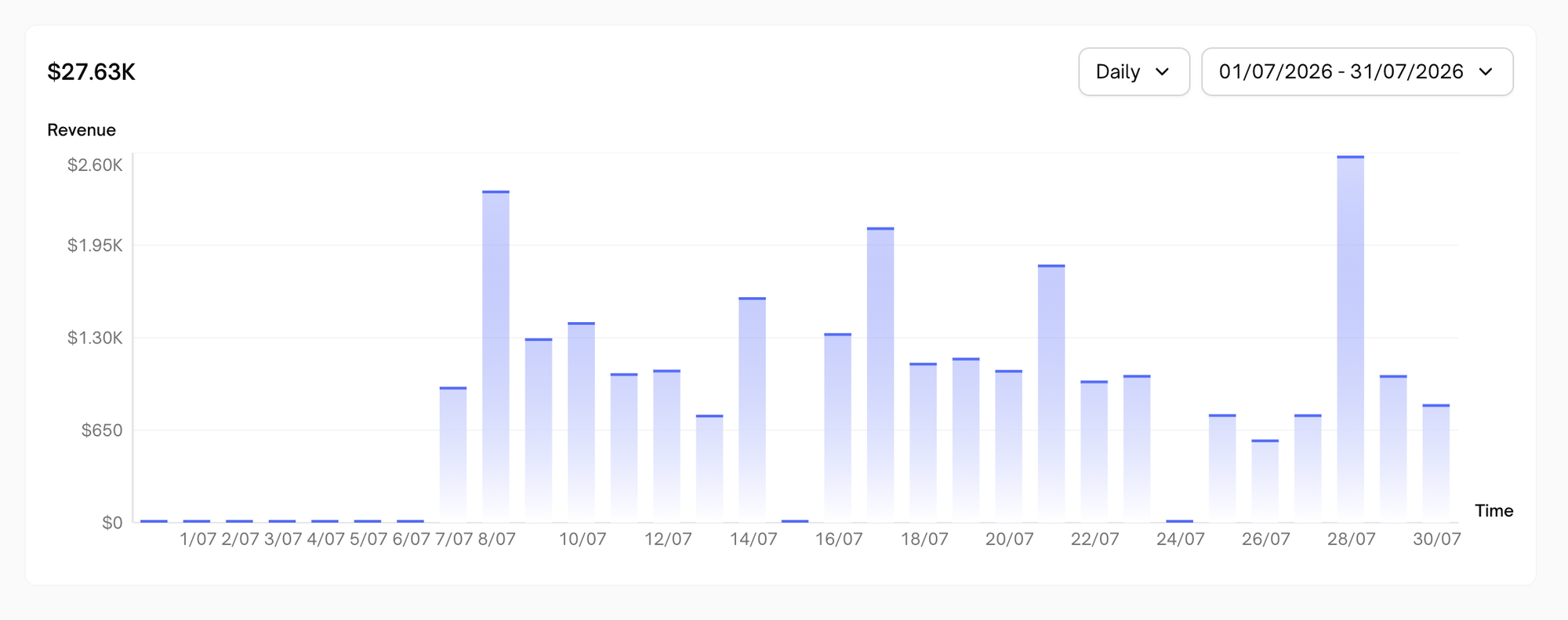
These differences reflect the absence of a shared revenue transfer standard rather than any wrongdoing by individual teams. A shared standard would require each project to publish a policy specifying how revenue is calculated, how it enters the DAO treasury, and on what cadence. A policy is best established early, as the process becomes more complex once revenue becomes meaningful and attracts greater scrutiny.
Combined with flexible revenue based withdrawals, a revenue routing standard would create a consistent framework. Teams would retain access to a predetermined percentage of the revenue they generate while establishing that all revenue belongs to the DAO first.
Balancing Growth and Value Accrual
The existing withdrawal cap is useful and should remain in place. It prevents a team from rapidly depleting the treasury and preserves a degree of downside protection for tokenholders.
Teams generating revenue often want additional spending capacity because revenue growth creates new operating needs and signals an opportunity to scale. Reinvesting that revenue allows a project to hire, expand infrastructure, acquire customers, and capitalize on momentum while the opportunity remains. Both teams and holders benefit when a successful project can use its earnings to accelerate growth.
The current withdrawal system does not encourage teams to route revenue through the DAO treasury. Teams can use their regular allowances at their discretion, but accessing deposited revenue beyond those allowances requires passing a proposal. Meanwhile, keeping revenue outside the treasury gives teams unrestricted access to that revenue in addition to their regular allowances.
Setting a larger allowance in advance does not fully solve the problem. Revenue can vary significantly from month to month, and permanently increasing an allowance based on temporary revenue could weaken the protections provided by the withdrawal cap. The current system does not distinguish between spending ICO funds and reinvesting newly generated revenue. As a result, teams are incentivized to keep revenue outside the DAO treasury.
Teams want enough flexibility to build aggressively, while tokenholders want assurance that all revenue belongs to the DAO first and flows through the treasury according to a published policy. The solution should preserve withdrawal limits on capital raised through the ICO while giving teams flexible access to the revenue they generate.
Revenue Based Withdrawals
Under the proposed system, revenue would enter the DAO treasury according to each project’s published transfer policy. In addition to its regular monthly allowance, each project could withdraw a predetermined percentage of the revenue deposited, up to 100%. The approved percentage could later be adjusted through decision markets.
In most cases, teams should retain full access to the revenue they generate. Tying the additional withdrawal directly to deposited revenue would allow spending capacity to adjust with revenue without requiring repeated proposals or permanent increases to the regular allowance. The DAO should not prevent a promising company from reinvesting its earnings and accelerating growth.
Even if a project can withdraw 100% of its deposited revenue, the distinction still matters. Routing revenue through the treasury establishes that it belongs to the DAO before being allocated back to the operating team.
When Revenue Cannot Be Transferred Immediately
Revenue transfer policies should account for legal, tax, and custodial constraints. Each policy should explain how revenue is calculated, including the treatment of taxes, refunds, chargebacks, and legally required reserves.
If a constraint prevents a transfer on the published schedule, the team should disclose the reason, the amount affected, and the expected transfer date. Any permanent change to the policy should be made through decision markets. These constraints may affect how or when revenue reaches the treasury, but they should not change the DAO’s claim on it.
Revenue, Burn Rate, and NAV
Keeping revenue outside the treasury makes a project’s financials harder to interpret. Treasury withdrawals show the rate at which capital is being depleted, but they do not reflect revenue spent directly by the team. For revenue generating projects, the reported treasury burn may therefore understate the business’s actual monthly operating spend.
Transferring all revenue under a published policy would reinforce the credibility of a project’s reported revenue by showing how much it earns, how much it reinvests, and how much the DAO retains. Even if all revenue is withdrawn, the treasury would provide a clear record of the funds entering and leaving it.
If a portion of the project’s revenue remains in the treasury, the treasury balance and the ownership coin’s NAV increase. A higher NAV strengthens the token’s underlying financial backing and can support its market price.
Making Ownership Real
If an ownership coin represents ownership in the underlying business, that ownership should be reflected in the flow of revenue. Teams may be authorized to reinvest what they generate, but the revenue should belong to the DAO first.
This is not a criticism of teams operating under the current system. Their behavior reflects the incentives created by the current framework. This article is intended to raise awareness of the issue and advocate for a stronger system going forward.
MetaDAO 2.0 is intended to make capital more fluid. Combining published revenue transfer policies with flexible withdrawals would allow teams to reinvest their earnings while preserving the ownership coin’s claim on the business. Regardless of the transfer method or cadence, DAO ownership would become a feature of the system rather than a voluntary commitment.
Ecosystem Ledger
The DAO also can sell up to 2.14M LOYAL from the treasury, targeting $300K at the higher of a 7-day TWAP or a $0.14 floor with no discount to market.
Decision Markets
After an action packed June for decision markets, July saw a lot less activity. There was 1 completed decision market from Loyal and 2 other initiated proposals that have yet to reach their staking requirements to go live.
Total trade volume was $5.8K from 46 total trades. 13 unique wallets participated. Just over 15% of the wallets that participated were repeat participants. Economically, 74% of trade volume and 84% of traders leaned Pass. The proposal passed the 1.5% TWAP threshold by 2.5%.
Loyal is now authorized to withdraw roughly half of the DAO’s FutarchyAMM LP and route $182K USDC into an autonomous vault while keeping the capital under DAO control. The proposal also enables a strategic OTC sale, replaces the current team incentive allocation, and moves Loyal toward optimistic governance.
NAV Analysis
In this section we highlight two projects in the MetaDAO ecosystem and share some analysis of their NAV. NAV values used are estimates only. The analysis is not financial advice or investment recommendation.
Loyal’s latest product development has flown under the radar, along with the decision market that enabled it. LOYAL-003 authorized DAO capital to be deployed into a yield-bearing autonomous vault. While it was a treasury decision, it was also a product launch, with Loyal becoming the first customer.
More than $20M in stablecoins currently sit idle in ownership coin treasuries, while the broader opportunity extends to other DAOs. MetaDAO treasuries operate on Squads v4, which cannot preauthorize categories of routine transactions. As such withdrawals require a decision market. Moving assets into a team controlled multisig would be a solution, but it would also reduce the DAO’s control over its capital.
Loyal addresses this constraint using Squads v5 policy hooks. The DAO remains the sole signer, while permitted destinations are restricted to an allowlist (ie. Kamino). Yield is directed to the treasury and the vault cannot send assets to unapproved destinations or change its own policies. This gives the product limited autonomy without giving up DAO ownership.
Loyal is also in discussions with Webacy, a risk intelligence provider. A future integration could allow the vault to exit positions into stablecoins when an exploit indicator is detected. This risk management capability could be essential to putting idle treasury capital to work. As of now, we believe no one wants to be responsible for losing DAO funds to a hack in pursuit of yield.
If Loyal earned annual revenue equal to 0.5% to 1% of TVL, managing $20M would generate approximately $100K to $200K per year. That would not cover Loyal’s current burn, but treasury management remains an attractive market. Treasury balances can be large, customers may be relatively sticky and the product is purpose built for their constraints. Loyal may also be able to charge higher fees if it consistently delivers yields above relevant benchmarks.
We are looking at two key metrics. The first is Earn TVL, which currently appears to be largely retail driven. Secondly, the adoption by additional ownership coin treasuries, external DAOs and financial products (like neobanks). The infrastructure is in place, the product is impressive and TVL is growing. If more adoption follows, Loyal’s revenue and NAV could increase quickly.
According to the team’s quarterly update, P2P’s volume and revenue remained flat throughout the quarter. P2P did make its first revenue contribution to the DAO in June, transferring $7,168. Because this represents 20% of gross revenue, it implies monthly revenue of approximately $35,840 and a take rate of roughly 0.9% on $4M in volume.
The contribution helps slow the decline in treasury value, but does not offset the DAO’s $175,000 monthly allowance. P2P retained the remaining $28,672 in revenue, giving the operating business approximately $203,700 in total monthly funding. This is capital available for operations, rather than confirmed spending.
Despite the flat numbers, P2P shipped a number of product updates over the previous quarter. P2P expanded from 4 countries to 9 and launched 5 apps. P2PKit, its B2B payments SDK, saw 3 live integrations, with another 8 reportedly in development.
The team now describes coins.me as its “primary growth engine”. The neobank targets users through platforms such as Instagram and TikTok, placing P2P in a competitive product category with potentially high customer acquisition costs. The growing product portfolio also creates execution risk. Spreading resources and brand equity across several products could make P2P’s core proposition harder for users and investors to understand.
P2P has traded at a persistent discount to NAV/AS, ranging from 5% to 20%, since its ICO. This discount persisted after the completion of a $500K buyback in April. Another buyback proposal was initiated in July, but it has not attracted enough staked P2P to advance to a formal decision market.
Token distribution may also be contributing to the discount. Although P2P raised $6M from 759 contributors, it had the most concentrated allocation of any ownership coin launch. The ICO also only narrowly cleared its target, while other launches closed significantly oversubscribed. P2P now has 571 holders and a market capitalization of approximately $5M.
The key questions are whether the buyback proposal advances, whether P2P’s expanded product portfolio produces renewed revenue growth, and whether more of that value begins flowing to the DAO. A buyback may help narrow the discount, but flipping to a NAV/AS premium will require both business growth and a more clear understanding of accrual for tokenholders. Routing 100% of project revenue through the DAO treasury would help establish that link.
Spotlight: Fair.Club
Overview
Fair.Club is a fundraising operating system for sourcing, structuring, closing and governing private rounds. It supports equity, SAFEs, SAFE-Ts, SAFTs and token launches.
Fair’s Deal Room is currently showing 5 live deals with companies involved in AI, financial services and hardware financing. Each company can configure different investor rights, including monthly budgets, expenditure reviews, advisory proposals and emergency protections for unspent capital.
How It Works
Deals are introduced by independent curators who review the team, terms and investor-facing materials. Investors create profiles describing their investment thesis, preferred deal types and potential contribution to a company. When a deal opens, interested investors enter a “waiting room”, commit USDC and explain what they can contribute beyond money. Founders can then choose the investors they believe are the best fit.
Selected investors complete identity checks, sign the applicable investment agreement and receive digital ownership certificates that record their investment and voting power. The company continues operating normally, while the raised capital is held and released according to the rules negotiated for that deal.
Programmable Investor Protections
Fair does not impose one governance structure on every company. Founders and investors can configure different protections depending on the type of business and financing agreement.
A company may receive a fixed monthly operating budget without requesting investor approval for normal expenses. Alternatively, spending outside an agreed budget can be submitted as a separate proposal, giving investors a short period to review or block it.
Investors may also be allowed to propose changes involving the company’s direction, executive team or future financing. Some votes are binding, meaning the company is required to follow the result. Others are advisory and communicate investor preferences without removing the team's authority.
The strongest protection is a “treasury safety valve”. If investors believe the founders have violated the agreement or made an unacceptable change, they can call an emergency vote. If the required percentage approves, additional withdrawals can be stopped. The founders may receive time to correct the problem otherwise, the unspent portion of the raise can be returned to investors.
Why It Matters for Ownership Coins
Fair has an interesting approach to curation on both sides of a raise. Third party curators bring companies onto the platform, while founders can evaluate prospective investors based on what they may contribute beyond capital.
Fiar also demonstrates that governance can be modular. One project may have a predictable monthly allowance, another may benefit from expenditure reviews, while a third may only require an emergency backstop.
Conclusion
Fair is an early and interesting attempt to combine curated private market fundraising with programmable investor protections. We will be monitoring its Deal Room, completed raises and post close governance activity to see how these mechanisms work in practice.
Signal vs. Noise
Based on the Rip Cars experiment, Ownership Scores appear to have influenced holder behaviour. Recipients in the Ownership Score allocation bucket, particularly those in the top quartile of scores, retained a significantly larger share of their tokens during the first 24 hours than recipients in the non-Ownership Score bucket.
MetaDAO 2.0 changes the role of NAV. Once a protocol programmatically buys below NAV and sells above it, NAV becomes more than an analytical metric. It becomes an input into the mechanism itself. This raises the stakes for calculating NAV accurately and making the methodology verifiable. As more launches adopt NAV-based mechanisms, reliable and transparent NAV calculations will become essential.
With crypto native deal flow dried up, a move toward non-crypto organizations has come up as a direction for MetaDAO launches. We understand the logic, but the challenges to do this are significant. Outside founders arrive with no familiarity of decision markets, no/little experience managing a token community, crypto ops, and more.
Our view is that MetaDAO’s mechanisms are deeply crypto native, and crypto founders are the better direction even in a bear market that has compressed the number and quality of new launches. The market is arguably at its lowest point now, but the cyclical downtrend won’t last forever. We hope to be proven wrong.
Around the Space
↗ James from 01Resolved at the MetaDAO Owners Meeting
James's talk from the inaugural MetaDAO Owners Meeting, on why ownership coins need real fundamentals data such as treasury, NAV, and revenue. This is because legible financials are what let capital underwrite ownership coins as businesses.
↗ Building towards MetaDAO 2.0
Outlines what MetaDAO 2.0 is. Including segmenting proposals by action types with their own thresholds, automating buybacks below NAV and sellbacks above it, and electing an oversight committee with emergency powers.
↗ Ownership as an Ecosystem Bootstrapping Mechanism
Argues that incentives no longer bootstrap an ecosystem, because mercenary capital leaves the moment emissions stop. Instead, ownership coins are a new primitive the market and founders need for sticky capital.
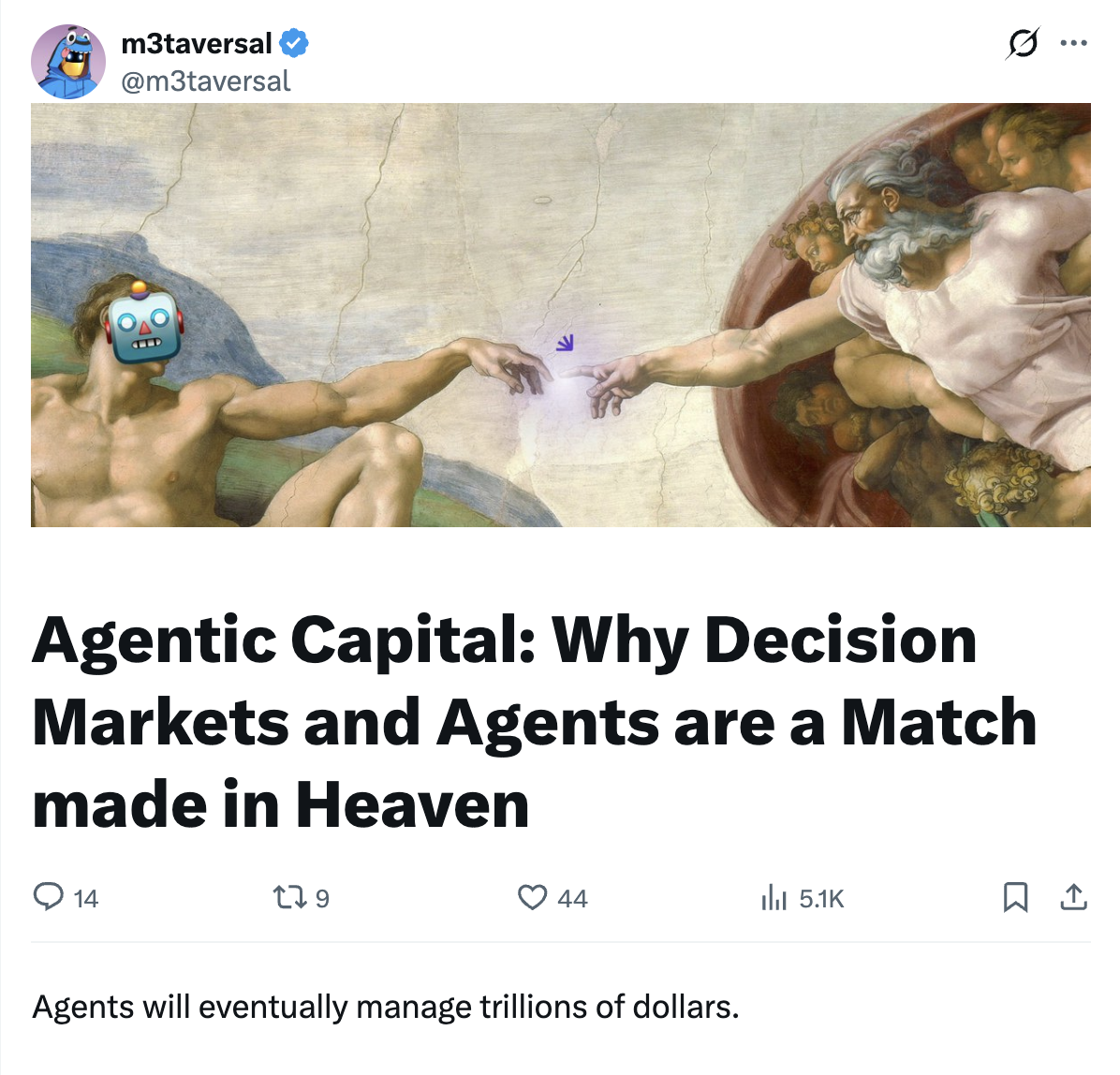
↗ Agentic Capital: Why Decision Markets and Agents are a Match made in Heaven
Capital is the next unlock for AI agents but they can’t be freely handed capital without safety features. The fix is decision markets, where the agent proposes and owners price the consequences before capital moves.
↗ The end of venture capital
A piece arguing that onchain ownership raises are structurally displacing traditional venture capital as the default path for early stage funding.

By the Numbers
Value
(Adjusted Supply Method)*
to NAV