
Analysis, takes, and signals from the ownership coin frontier
-
01
-
02
-
03
-
04
-
05
-
06
-
07
-
08
-
09
The Big Picture
April was a record setting month for decision market activity. The $2.84M in decision market activity was driven almost entirely by one proposal (the largest volume proposal to date), Solomon's Gigabus omnibus, which accounted for $2.67M of the total. In addition to attracting the most capital, it was also a highly contested market, finishing ~5% above threshold after concentrated opposition challenged the proposal early in the TWAP window. The team engaged publicly, adjustments were discussed, and the pass market repriced in real-time. The final outcome was an excellent illustration of how decision markets are supposed to function.
Outside MetaDAO, the ownership coin launchpad ecosystem continued to develop. Crafts announced its first project launch, ReFi Hub. Star.Fun introduced curation markets, putting the fundraising slot allocation decision itself through a decision market. Both have different underlying legal structures but their focus on getting new projects funded.
The design space for what happens after launch is less explored. Follow-on funding, which relates to how a live project raises again, is still an area with opportunity for improvements. This month's Call examines what a more transparent, community-first approach looks like, and why ownership coins are positioned to do it differently.
"Follow-on funding, which relates to how a live project raises again, is still an area with opportunity for improvements."
The Call
Follow-on funding has always been a backroom deal between founders and liquid funds. Ownership coins are the first structure that could enable existing holders to participate on equal terms.
Follow-on Funding
Imagine a project trading 50% below its launch price. The team is still shipping and usage is growing. But the treasury is thinning and they need to raise.
Before ownership coins, the answer was almost always an over-the-counter (“OTC”) deal. Founders would call a few liquid venture funds, negotiate a discount to the 14 or 30 day average price, layer in some combination of lockups, vesting, or side terms, and close the deal. The project got capital and the investor got a price no one else could access. This playbook allowed teams to raise, but not without consequences.
The terms were negotiated in private, the information flow is asymmetric and the buyer could profit from the trade in a way other holders could not. Additionally, not only was the community excluded from the deal but at some point they could see large chunks of tokens hitting order books without any explanation for why.
The good news is the market is starting to adapt. In 2025, MetaDAO ran back-to-back follow-on funding proposals through Futarchy:
- Engage in $6M OTC with DBA and Variant? - Failed
- Sell up to 2M META at market price or premium? - Passed
In the first proposal, the market decided that tokens should not be sold at a discount. In the second proposal, the market decided they can be sold, but at market price or better. The pricing question was resolved, but the overall sale design and who was allowed to participate deserves a closer look.
In this month's Call we suggest opportunities to improve the design of follow-on funding rounds using community-first and ownership coin specific principals.
What Holders Need to See
Before going to a decision market, the project should publish a disclosure package explaining its intention to raise follow-on capital. This is not limited to the following:
- Product - What has been built and what is coming next.
- Financials - Project treasury balance, composition and runway at current burn revenue and expense breakdowns
- Growth Indicators - Usage trends and other key performance metrics.
- Sale structure - Plans for minting new tokens, dilution under different fundraising scenarios, pricing, token distribution, and treatment of unsold tokens.
- Use of Proceeds - How raised funds will be spent.
- Risks - The potential consequences of the raise failing.
In this way, institutions and retail participants receive the same information at the same time. This is the part the “old school” OTC playbook never solved, and the part ownership coins are uniquely positioned to fix.
The decision market is then published and asks “is the project worth more if the planned raise passes than fails?”
Pricing and Distribution
The sale structure can take many shapes and forms. It could be similar to the MetaDAO OTC deal from last year. Or it could be more programmatic. For example, there could be a public dashboard with an average price, defined sale window and first come first service or pro-rata allocation system. Buyers put stablecoins into a contract, the contract then helps with distribution of the token.
A more interesting option could have part of the sale allow-listed or reserved for participants with demonstrated commitment. This could be existing long-term holders, product power users, previous decision market participants, or any other project contributors. The terms of their participation can take several forms from early access, a guaranteed minimum allocation, or a small discount paired with vesting. The idea is that demonstrated commitment to the project is taken into consideration and/or rewarded in a follow-on funding campaign.
Whatever the structure, the execution should be transparent. Newly sold tokens are distributed from a known address or locked in a public vesting contract. The dashboard publishes the amount raised, the number of participating wallets, the vesting schedule (if any) and so forth.
Fluid Sales
Some projects may not be best positioned for a discrete financing event. They would prefer flexibility and optionality to raise on-the-go.
The fluid version of follow-on funding is the onchain analog of an at-the-market facility from public equity markets. Rather than approving a one-time raise, the market approves a window where the project can sell up to a defined number of tokens, or raise up to a defined amount of stablecoins.
A contract enforces the sale and any sale-specific guardrails (price floor, daily/weekly limits, expiration date, etc.). If any guardrails are activated, no tokens are sold. If they are not, buyers can freely transact.
The benefit for projects is timing. The project doesn't have to raise a round all at once, or when the market is moving against them. It can sell gradually as demand appears, at prices the market has already agreed are acceptable. If conditions improve, it raises at better levels. If demand disappears, the selling stops. This removes some of the pain of having to urgently close a round.
When the Token is Down Bad
A challenging situation for founders and holders is when a token is trading well below its starting price. A coin that launched at $1.00 and now trades at $0.30 has to issue more than three times as many tokens to raise the same dollar amount. The project needs funds, but it comes with a large amount of dilution to existing holders.
This is where decision markets will produce interesting information. The market will decide whether the dilution is better than the alternative. If the alternative is running out of money, slowing development, cutting team members, etc., a dilutive raise may still be value-accretive.
In this case a follow-on should probably be smaller, staged, or holder-protective - especially if it's perceived as a distressed raise. Some options worth considering in this situation:
- A bridge. Raise a small amount, just enough to reach the next big milestone.
- Pro-rata rights for existing holders. Long-term holders get the first chance to participate before the round opens to outside capital.
- Milestone-based tranches. The round is committed at full size, but capital is drawn and tokens are issued in stages as the project meets milestones. Missed milestones can trigger refunds.
This is a challenging situation especially for teams who are performing well in a bad market. If there is traction and good execution, we believe transparency actually compounds. Highlighting these successes alongside your capital requirements and risks the fundraising isn’t successful will help the guide the market to the best decision.
Conclusion
Follow-on funding has historically been the part of a project's lifecycle that holders saw and influenced least. The round was negotiated in private, priced against information they didn't have, and announced after the fact. Whether the deal was good or bad for the project, it was almost never their decision.
Ownership coins move follow-on funding into public view through a decision market which is a meaningful improvement. Pricing, structure, and dilution are decided deliberately, by the existing holders.
The design space for follow-on funding is wide open. Fixed-price sales, fluid windows, special terms for long-term holders, and pro-rata rights are all worth testing.
The common thread across these designs is how the round gets executed. Move from individual transfers to programmatic sale contracts. Open the round to a broader base instead of a handful of funds. Prioritize the holders who have already demonstrated conviction and layer outside capital on top. Liquid funds are still high priority they just participate on the same terms, through the same contracts, with the same information as everyone else.
The lead-up to publishing a decision market is a credibility event. The disclosure becomes a showcase of everything the project has built. The debate about it becomes evidence of how seriously the community engages with its own governance. If the team has been executing, this is the best opportunity to earn trust and secure the next round, even if there is a difficult market as the backdrop.
Tracked: MetaDAO Ecosystem
Product updates and headlines from the MetaDAO ecosystem.
MetaDAO
MetaDAO is partnering with Novora as its capital markets and IR advisory firm. Novora will help MetaDAO ecosystem founders get introductions to liquid token investors, think through positioning their raises and their tokens.
Loyal
Loyal had a high-velocity month, shipping across mobile, browser, and core product infrastructure as it continues to push toward a more seamless, privacy-first smart wallet experience.
- Live on Solana Mobile (Seeker), bringing native on device access with up to ~8% APY on USDC and integrated private transfers.
- Launched a Chrome extension, enabling “autopilot” asset management directly from the browser without sacrificing user control.
- Continued pushing its Telegram-native payments experience, allowing users to send funds via @usernames with privacy abstracted away.
- Published its Q1 2026 Transparency Report, detailing ~$162.8k in operating expenses, $581k+ in treasury assets, and ongoing execution of its buyback and liquidity programs.
Avici
This month, Avici shipped a full product redesign, reinsurance yield through its OnRe partnership, tokenized US stocks, Grow, and Smart Credit. Metrics grew, but Ram was first to say it's not enough.
- Launched reinsurance yield, bringing real-world, non-circular returns onchain with up to 10% yield, uncorrelated to broader DeFi conditions.
- Now live in-app alongside Grow, Smart Credit, and tokenized stock trading features.
- In his founder update, Ram was clear that the team didn't ship fast enough. Execution stretched days into weeks and he's taking direct ownership to fix it.
Omnipair
Omnipair continued to expand its core vision of permissionless leverage for any asset on Solana, pushing toward a unified liquidity layer where swapping, lending, and margin all exist in the same pool.
- Protocol data now live on DeFiLlama and Dune, improving transparency and trackability.
- Crossed $500k+ in deposits, signaling early liquidity formation and market adoption.
- Teased a native leverage interface, enabling long and short positions directly within any Omnipair pool.
Tracked: MetaDAO Ecosystem
Analysis on this month's resolved proposals. Full analytics can be found on 01Resolved.com.
Total trade volume was ~$114K across 241 trades with 26 unique wallets. Economically, ~89% of trade volume and ~82% of traders leaned Pass. The proposal passed the TWAP threshold by +43.97%.
The proposal introduced a milestone-based team compensation package where up to 8.24M AVICI can be earned via price target unlocks, with no tokens minted if milestones are never hit. All earned tokens remain locked until January 2029. It also migrated Avici to MetaDAO’s latest program, enabling team-sponsored proposals with a -3% pass threshold and future optimistic governance upgrades.
Total trade volume was ~$51K across 417 trades with 15 unique wallets. Economically, ~61% of trade volume and ~83% of traders leaned Pass. The market passed the TWAP threshold by +7.14%.
The proposal authorized up to $500K USDC of operational funds to repurchase P2P below the $0.60 ICO price, aiming to absorb post-ICO sell pressure while building reserves for future initiatives such as liquidity, staking, or cashback programs. As outlined in our recent report, buybacks can be prudent when treasury spend remains sustainable. At the time, P2P was estimated to retain 24–30 months of runway post-buyback.
Total trade volume was $886.72 across 23 trades with 14 unique wallets. Economically, ~100% of trade volume and ~94% of traders leaned Pass. The market passed the TWAP threshold by +55.15%.
The proposal burned SuperClaw’s entire 2M team performance allocation and approved its Q2 roadmap, shifting incentives away from upfront team rewards toward future performance-based compensation once traction is achieved. The market signaled strong support for aligning incentives with results.
Total trade volume was $2.67M across 2.27K trades with 60 unique wallets. Economically, ~50% of trade volume and ~77% of traders leaned Pass. The market passed the TWAP threshold by +4.55% after a highly contested trading window.
This omnibus proposal activated Solomon’s treasury structure, formalized its DAO LLC setup, and authorized an initial $4.5M USDC transfer into a designated vault.
The market initially traded below threshold as concentrated opposition challenged the proposal. After team engagement and expected follow-up refinements, broader Pass support entered and pulled the proposal to approval, becoming a clear example of decision markets working as intended. Concerns were expressed through capital, the team engaged directly, adjustments were discussed, and the market repriced.
Watchlist: Other Launchpads & Frameworks
Overview
Crafts brings a startup-finance lens to the ownership coin ecosystem. Instead of making the token represent full DAO ownership of a project’s treasury and IP, Crafts tokenizes a claim on the company (typically a SAFE instrument), which is held in an SPV. The token governs that SPV.
Launch Mechanics
Crafts uses sealed-bid auctions for launches (powered by Arcium). Bids are submitted privately, throughout the raise. The intent is to reduce front-running and improve price discovery before tokens reach public markets. Once the raise closes, founders can earn up to 0.6% of secondary trading volume on their token.
Stakeholder Token Standard (STS) and Contracts
Crafts has introduced the Stakeholder Token Standard (STS). Under STS, an SPV holds the company-linked claim (such as a SAFE), and the token governs that vehicle. For each launch, Crafts deploys and configures the full contract stack which includes a vault contract holding 100% of token supply across defined buckets and recipients; a fundraise contract encoding raise rules, allocation logic, and settlement terms; a monthly allowance contract streaming funds from the treasury to the operating company; and the associated roles, permissions, and safety controls. Governance integrations, final bucket plans, optional milestone-based unlock triggers, and emergency procedures are also configured at launch. Each deployment is deal-specific.
Crafts announced its first launch in April - ReFi Hub, an energy infrastructure finance platform focused on tokenizing operating energy assets. ReFi's materials report eighteen-plus months of consecutive distributions, a 12.5% average realized IRR, a 48% reinvestment rate, five live assets, and a $35M-plus deal pipeline.
ReFi uses Financial Infrastructure Tokens (FITs) which are tokenized claims tied to the cashflows of specific energy projects. ReFi is issuing 14% of equity (via SAFE) at a $4M to $8M valuation cap through the sealed-bid auction format.
Anyone interested in reviewing the ReFi launch information can create a Crafts account and access a deal room which has full project disclosures.
Overview
Adam, Star founder, announced curation markets, a new decision market system (powered by Combinator Trade) that lets the market decide which startup raises next on Star.Fun. The top 3 pipeline projects are batched into a single market. Curators trade conditional positions to rank teams relative to each other (and to a “None” outcome). The highest-ranked project wins the fundraising slot. Curators who are right earn 2.5% of the raise and 100% of decision market trading fees (requires staking $STAR). First decision markets launching soon.
Mechanism
Curation markets aggregate market signal before capital is committed. Instead of teams being selected internally, traders price relative quality in a live market. This introduces pre-fundraise price discovery and aligns incentives around selecting stronger projects.
As a reminder the Spark platform allows users to:
- Post an idea
- Community members can fund the idea
- Builders apply to execute the idea and receive the funds (hackathon style)
- Community decides via decision market which builder (if any) wins
In April there were two ideas previously funded that went to the decision market. The first was for MKTA (Marketing Copilot). The decision market resolved to “No” builder selected. As such, all community members who supported the idea were refunded. Spark emphasized that builders still walked away with shipped products and portfolio pieces, despite the outcome.
However, the second idea, Predict, an open, permissionless prediction market layer built on top of Omnipair's pool infrastructure on Solana saw three winners through a "Unified Team" option.
Other Spotlight
Fraudsworth is planning to deliver a unique implementation of futarchy - aptly named MILF (standing for Market Intelligence Liquidity Fund). The MILF will use futarchy for liquidity pool allocation decisions - for example, what percentage of protocol liquidity should be allocated in SOL and USDC?
The idea is that the fund can capture upside or protect from the downside by being more right with their allocation decisions over time.
Fraudsworth: How It Works
Mechanism Primer
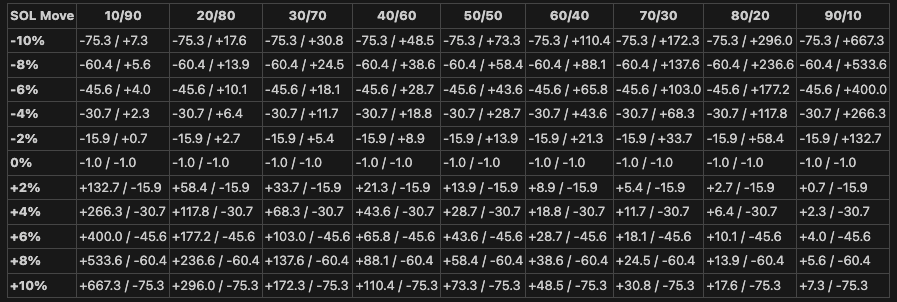
Each week, participants take a position on where SOL is headed, up or down relative to the prior week. Bets flow into a shared pool, and when the market closes, whatever split emerged between bulls and bears directly determines how the protocol allocates its assets. For example, 70% bullish means 70% into SOL pools, the rest into USDC.
We find the following aspects most interesting:
Continuous decisions: Because the same call repeats weekly, analysts sharpen over time. Sharps and wallets with a consistent edge will naturally surface, creating the conditions for copy trading dynamics to emerge around regular winners.
Wrong bets are costly, right bets are rewarded: Payouts scale to how right you were, not just whether you were right. Small SOL moves mean small redistribution; a 10%+ swing triggers the maximum multiplier, capping contrarian gains at roughly 650%. If price barely moves, almost nobody loses their full stake.
Signal vs. Noise
In our monthly report from March we argued decision markets are a good way to scale curation. By allowing the market to decide which projects should run a fundraising campaign on a launchpad, launchpad teams can reduce due diligence misses that lead to brand damage and gain better insight into what the market actually wants to support. The first instance of this mechanism is being tested by Star.Fun right now (powered by Combinator).
We believe that from an investor perspective there should be one asset that captures value and it should be the only one available. Token plus equity structures create market confusion and can suffer from misalignment. Yes, there may be some edge cases where it works, but overall it is an inferior option to a single asset that accrues value.
Around the Space
Notable Discussions
↗ Pumpcade Launches an ACE Round Bridging Tokens and Equity
PumpCade's Autonomous Conversion Event (ACE) lets token holders convert tokens into equity via a SAFE, retrofitting the dual asset structure (tokens and equity) that VCs typically receive from day one. Supporters framed it as a real innovation claiming “anyone can now hold equity for exit upside while keeping token liquidity if they don't convert” and “token supply reduction would be seen as a price positive”.
While ACE is an incremental improvement over separate token and equity structures, there should still only be one instrument that captures a project's value. When you have multiple assets you're fragmenting value accrual. There may be edge cases where a structure like this has worked in the past, but those will be less prevalent going forward.
↗ 01Resolved Teases Treasury Intelligence
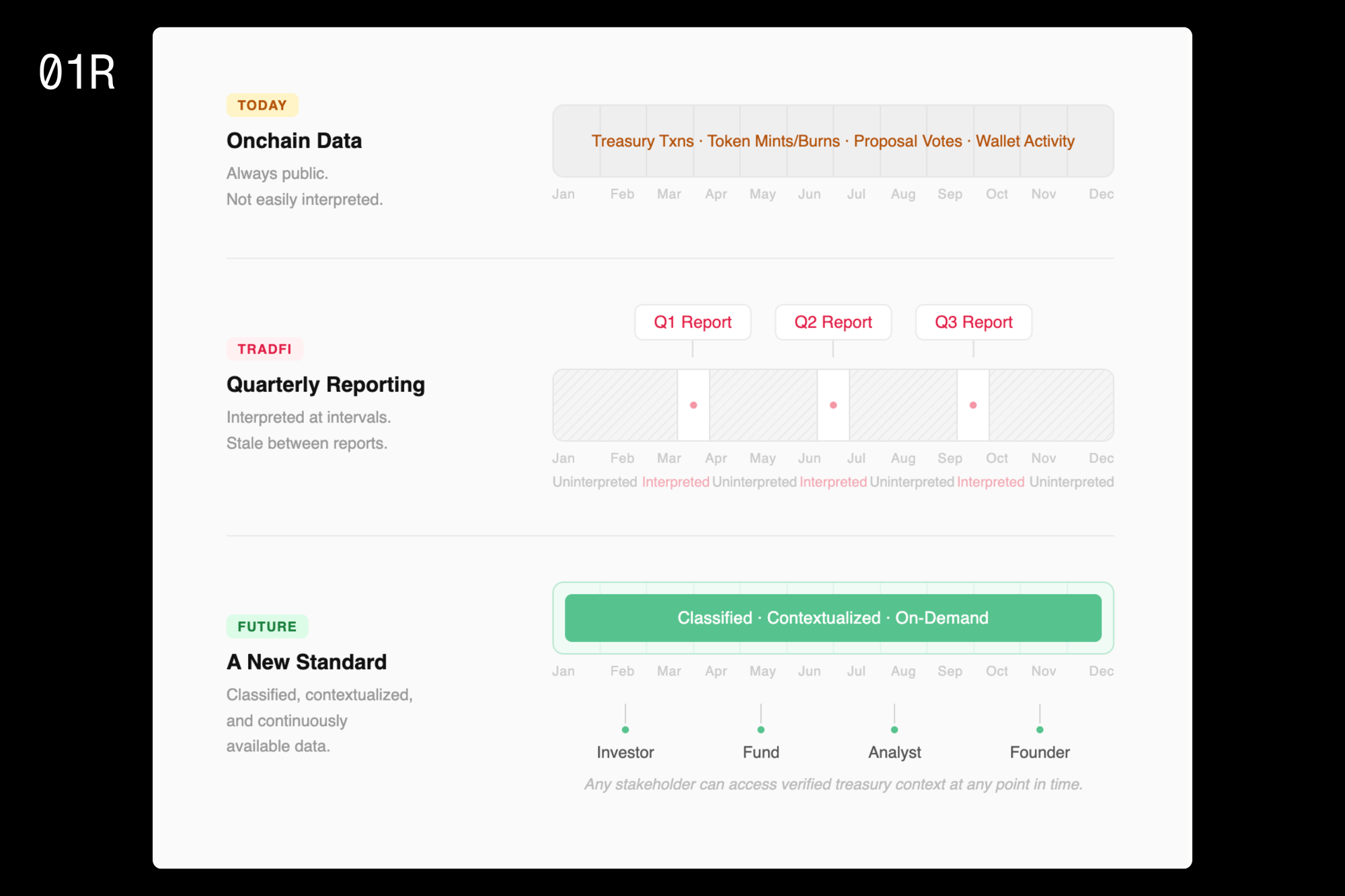
Early this month, we published “Building in the Open”, an article where we outlined why ownership coins require a new standard of transparency and why the infrastructure to support it doesn’t yet exist. More recently, we teased Treasury Intelligence, a product we're preparing to ship that will turn onchain data into a structured, operational financial record for ownership coins.
Reading & Listening Worth Your Time
Papers, podcasts, and posts, worth reading this month.
↗ Ownership Podcast with Proph3t | MetaDAO
A primer for anyone interested in ownership coins or what MetaDAO is building. 8Bit and Proph3t cover a range of topics such as the future of decision markets, how MetaDAO started, attracting founders, why Solana and insider trading.
Ownership Podcast S1 E7: Proph3t (MetaDAO)
— Ownership (@ownershipfm) April 22, 2026
"@metaproph3t Takes the Mask Off"
00:00 - Intro
02:15 - The Futarchy pill
10:05 - On Market Governance Civilization
20:40 - How MetaDAO Started
27:40 - Liquidating Companies: Feature or Bug?
32:15 - How MetaDAO Gets the Best Founders… pic.twitter.com/55D8SMzi43
↗ The Index Podcast with Kru | Umbra (link)
Kru shares more about Umbra as the first live application on Arcium’s Mainnet Alpha, and why its mission and potential impact on the human value system is what truly drives him.
What if every trade you make on Solana is public? That's what led Kru Shah to build @UmbraPrivacy — the first live app on Arcium's Mainnet Alpha.
— The Index Podcast (@theindexshow) April 15, 2026
New ep. with @afkehaya on The Index Podcast 🔒 pic.twitter.com/E9g8AwopRE
By the Numbers
Value
(Adjusted Supply)
to NAV
For all, unclear which wallets are DAO-owned or not.
MetaDAO, unclear the exact team token allocation and terms since token migration. Assume 3.95m.